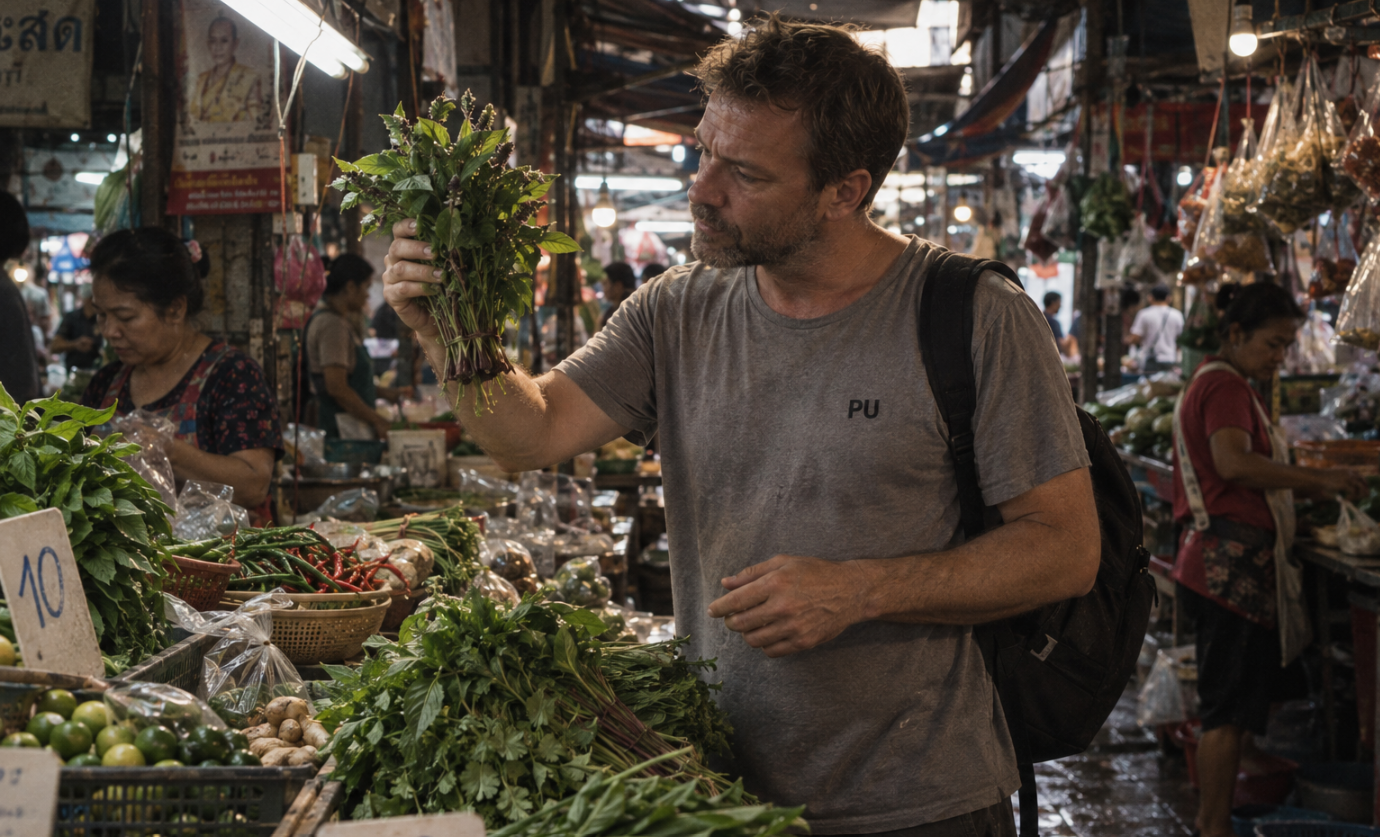
It happens quietly. There is no grand ceremony or official turning point. You just wake up one morning and realize the television is playing a Thai broadcast, and you are actually following the plot. You open your fridge, and the imported steaks and frozen french fries are gone. Instead, there is an organized inventory of fish sauce, fresh holy basil, and precisely sorted chilies.
You go to the local wet market, and the vegetable stalls are no longer just a chaotic, intimidating pile of random green weeds. You know the exact name of every leaf. You know which ones go into a slow-cooked broth, which ones need to be stir-fried, and which ones are eaten raw. You don’t need a guide to navigate the food stalls anymore. You walk into a shop, automatically kick off your sandals, and actually have to nudge your Thai partner to remind her to take her shoes off.
You have completely, silently dissolved into the ecosystem.
This phenomenon is fascinating because of the speed and absolute totality with which it consumes a specific type of foreigner. In sociology, this might be called acculturation or deep structural assimilation. But on the ground, it is simply the path of least resistance.
Thailand is unique because it offers a very stark choice to outsiders, and it absolutely does not care which one you pick.
The Two Operating Systems
On one side, you have the “20-Year Tourist.” This is the guy who has lived here for two decades but still operates entirely within an imported simulation. He eats a heavy English breakfast of baked beans and sausages every single morning. He complains about the heat. He hasn’t learned a single word of Thai beyond ordering a beer and aggressively disputing a bill. The country completely allows this. Thailand will happily build you Irish pubs, air-conditioned Western supermarkets, and English-speaking enclaves. It will gladly take your money while keeping you permanently walled off from the actual mechanics of the society.
On the other side, you have the guys who experience the complete dissolution. Why does it work for them? Because they stop treating the country as a long-term holiday resort and start treating it as a functional reality.
They realize that fighting the local operating system is physically and psychologically exhausting. Trying to force Western logic onto Thai infrastructure is a recipe for a heart attack. So, they surrender. It is a “soft surrender.” They learn the language because it removes daily friction. They trade the heavy bacon for a steaming bowl of khao tom (rice soup) in the morning because the local climate demands it. They adapt to the local rhythm because it is the only way the machine actually works.
The moment you stop fighting the current, the culture swallows you whole. The ultimate marker of this transition isn’t just speaking the language or marrying a local. It is that quiet moment in the supermarket when you are the one reminding your wife that you need to buy more jasmine rice.
Leave a Reply