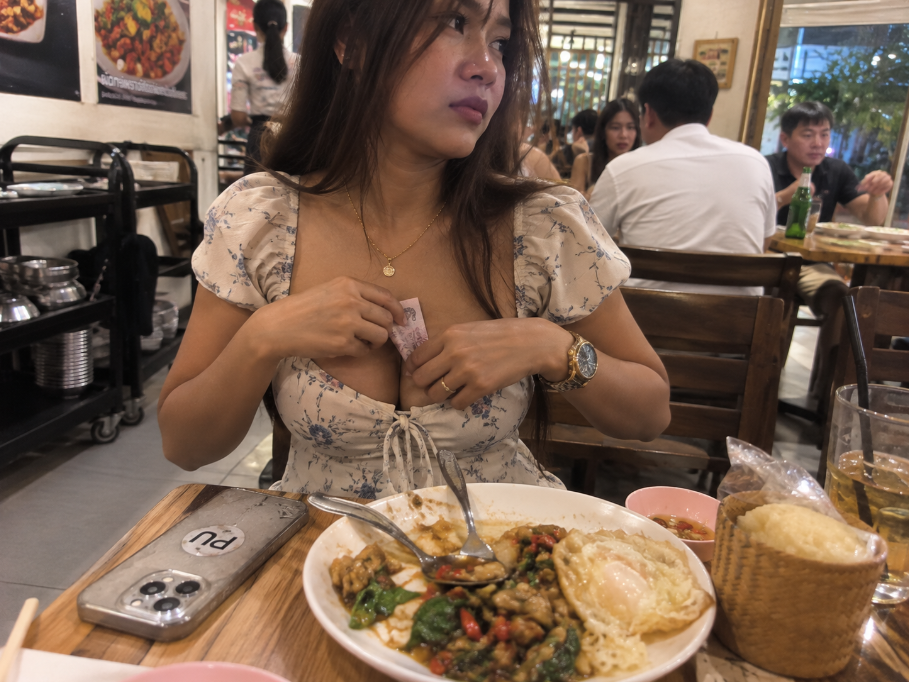
You hand her a crumpled 50-baht note as a tip for fetching your beer. Instead of simply pocketing the cash and saying thank you, she executes a deeply bizarre sequence of movements. She grips the bill, slaps it casually but deliberately against her crotch, and then presses the money to her forehead between her palms in a respectful, prayer-like wai. You sit there with your drink halfway to your mouth, completely confused, wondering if you just witnessed a religious tribute to her genitalia. Is she paying literal homage to the primary breadwinner?
The short answer is yes. But to understand the mechanics of this ritual, you have to look outside the red-light district and into standard Thai market culture.
When a street food vendor or a clothes merchant in Thailand makes their first sale of the day, they don’t just put the cash in the register. They take the banknotes and lightly tap their merchandise with the money. It is an old animist tradition to bless the goods, appease the spirits of commerce, and magnetically attract more paying customers to the stall. The girls working the grid in Pattaya simply adapted this ancient market logic with brutal, unvarnished honesty. She isn’t selling mangoes or cheap tourist t-shirts. Her inventory is herself. By tapping the money against her crotch and thanking the spirits, she is literally blessing her primary asset, actively inviting the universe to send more financial transactions to the source of her income.
But this isn’t the only behavioral artifact she picks up. The grid installs deep muscle memory that is almost impossible to erase, creating a physical signature that instantly gives away her professional history to anyone who knows how to read it.
You can see it in the aggressive way she pours a beer. She doesn’t just fill your glass and sit back; she hawkishly guards the bottle, topping up your drink using two hands the absolute second the liquid drops half an inch. Foreigners think this is just traditional Thai hospitality, but it is actually a relentless habit drilled into her by mamasans to maximize liquid consumption and inflate the final bill. You can see it in the way she folds cash into tiny, tight squares to slip into her cleavage, because go-go boots and sequined bikinis don’t have pockets. You can see it in the three-second ocular pat-down she performs on every man who walks into a room—her eyes scanning his shoes, his watch, and his phone before she even bothers to look at his face, calculating his net worth with the speed of an algorithmic trading bot.
The friction happens when she eventually leaves the neon bubble and tries to integrate into normal civilian society. A retired expat will proudly take his new girlfriend out of Pattaya to a respectable family restaurant in Bangkok, introducing her to his middle-class Thai acquaintances. The waiter brings the change, and without thinking, her hands execute the ritual. She grabs a 100-baht note, taps it against her thigh, folds it into a tight square, and tucks it into her bra. Or she aggressively leans over the table to top up the beer of a dignified Thai businessman every time he takes a sip.
The Westerner sitting next to her thinks she is just being a sweet, attentive partner. He doesn’t notice the sudden, heavy silence at the table.
The Thai civilians don’t say a word. They remain perfectly polite, they keep smiling, and they don’t point fingers. But the social verdict is delivered instantly. They read the code. The bar leaves invisible behavioral tattoos on a woman, and the civilian world is incredibly unforgiving at spotting them. They know exactly where she comes from, they know exactly what she used to sell, and in their minds, no amount of expensive clothes or farang sponsorship will ever wash the grid off her hands.
Leave a Reply