There are two entirely different cities occupying the exact same geographical coordinates.
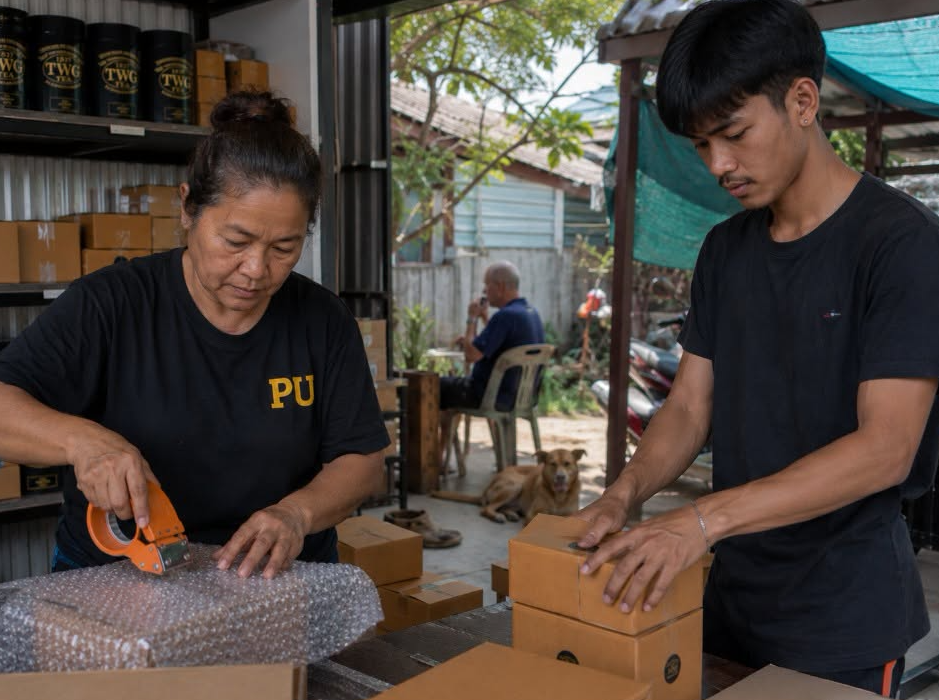
In the first city lives Harry. He is in his early forties, currently in his ninth year here. Harry doesn’t own a yacht at the Ocean Marina; Harry owns a microscopic store on Shopee selling decent Western tea. The business doesn’t generate millions, but it makes just enough—down to the exact baht—to cover the rent on a small house, buy kibble for a stray dog, and pay the salaries of two local employees.
The first employee is Poi. She is forty-five, and she wraps boxes in bubble wrap. Harry knows her full biography: fifteen years ago, Poi danced on a bar top on Soi 6. Today, she is married to a hard-of-hearing, seventy-year-old Brit with a failing liver who used to buy Harry’s Earl Grey. Harry has been to their house. He sat on the porch, drank ice water, and spent forty minutes out of sheer British politeness listening to the old man recount military operations he was physically too young to have fought in. To Harry, Poi isn’t “retired Pattaya infantry.” She is just a tired woman with bad knees who brings him a bunch of homegrown bananas on Monday mornings.
The second employee is Wut. He is twenty-two, possesses a wispy, peach-fuzz mustache, and rides a rusting Honda Wave. Wut drops parcels off at the post office. His official girlfriend works in a bar. But Harry knows the secret Wut keeps from her: in the neighboring province, Wut has a second girl, and two weeks ago, she gave birth to his son. Wut doesn’t sleep. After his shift with Harry, he cuts lawns for 200 baht, then logs onto the delivery apps for the night shift. In standard Pattaya lore, Wut is supposed to be a “scheming local pimp.” In Harry’s viewfinder, he is just an exhausted kid trying to hold up the sky for two women at once.
Harry’s LINE app contains over a thousand contacts of local women. He has never met eighty percent of them. Occasionally, on a Friday night, he’ll grab a pint at a quiet Darkside pub or sit in a gentleman’s club. He is a man, after all. But the concept of a “tourist trap” does not exist for him. The city is rendered entirely transparent: Harry knows why he walked in, what it costs, how to get it, and the precise second to say thank you and walk home. He doesn’t watch TikTok reviews of Pattaya. He scrolls past them with a mild, quiet distaste.
He cannot, however, scroll past Philip.
Philip is his old school mate from Manchester. Philip flies into Pattaya once a year for a two-week bender, fifteen years running. Philip genuinely, with a tremor of pride in his voice, considers himself a “Thailand Veteran.”
The second Philip steps across Harry’s threshold, the geometry of the room warps.
“Mate, be honest with me—you’ve smashed Poi, haven’t you?” comes the standard opening nudge to the ribs.
“Why are you keeping that junkie on the deliveries? Look at his pupils, Harry, he’s gonna clear your stockroom!”
“Let’s get down to Walking Street! What are you doing sitting out here in the sticks?”
“Look at that old bloke selling the corn. See the way he’s squinting? Calculating how to fleece a white guy, I’m telling you…”
By the evening of day two, Harry opens a mental calendar in his head and begins silently counting down the days to Philip’s return flight out of Suvarnabhumi.
The Anatomy of the Abyss
Why does this existential chasm open up between two intelligent men born on the exact same street in Greater Manchester? Why does Philip, who has spent a cumulative total of nearly a full year of his life in Pattaya, understand precisely zero percent of it?
It comes down to three immutable laws of the human psyche.
1. Dopamine Compression
Philip has 336 hours of freedom a year. His holiday is a pressurized decompression chamber. A tourist’s nervous system is legally obligated to extract the absolute maximum volume of passion, alcohol, validation, and dopamine out of every single minute, otherwise the trip was “a waste of money.” A tourist lives on afterburners.
Harry has 8,760 hours ahead of him this year. He doesn’t need to “get it all in by the 15th.” On Thursday, the air conditioning technician is coming; on Saturday, the dog needs its rabies booster; and his lower back has been acting up since Tuesday. When you spread Pattaya thin over the timeline of a life, the neon stops blinding you—it just becomes municipal street lighting.
2. The NPC Syndrome
For Philip, Thailand turns off the exact second the landing gear of his Boeing 777 leaves the Thai tarmac. The local population consists of Non-Playable Characters in a live-action Grand Theft Auto. While Philip is walking around the map, they are pre-programmed to smile, pour Leo beer, and offer a foot massage. When Philip hits “Quit Game” and flies back to the UK, Poi, Wut, and the corn vendor simply cease to exist, suspended in a digital void.
NPCs don’t get gout. NPCs don’t have a sister who died in Sisaket. NPCs don’t owe 40,000 baht on a Kubota tractor.
Harry watches these people continue to exist at 9:00 AM on a rainy Monday while Philip sits in bumper-to-bumper traffic near Birmingham. Harry sees their quiet shame, their micro-acts of nobility, and their baffling, distinctly non-Western capacity to sit down over a bowl of plain rice and laugh in the face of absolute financial ruin.
3. Weaponized Cynicism as Cowardice
Why is Philip so terrified of the corn vendor?
Tourist paranoia is a psychological hazmat suit worn by someone who doesn’t understand the rules of the room. When you are blind to the micro-codes of Thai social hierarchy, the language of the unspoken, and the concept of kreng-jai (mutual consideration), the safest way to avoid looking like a fool is to preemptively declare the entire country a syndicate of con artists. If you treat every single person you meet as an opportunist or a thief, you can never be betrayed. You are fully insured.
Harry took the hazmat suit off years ago. He knows people get scammed in Pattaya, but he understands the exact physics of it: nobody reaches into your pocket to steal your wallet here; they only take the money you threw onto the table yourself in a rush of Western hubris, demanding to be treated like a king.
On day fourteen, Philip hugs Harry by the open trunk of a Bolt taxi. Philip smells of Tom Ford cologne, stale Singha, and European anxiety.
“Take care of yourself, Harry,” Philip says solemnly, gripping his shoulder. “I can see it, mate. You’ve gone soft. They’re gonna eat you alive out here with all this gentle stuff. You’re just an ATM to them, never forget that.”
Harry nods, gives him a warm pat on the back, and waits for the Toyota to turn onto Sukhumvit Road.
Then he walks back inside, pours himself a cup of hot English breakfast, steps out into the backyard, and watches Wut—exhausted, shoulders slumped, finally finished with the day’s deliveries—sit in the shade of a mango tree. Wut isn’t doing anything remarkable; he is just staring at his phone, watching a grainy video of a newborn baby, his face softening into a look of quiet, desperate love that a tourist would never see, and that Philip would never understand.
Leave a Reply