His British pension is barely enough to cover the rent and the groceries. He is completely priced out of the grid. He cannot afford to sit on barstools, and he certainly cannot afford to buy drinks for women. But ironically, he is one of the only expats in the city who is genuinely at peace.
He lives alone in a cheap, anonymous concrete apartment block deep down Soi Ko Phai. The building is filled almost entirely with girls working in the nightlife industry, because the rent is dirt cheap and it’s a quick motorbike ride to Walking Street.
Every morning, you can see him walking slowly down the dusty shoulder of the road with his wooden cane. He doesn’t go to the 7-Eleven on the corner. He walks all the way to the Lotus, simply because the doctor in England told him he needs to keep his heart moving. And as he walks, he is happy. He has outlived the frantic, desperate need for luxury, for status, for women. He is just profoundly grateful that the air is warm, that the sea is near, and that his knees still allow him to walk.
Because of the demographic of the building, the entire concrete block is a tomb until three in the afternoon. The girls are sleeping off the alcohol and the neon. The old man respects this ecosystem. He walks down the open-air corridors on his tiptoes, leaning his weight heavily onto his cane, moving like the warden of a museum of sleep, terrified of waking the night shift.
He spends his days sitting in the wooden gazebo in the courtyard. It is designated for smoking, but he quit twenty years ago. He just sits there, watching the world move.
A taxi pulls up. The new girl from Room 202 steps out, struggling to drag a massive canvas bag out of the trunk. A reflex from a different era of gentlemen kicks in, and he tries to jump up to help her. But his worn-out knees lock up, instantly forcing him back down into the plastic chair. The girl notices. She gives him an awkward, exhausted wai, whispers “Sawadee ka,” and drags her bag toward the stairs.
He is just part of the landscape now. Sometimes, a girl coming back from the morning market will hand him a cold coconut, a plastic cup of sweet Thai tea, or a skewer of grilled sausages. He just smiles, nods, and stays in his gazebo.
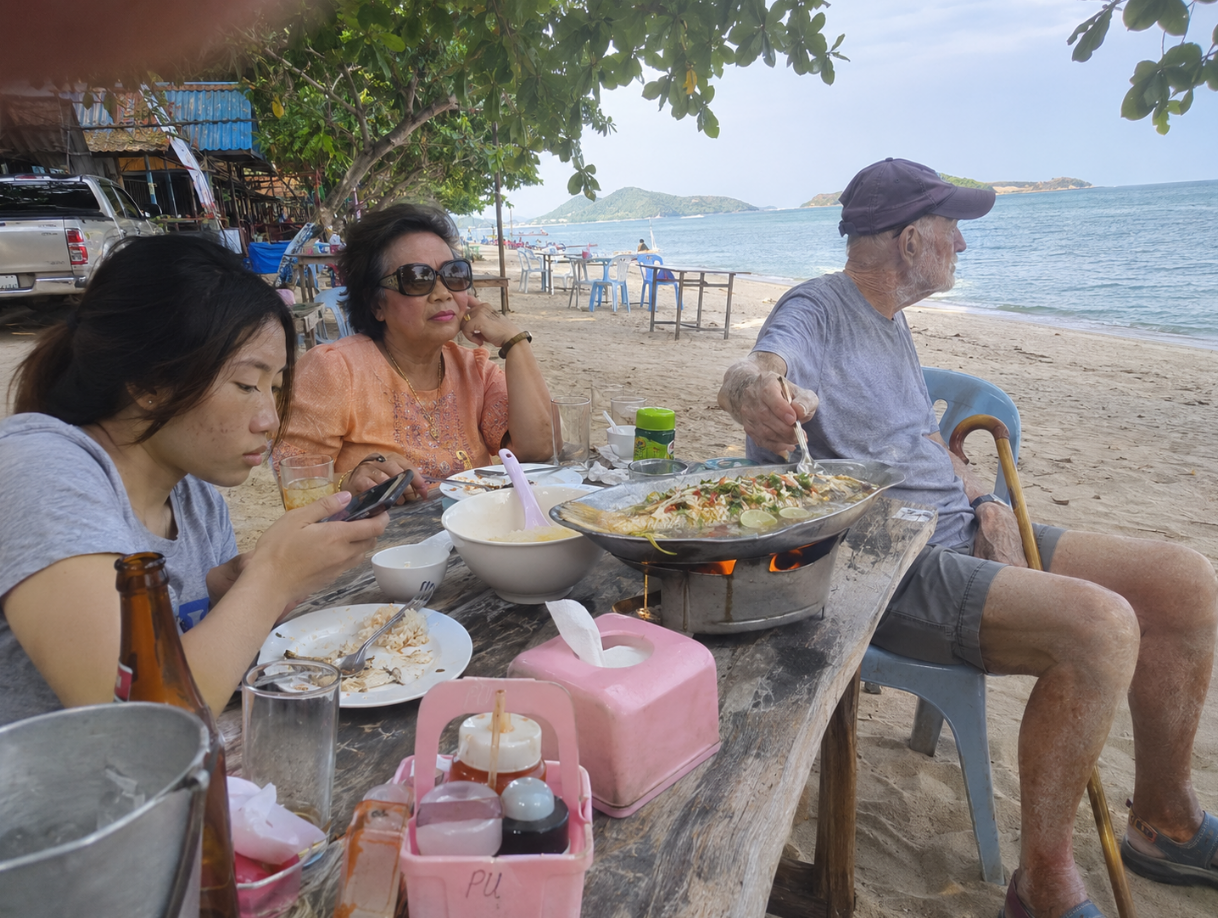
One afternoon, a Thai woman close to his own age walks out of the building wearing massive, dark sunglasses. Right behind her is Nida, the girl who lives in the room directly across from his. Nida is barely twenty. She walks up to the gazebo and tells the old man that her mother just arrived on a bus from Phitsanulok to visit. They are driving to the military beach in Sattahip for the afternoon.
“If you don’t have plans,” Nida says, “come with us.”
He immediately starts to mumble a polite excuse about having things to do. But he stops. He looks at Nida, and she looks at him. They both know perfectly well that he is going to sit in this exact gazebo until the sun goes down.
Ten minutes later, he is sitting in the back of a car.
An hour later, he is sitting at a battered wooden table on the sand in Sattahip. He honestly cannot remember the last time he traveled this far from his tiny room. Nida is silently scrolling through her phone. Her mother is adjusting her massive sunglasses. In the center of the table sits a metal tray over an open flame, holding a massive fish swimming in a violently spicy, lime-green broth.
The old man reaches out with a spoon and takes a piece of the white fish. He scoops up some of the burning broth. He looks out at the calm, blue water of the Gulf.
He is sitting at a table with a girl young enough to be his granddaughter, and a complete stranger hiding behind dark glasses. The wind is warm. The food is perfect. And as he looks out at the horizon, stripped of all the noise and transaction of the city, he realizes he is unbelievably happy just to be there.
Leave a Reply