If you scroll deep enough past the food videos and TikTok dances on the Thai side of Facebook, you will eventually hit the underground economy of digital witchcraft.
The advertisement is always a poorly lit photograph of a small glass vial. Inside the vial is a yellowish oil, floating with flakes of 24-karat gold leaf, a tiny rolled copper scroll called a takrut, and the extract of Wan Dok Thong—a rare herb believed by local shamans to induce uncontrollable lust and obedience.
Below the vial is the “proof of work.” A collage of screenshots.
There is a WhatsApp message from a foreign number: “I miss you so much teerak. I am going to the bank now.” Next to it, a green Kasikorn Bank notification showing a transfer of 40,000 baht. Next to that, a photo of a Thai girl holding a thick fan of one-thousand-baht notes, smiling blankly at the camera.
The comments section is a unified chorus of provincial desperation. Hundreds of women typing the exact same things: “Son jai kha” (Interested). “Bucha thao rai kha?” (How much to worship this?).
This is the business of Nam Man Maha Sanae—the charm oil. And it is the most perfectly cynical distillation of the Pattaya dynamic ever bottled.
Let’s look at a Tuesday night in a cramped, 3,000-baht-a-month rental room on Soi Khao Noi.
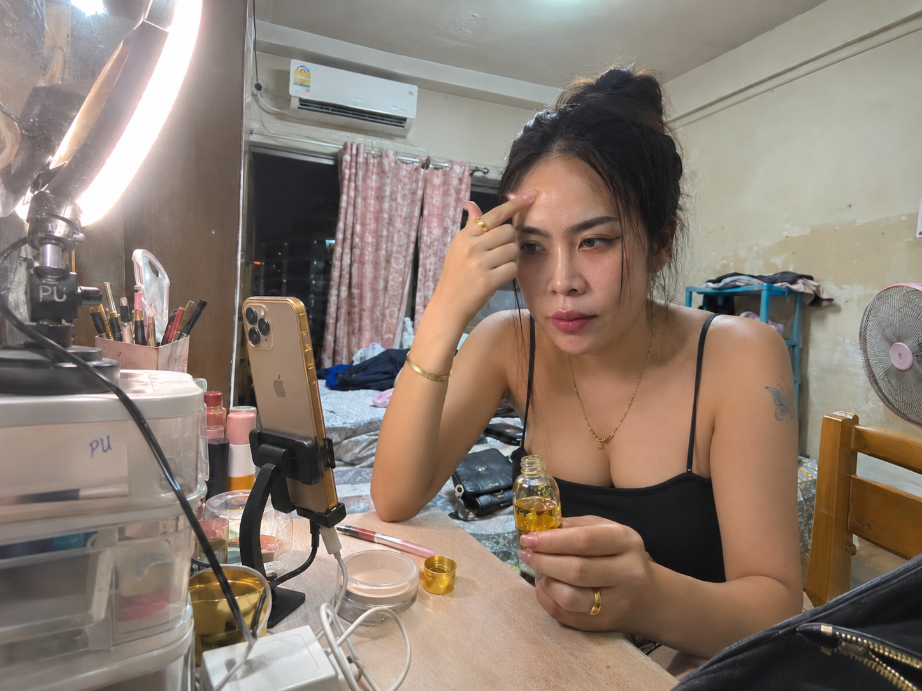
Nan is sitting in front of a cheap LED ring light, preparing for an 8:00 PM video call with David, a fifty-four-year-old divorced contractor from Ohio. Nan doesn’t trust her own English. She doesn’t trust her own beauty, which she thinks is fading at twenty-eight. She knows David has options. She knows there are ten thousand other girls in this city with better English and tighter skin.
So, she doesn’t rely on herself. She relies on the vial she bought on Facebook for 499 baht, blessed by a rogue monk in Surin.
Before she hits the green ‘Accept Call’ button, she unscrews the cap. The smell of cheap sandalwood fills the room. She dips her pinky finger into the oil. She dabs a drop on her forehead, a drop on both earlobes, and—this is the modern upgrade to the ancient ritual—she smears a tiny smudge directly onto the camera lens of her smartphone.
She whispers a fast, three-line Pali mantra. Then, she answers the call.
Ten thousand miles away in Ohio, David looks at his computer screen. The slight smudge of the oil on the lens gives Nan a soft, glowing, cinematic blur. She smiles. She speaks a few broken words. She looks vulnerable, sweet, and entirely dependent on him.
David feels a profound, heavy warmth in his chest. He feels needed. He listens to her talk about how her air conditioning is broken and how her mother is sick. He doesn’t hear a scam. He hears a damsel in distress. The next morning, David drives to the Western Union branch at his local strip mall and sends $1,200.
When the money arrives on Nan’s phone, the absolute symmetry of the illusion is complete.
David sits in Ohio, completely convinced that he is loved. He believes his money bought genuine affection. He believes that the look in her eyes through the webcam was the look of a woman who finally found a good man.
Nan sits in her room in Pattaya, looking at the bank balance, completely convinced that David feels nothing of the sort.
In her mind, she didn’t earn this money. Her smile didn’t win him over. The oil did the heavy lifting. The magic forced his hand. The shaman in Surin hacked the Ohio contractor’s brain.
It is a masterpiece of mutual delusion. He outsources his loneliness to a glowing screen, and she outsources her agency to a 499-baht bottle of sandalwood oil. Neither of them believes in each other. They just believe the magic worked.
Leave a Reply