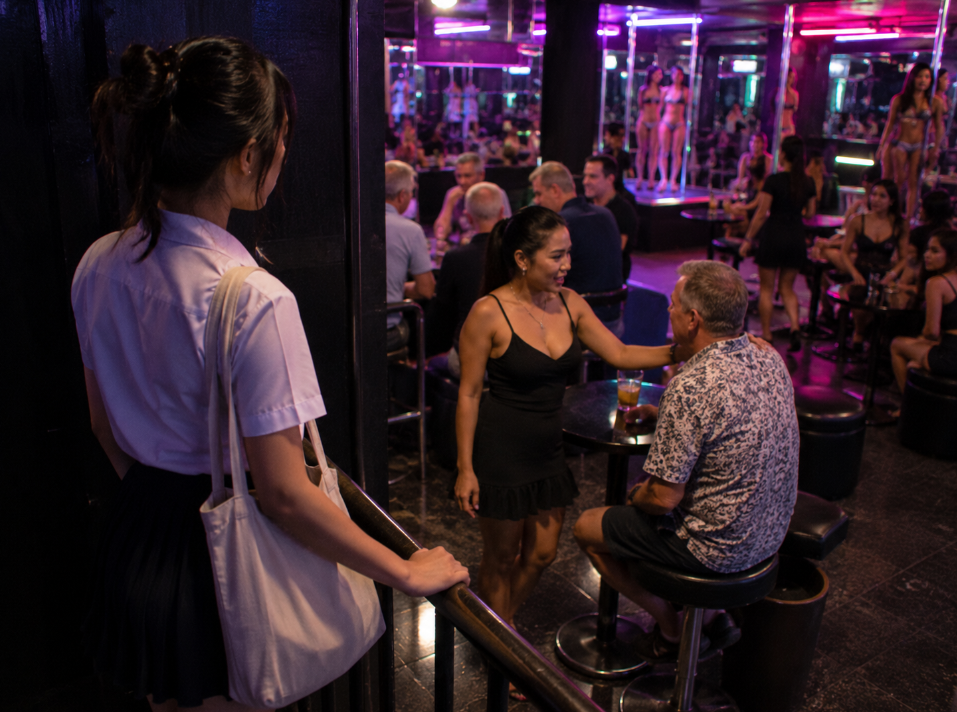
For nineteen years, the bar was just a playground.
When Noi was seven, the flashing pink neon signs of Pattaya were her nightlight. The thumping bass from the speakers was her lullaby. The girls in the sequined bikinis were her older sisters, always slipping her Baht coins for ice cream and braiding her hair before the first customers arrived. And her mother? Her mother was just the boss. The one who yelled at the ice delivery guy and kept the ledger.
It was normal. It was just home.
But this weekend was different. Noi was nineteen now, a second-year sociology student at a prestigious university in Bangkok. She had spent the last two years sitting in air-conditioned lecture halls, reading textbooks about gender dynamics, economic inequality, and social mobility. She wore the crisp white blouse and pleated dark skirt of the academic elite.
She took the bus down from Ekkamai to surprise her mother. Arriving at 9:00 PM, Noi didn’t walk through the neon-lit main entrance. Instead, she slipped through the dark back alley to the metal staircase that led to their small apartment directly above the bar.
Halfway up the stairs, she stopped on the shadowed landing. Through the open staff door, she had a perfect, unseen vantage point of the floor below.
She only meant to pause for a second, but for the first time in her life, Noi looked at her mother not with the naive eyes of a child, but with the sharp, educated eyes of an adult.
Her mother, Lek, was forty-five, but under the harsh lights, she wore the armor of a woman who had fought a thousand wars. She was the Mamasan.
Noi watched a group of loud, red-faced European tourists walk in. As a kid, Noi thought her mother was just being friendly when she greeted customers. Now, Noi saw the instantaneous, micro-second transformation. Lek’s spine straightened, her smile stretched into a perfect, practiced curve of hospitality, but her eyes remained cold and calculating, like a scanner assessing a barcode. In three seconds, her mother had calculated their budget, their drunkenness level, and exactly which girls to send over to extract the maximum amount of Baht.
It wasn’t hospitality. It was high-stakes psychology.
Five minutes later, a heavy-set expat grabbed one of the newer girls entirely too hard by the wrist. The girl panicked, her professional smile dropping into raw, village-girl terror.
Before the bouncer even shifted his weight, Lek was there.
On the dark staircase, Noi held her breath. She expected her mother to scream or call security. Instead, Lek materialized beside the man, laughing her deep, smoky laugh. She gently but firmly clamped her hand over the man’s thick wrist, applying just enough pressure to hit a nerve, and smoothly peeled his fingers off the girl.
“Oh, handsome, you are too strong for her!” Lek purred in broken but weaponized English, signaling the bartender with her free hand. “She is shy. Let me buy you a tequila, yes? We drink together.”
The man, distracted by the free alcohol and the flattery, let the girl slip away. Lek didn’t miss a beat. She poured the shots, clinked glasses, and maintained eye contact, all while subtly shifting her body to act as a physical shield between the man and the rest of the floor.
Standing in the shadows, Noi felt a sudden, heavy lump in her throat.
She looked at the younger girl, who was now trembling near the bathroom, adjusting her top. The girl couldn’t have been older than eighteen. She was younger than Noi.
I could have been her, Noi realized, the thought hitting her like a physical blow. If it wasn’t for my mother, I would be the one wearing the plastic heels, dodging the heavy hands.
Every textbook Noi had read in Bangkok suddenly felt incredibly naive. Her professors talked about “marginalized workers.” They didn’t know anything. They didn’t know the sheer tactical genius, the emotional compartmentalization, and the ruthless dignity it took to survive on this street and keep your humanity intact.
Noi couldn’t watch from the shadows anymore. She walked down the remaining steps and pushed through the staff door, stepping right into the flashing neon lights.
Lek’s radar caught the movement instantly. She turned, her Mamasan armor fully raised—until she saw who it was.
In a fraction of a second, the armor dropped. The fake smile vanished, replaced by a genuine, bone-deep exhaustion, and then a soft, radiant joy. Not the Mamasan smile. A mother’s smile.
“Noi!” Lek rushed over, ignoring the customers. “Why didn’t you tell me you were coming? Did you eat? Do you need money for university?”
She instinctively reached into the pocket of her apron, her fingers brushing against the thick wad of cash she had just fought for.
Noi looked at the money. She thought about her pristine white university uniform hanging in her dorm closet in Bangkok. She realized for the first time exactly how much that white shirt cost, and how much darkness her mother had to stand in to keep it clean.
Noi stepped forward, ignoring the smell of spilled beer and cheap perfume, and wrapped her arms tightly around her mother.
“I don’t need money, Mae,” Noi whispered into her mother’s shoulder, her voice shaking slightly with a newfound, overwhelming respect. “I just wanted to see you.”
Leave a Reply