If you want to see the real Pattaya, don’t look at the glowing neon of Walking Street, and don’t look through the tinted glass of the high-rises in Wongamat. And definitely don’t go to Bangkok Hospital Pattaya with its marble floors, English-speaking concierges, and pristine air conditioning.
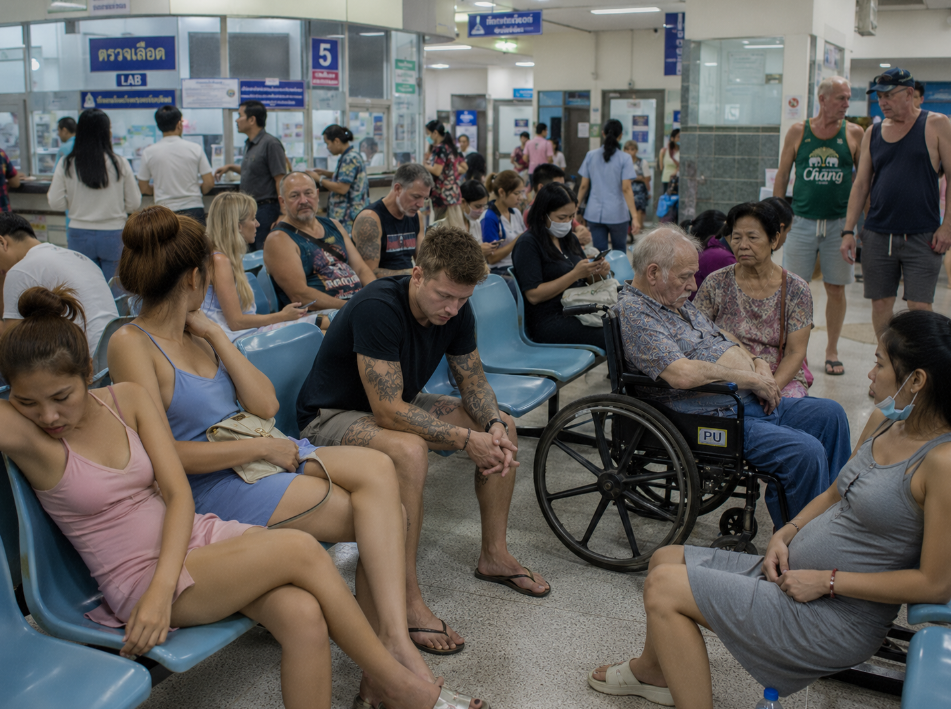
Go to Banglamung Hospital (BhattamaKun Hospital) on a Friday morning.
Today, I wasn’t a tourist, a customer, or a businessman. I was playing a simple role: a driver waiting in the lobby. And when you have two hours to kill with nowhere to be, you start noticing things.
You know those massive historical panorama paintings in museums—like the Battle of Trafalgar—where dozens of distinct, chaotic human dramas are captured on a single, sprawling canvas? Banglamung Hospital at 8:00 AM is the ultimate panorama of Pattaya. A masterclass in raw, unedited reality.
Every familiar face from the ecosystem was there, stripped of their nighttime armor.
Near the entrance, the casualties of the night were arriving. A police pickup truck was parked outside, blue lights still softly flashing. Inside sat a farang, staring blankly out the window, waiting his turn to be processed. Behind him, two guys were being brought in by officers—one needing stitches over a bloody eyebrow, another so heavily intoxicated he could barely keep his chin off his chest.
At the registration desk, three bar girls stood in a loose cluster. They were still visibly tipsy from the night before, their mascara slightly smudged. One of them was leaning heavily on her friend, wincing in pain—she’d taken a bad spill in high heels on a wet soi and twisted her ankle.
Further down the corridor, in the quiet line for blood tests and lab work, a different kind of tension hung in the air. People sat with their caps pulled low and medical masks pulled high, avoiding eye contact. Among them sat a young farang guy. He couldn’t keep his feet still. His eyes darted nervously around the room while he stared down at his arm, silently praying that those tiny red spots were just an allergic reaction—just something that would magically disappear by tomorrow.
A few rows back sat the final chapter. An ancient European man in a wheelchair, his hands trembling over his lap. Looking into his eyes, you could tell he knew the truth: his long, chaotic tropical adventure had finally reached its last stop. Sitting beside him was his Thai partner—also advanced in years, her face carved with a deep, crushing fatigue born from months of endless waiting, endless caregiving, and endless uncertainty.
Right next to the end of one journey, another was just beginning. A young girl, unmistakably from the nightlife industry, sat with a visible baby bump. Her friend held her hand, whispering words of encouragement. Looking at her soft, anxious face, one thought echoed through the room: that child will almost certainly never know his father.
Past them walked a girl in a impossibly short club dress and smeared eyeliner, walking fast, clearly coming straight off her shift. Nearby stood two stereotypical expats wearing faded ‘Chang’ singlets and flip-flops, looking utterly lost, waiting for something they didn’t seem to understand themselves.
And then came the comedy of the ecosystem. I walked over to the hospital cafe to grab a water, and there she was: a girl who had borrowed 500 Baht from me over two years ago and then vanished, claiming on LINE that she was “back home in her province caring for her family.”
She froze for a split second, looked me dead in the eye, smiled as if nothing had ever happened, and whispered:
“Tomorrow”
I couldn’t even be angry. It was poetic.
Because what makes the public hospital so extraordinary is that it is the only place in Pattaya where the marketplace vanishes.
In the bars, the condos, and the restaurants, everyone is playing a role. Money changes hands, illusions are bought and sold, and everyone pretends to be in control. But in the drafty hallways of Banglamung Hospital, there are no transactions, no VIPs, no sponsors, and no working girls.
Everyone is holding the same crumpled paper queue number. Everyone is sitting on the exact same chairs. Everyone is on the exact same side of the counter.
When you take away the neon, the alcohol, and the money, Pattaya is just a collection of fragile human beings—scared, exhausted, hopeful, and hurt—all waiting for their number to be called.
Leave a Reply