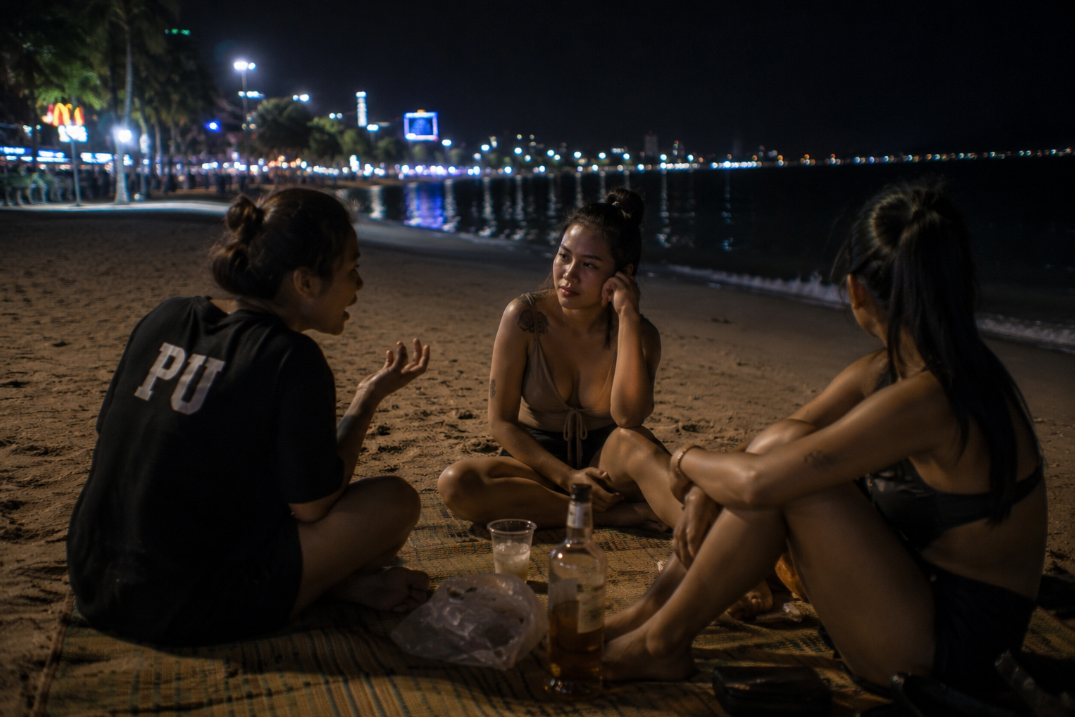
If you walked past this dimly lit stretch of Beach Road at 3:00 AM, hearing the sharp, aggressive tones cutting through the sound of the crashing waves, you wouldn’t realize you were looking at three unemployed freelancers. You would think you had stumbled into an executive board meeting of Wall Street hedge fund managers, aggressively comparing their first-quarter dividends.
They sat on a cheap plastic mat, nursing a single, rapidly melting cup of Hong Thong whiskey and soda, holding a financial summit in the dark.
The first one opened the floor, her voice heavy with the nostalgia of a retired CEO:
“God, the city is so dead lately. I miss the old days. My European ex had me on a strict 30,000-baht monthly retainer. Back then, I woke up in air-conditioning, my skin looked flawless, and I never had to sit out here swallowing sea breeze and humidity.”
The second one—the venture capitalist of the group—couldn’t let that stand. She immediately launched her counter-offensive, terrified of losing market share in the conversation:
“Thirty thousand? That’s minimum wage. When I was with my Brit, he dropped a 200,000-baht lump sum into my Kasikorn account. Told me to open a business. I spent the entire month ‘investing’ in Central Festival and Terminal 21. Life was a dream.”
The third girl sat quietly for a moment, letting them exhaust their portfolios. Then, she played the ultimate trump card of the fishing village:
“Please. Both of you are talking about pocket change. My sponsor bought me a car. Brand new, red plates right out of the showroom.”
She didn’t make eye contact. Instead, she took a long, defensive sip from the plastic cup, her eyes darting nervously out toward the black water of the Gulf, hiding the awkward weight of her own fabrication.
The conversation escalated into a fierce, aggressive bidding war. They dug up ancient legends of past glory, phantom bank balances, and mythological sponsors, desperately trying to bury one another in the sand with their financial ghost stories.
But the brutal, cinematic truth of the neon ecosystem was sitting right there on the mat.
No one knows what percentage of those stories was real, and how much of it was just an emotional shield—a psychological fortress built out of lies to protect their fragile egos from the crushing weight of a lonely, unprofitable night.
Because the reality right in front of them was stark: three women hugging their knees in the dark, sharing a 160-baht bottle of local liquor, staring blankly into the abyss.
The legendary 200,000-baht lump sums and the mythological red-plate cars couldn’t magically manifest a bowl of Mama noodles to cure their hunger. They were trading shares in ghost companies that had gone bankrupt years ago.
The only real risk they shared right now was the ticking clock. They were waiting, praying that some lonely tourist would stumble out of the darkness and offer them a baseline micro-transaction—just enough to buy a late-night meal and justify their existence for one more shift.
Because in Pattaya, if the sky turns grey with dawn and no customer has stopped to say hello, all the talk of gold chains and overseas wire transfers is just hot air.
At 4:00 AM on a plastic mat, the only true story is hunger.
Leave a Reply