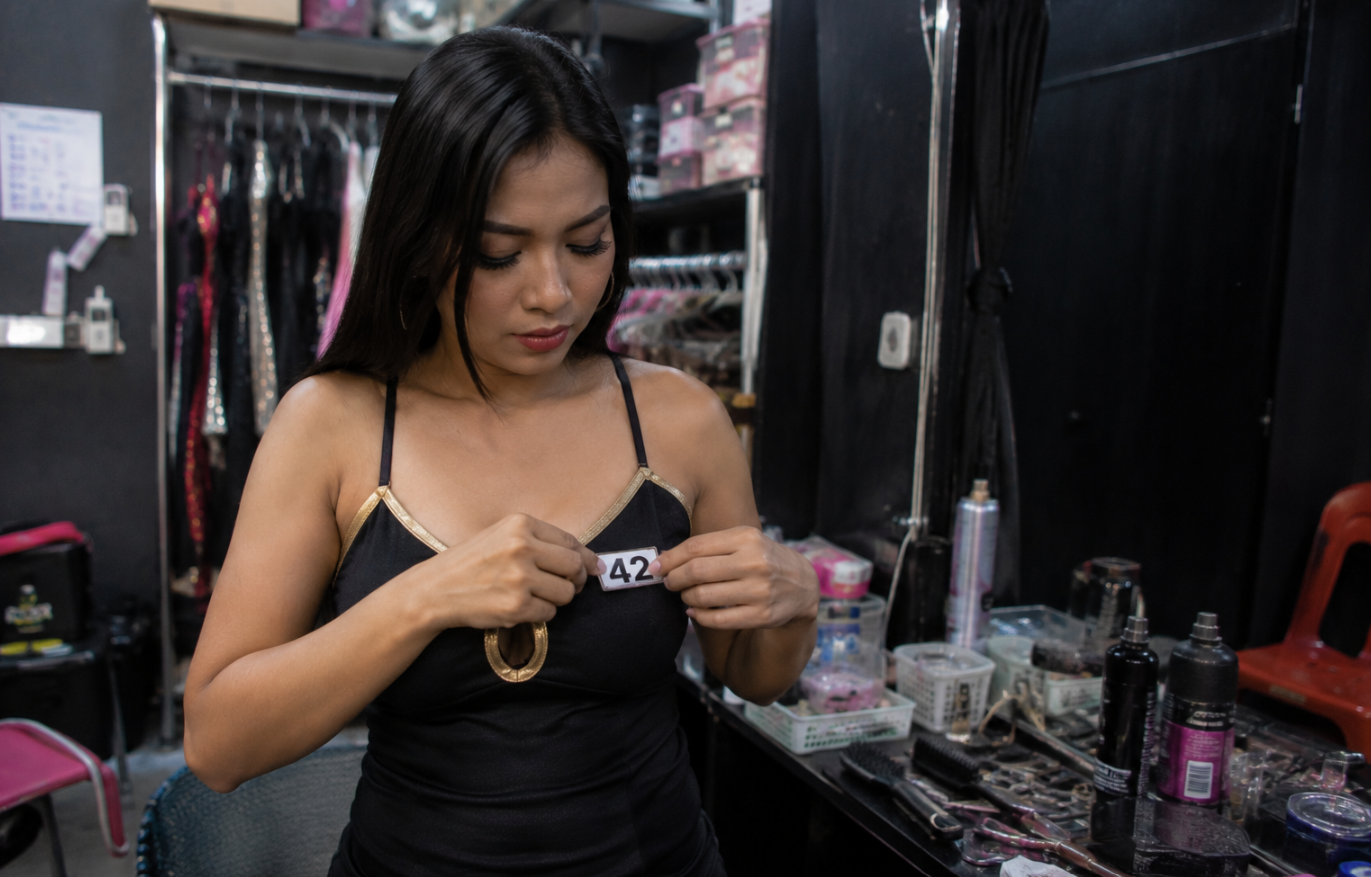
The dressing room behind the main stage of the Walking Street go-go smells intensely of vanilla body mist, freezing air conditioning, and the sharp metallic tang of cheap hairspray. Kwan sits on a plastic stool in front of a heavily smudged mirror, meticulously applying a final layer of matte lipstick. She is twenty-six, a mother to a four-year-old boy in Sisaket, and a woman who spent the entire afternoon quietly calculating the compounding interest on a microfinance loan.
Then, she reaches into her clear makeup bag and pulls out the tag.
It is a small, rectangular piece of white acrylic. The black digits “42” are stamped into the center, the paint slightly chipped at the edges from years of use by dozens of other girls who wore it before her. The safety pin on the back is bent and dull. Kwan pushes the blunt metal through the thin fabric of her uniform, perfectly centering it just above her ribs.
The moment the pin snaps shut, a profound, invisible transformation occurs. The physical act of attaching the plastic badge is the exact moment of her erasure.
Kwan—the mother, the daughter, the human being with a history and anxieties—ceases to exist. She steps through the heavy black curtain and out onto the neon-drenched floor. Out here, she is no longer a person. She is a standardized commodity. She is an item on a highly optimized, high-decibel menu.
A tourist from Manchester named Liam sits at a front-row table, nursing a cold beer. He watches the girls rotate on the illuminated plexiglass stage. He doesn’t need to learn how to pronounce Thai names. He doesn’t need to navigate the tonal inflections of the language or pretend to care about the cultural context of who she is. When he decides he wants her company, he simply catches the mamasan’s eye, raises a finger, and points.
“Forty-two,” he shouts over the vibrating bass.
The mamasan nods, pulls a pen from her apron, and scribbles “42” onto a laminated receipt pad. That is all it takes. The transaction is seamless, frictionless, and completely devoid of human complexity.
Western tourists and armchair sociologists often look at these badges and see absolute tragedy—the ultimate degradation of women reduced to mere barcodes in a meat market. They pity the girls for being stripped of their identities.
But what the outside world completely fails to understand is the psychological utility of the plastic tag. For Kwan, the number isn’t a brand of ownership; it is a piece of bulletproof armor. When a drunk customer makes a crude joke, when a man grabs her waist too tightly, or when a client unloads his neurotic emotional baggage on her in a rented room, it isn’t happening to Kwan. It is happening to Number 42.
The badge absorbs the indignity of the street. And when the shift finally ends, she simply unpins the plastic tag, tosses it into her bag, and walks out into the dawn air—leaving Number 42 locked inside the dark, sticky bar, leaving herself entirely untouched.
Leave a Reply