This is perhaps the biggest cultural gap in Pattaya. It is the root cause of countless arguments, shattered illusions, and panic attacks among expats. We constantly hear the same frustrated question from foreigners: “She made 100,000 baht last month! How is she asking to borrow 500 baht for rice today? Where did the money go?”
The Westerner assumes she is lying, hiding it, or fundamentally incapable of basic math.
But the truth is much deeper. It’s not about an inability to plan. It is a completely different operating system.
For a Westerner, wealth is a reservoir. You build a dam, you collect the water (money), and you protect it for the future.
For a Thai—especially in the service and entertainment industry—money is a river. It is a continuous flow. It comes, and it goes. You just stand in it.
The 180,000 Baht Illusion
Imagine Joy has 180,000 baht sitting in her Kasikorn bank account after a very good month.
The farang looks at that number and does the math: “Excellent. If she budgets correctly, she doesn’t have to work for three or four months. She is secure.”
Joy looks at the exact same number and thinks: “Today is going to be a phenomenal day.”
A week later, the balance is 40,000.
Two weeks later, it is 5,000.
The farang is hyperventilating. He is projecting future starvation. He asks, “Why did you buy a new iPhone and treat five friends to a seafood buffet? You have no savings left!”
Joy is completely calm. She shrugs and gives the classic answer: “Up to me. I will earn it later.”
This isn’t empty bravado. It is her genuine lived experience. Her entire life, money has appeared and vanished. It is not capital to be accumulated; it is energy to be spent while you have it. The money has done its job. Asking “where did it go?” is like asking where the wind went.
The Endless Conveyor Belt
If you ask a Western expat what their financial goal is, they will give you a final number: “I need $500,000 in index funds to retire.”
If you ask a girl on Soi 6 what she wants to save up for, there is no final number. There is only the immediate next target.
“First, I need a new Honda PCX.” (Done).
“Now, I need the iPhone 17 Pro Max.” (Done).
“Now, we go to Koh Chang.” (Done).
“Now, I need to buy a new roof for my mother’s house.”
There is no concept of a “safety cushion.” The cushion is the belief that when the balance hits zero, she will simply figure it out.
The Ultimate Survival Mechanism
Most expats look at this and call it gross financial irresponsibility. And by Western standards, it absolutely is. But there is a twist that most foreigners miss.
This exact mindset makes Thai people incredibly, almost terrifyingly resilient to crises.
Look at what happened during the Covid lockdowns. When the borders closed and the bars shut down, Western expats who lost their income fell into severe depression. Their identities were tied to their careers. They sat in their condos, stared at their spreadsheets, and panicked.
What did the local girls do?
On Tuesday, she was a go-go dancer.
On Wednesday, she was on the beach digging for clams to eat.
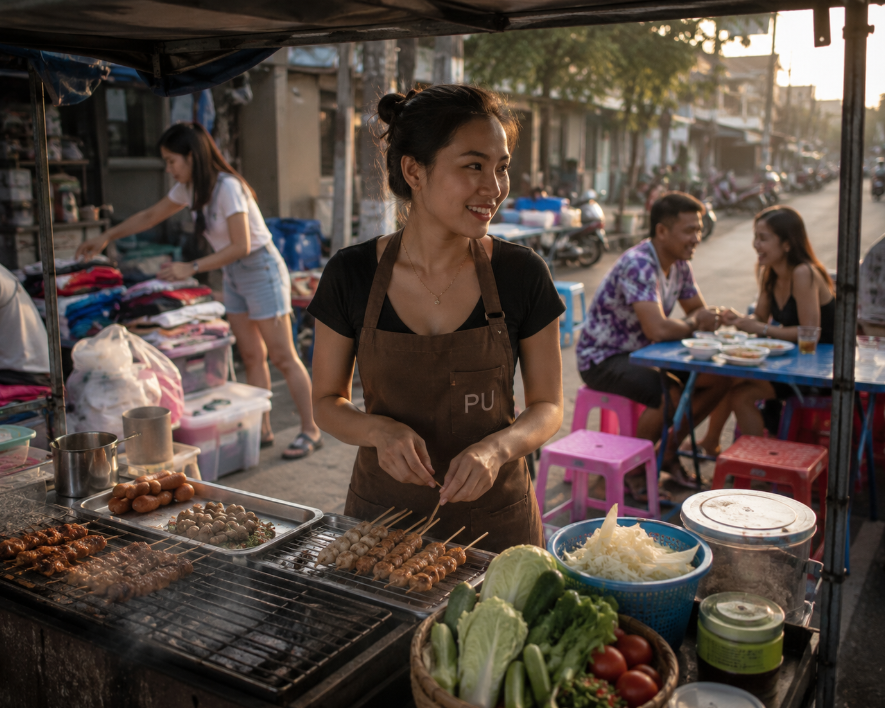
On Thursday, she rented a cart and started selling grilled sausages.
By Friday, she was selling second-hand clothes on Facebook Live.
A week later, she bought a UV lamp and started doing cheap nails on the sidewalk.
There was no existential crisis. There was no “Oh god, I lost my profession, who am I?” There was only: “Okay, the river dried up here. Let’s go find water over there.”
They might lose the Western game of long-term capitalism. They might not build generational wealth or stock portfolios. But when the world ends, the guy with the spreadsheet will be staring at a wall, while Joy will have already set up a Som Tum stall in the post-apocalyptic wasteland.
Leave a Reply