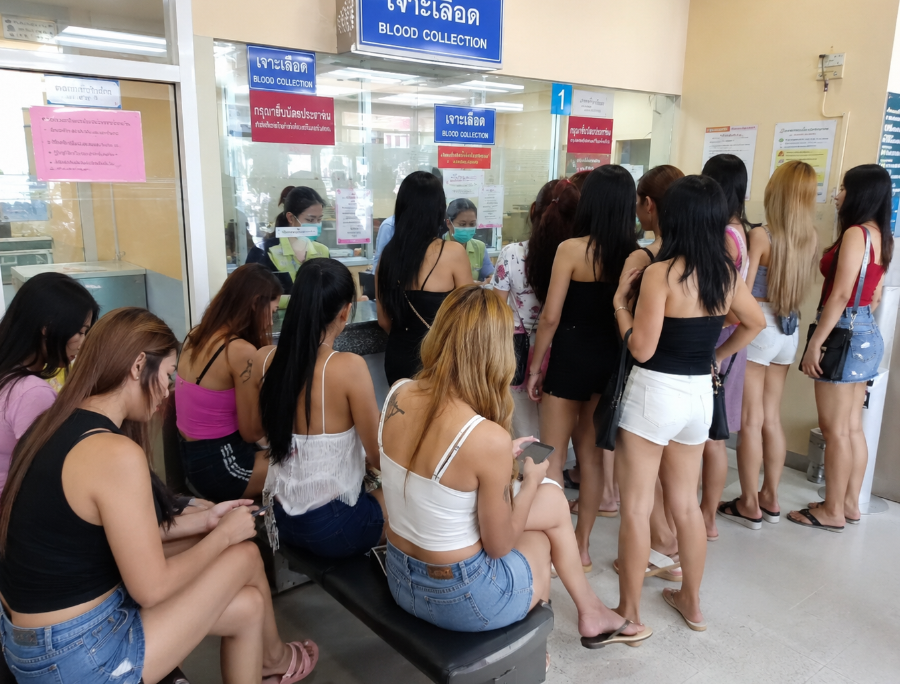
Most people arriving in Pattaya think Thailand’s entertainment industry is a walking biohazard. They operate on stereotypes built decades ago, assuming every bar is an epicenter of infection.
The data says something completely different. Not because the problem doesn’t exist, but because the reality of the industry today is significantly more complex—and highly optimized—than the stereotype.
1. Where the Fear Came From: The 1990s
You can’t understand the numbers without the context. In the late 1980s and early 1990s, Thailand faced an explosive HIV epidemic with overlapping waves of infections across different demographics. It was one of the most heavily affected countries in Asia. This era permanently cemented the country’s, and Pattaya’s, reputation in the global consciousness. The fear was entirely justified back then.
2. The Policy That Changed Everything
In 1991, Thailand didn’t just issue health recommendations; they weaponized policy. The “100% Condom Programme” was elevated to the Prime Minister’s Office. It became a mandatory requirement for all commercial entertainment venues, enforced by monthly health checks.
The documented result:
New HIV infections have plummeted by 49% since 2010 (down to approx. 9,100 new cases in 2023).
Thailand became the first country in Asia to completely eliminate mother-to-child transmission of HIV and syphilis.
This wasn’t a medical miracle; it was the result of ruthless, systemic regulation.
3. The 10x Gap: The Most Unexpected Fact
Here is the biggest twist in the data. When researchers analyzed the industry in Bangkok, they found a massive disparity based on where the sex work happened.
Venue-based workers (licensed bars, Agogos with regular testing): HIV prevalence was around 2.5%.
Street-based / Informal workers (freelancers): HIV prevalence was 22.7%.
The difference is almost tenfold. This isn’t a moral judgment; it is a statistical reality. A licensed bar operating within the system is a fundamentally different world of risk compared to the unregulated street sector. Regulation works.
4. Where is the Real Risk Today?
The epicenter has shifted, but the stereotype hasn’t. According to a massive incidence study of 373,000 individuals, the highest rates of new HIV infections in Thailand today are found among:
MSM (Men who have sex with men): 2.23 per 100 person-years.
Transgender Women (TGW): 2.06 per 100 person-years.
Female Sex Workers (FSW): 0.41 per 100 person-years.
The heterosexual bar industry is simply no longer the primary engine of the epidemic. The focus has completely shifted.
5. The Pattaya Data Black Hole
What about Pattaya specifically? The most referenced clinical study conducted locally comes from the Pattayarak Clinic (data from 2005-2009). It tracked male sex workers in the city, showing a prevalence of 15.2% and an incidence rate of 6.3% per year.
The honest truth? There is a glaring lack of fresh, publicly available, Pattaya-specific clinical data for the heterosexual sector in 2026. The fact that a city with an industry of this scale lacks public, localized real-time data is a story in itself.
6. The Technology That Broke the Math
Finally, you have to factor in technology. PrEP (Pre-Exposure Prophylaxis) has fundamentally altered the risk equation.
In Thailand, PrEP users jumped from 26,619 in 2023 to 32,991 in 2024, heavily supported by Key Population-Led Health Services (KPLHS). Add to that 260,000 free HIV self-test kits distributed, with access across 300 hospitals.
For those who understand the system, the tools to eliminate risk entirely are now cheap, accessible, and highly normalized.
The Mirror
Pattaya carries the heavy reputation of the 1990s in a world that has already moved on. The data doesn’t say there is zero risk. It says the risk is distributed entirely differently than tourists think, that systemic regulation is vastly superior to prohibition, and that the highest danger today lies exactly where the system doesn’t exist.
📂 DATA CORNER (Official Sources):
- UNAIDS (2023). Thailand Country Factsheet. (580k living with HIV, 1.1% prevalence, 49% reduction since 2010).
- World Health Organization (WHO) (2016). Thailand is first country in Asia to eliminate mother-to-child transmission of HIV and syphilis.
- Rojanapithayakorn, W. (2006). The 100% condom use programme in Asia. Reproductive Health Matters.
- De Lind van Wijngaarden, J. W., et al. (2013). Prevalence of HIV and sexually transmitted infections among female sex workers in Bangkok, Thailand. International Journal of STD & AIDS. (Venue vs. Street 10x gap).
- ScienceDirect / Kasetsart University Cohort (2023/2024). HIV incidence among key populations in Thailand (2015-2022). (Incidence rates: MSM 2.23, TGW 2.06, FSW 0.41).
- Pattayarak Clinic / Disease Control Journal (Data 2005-2009). HIV incidence and risk behaviors among male sex workers in Pattaya, Chonburi.
- CDC (2024). Global HIV/TB: Thailand Overview. (PrEP expansion and self-testing distribution).
Leave a Reply