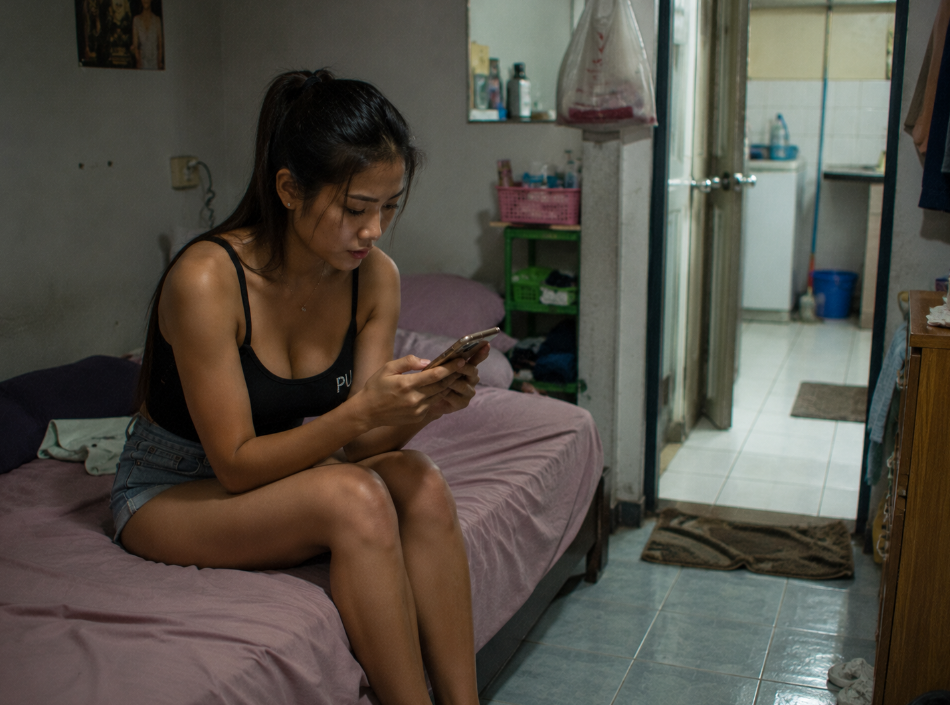
She sits on the edge of the bed in her cheap Third Road apartment. It has been exactly one year since Mike packed his bags, threw the keys on the table, and took a taxi to the airport, calling her a traitor.
She opens LINE. The chat with Mike is buried deep at the bottom of her feed. His last message is just a dry, cold “Goodbye.”
She begins to type. In Thai. Because her broken English was never enough to explain things that sound like cheap excuses to a farang, but are the fundamental laws of physics to a Thai girl.
She types fast, deletes, and types again:
“Mike. I am not angry at you. We didn’t do anything wrong; we are just from entirely different worlds.
You thought the 15,000 baht you gave me every month solved everything. To you, it was a ‘salary’ to keep me out of the bar. And I did leave the bar. But you never understood Bunkhun—my eternal, unpayable debt to the parents who gave me life. My mother in Isaan, my younger brother who needs his school fees paid—they cannot eat your love for me.
15,000 baht in Pattaya is barely survival. I had nothing left to send home. This is Katanyu—the absolute duty to care for your family. If a Thai daughter fails to do this, she is lower than a street dog.
When my mother’s roof leaked right before the rainy season, I needed 20,000 baht. Do you remember when I was quiet and sad for days? I couldn’t ask you. We call it Kreng jai—a deep, paralyzing fear of becoming a burden to someone you respect. You already paid for my food and our room. My Kreng jai towards you was too strong.
So I messaged an old customer from Europe. I asked him to send the money. And then you found that chat in my LINE. You screamed that I was a whore, that I lied to you, that I betrayed us.
But Mike… I didn’t betray you. In your world, sex and text messages are about love. In my world, it is just an ATM. It is just work. My body could go with a customer so my brother could stay in school, but my heart never went anywhere. My heart stayed home when I boiled your khao tom in the morning and ironed your shirts. I was your Mia (wife), and they were just a job.
You left because you thought I chose money over you. I was just trying to be a good daughter without being a burden on you. I am sorry you didn’t understand.”
She stops typing. She looks at this long, deep, brutally honest text.
Then she copies it, opens Google Translate, and pastes it into the box. The algorithm ruthlessly grinds down complex Thai social concepts into flat, broken English.
The screen spits out:
“Mike. I no angry. 15,000 baht not enough for my family. I must care my mother, it is Thai way. I no ask you money because I shy. I talk to old customer for money. You think I bad girl. But I love you. It just work. I your wife. Sorry you no understand.”
She stares at the translation. There is no Bunkhun. There is no Kreng jai. In this translation, she sounds exactly like what he always thought she was—just another greedy bar girl making excuses.
But she hits ‘Copy’ anyway. She pastes the broken English text into LINE, hits ‘Send’, and locks her screen. It is time to go. Her shift on Soi 7 starts in 20 minutes.
6:30 AM.
She walks back into her room. She strips off the cigarette-scented dress and scrubs off her heavy makeup. She opens her mobile banking app and transfers the 3,000 baht she just made from a drunk British tourist straight into her mother’s account. Duty fulfilled. Katanyu in motion.
She lies down on the bed and opens LINE.
Next to the long message to Mike, there is empty space. Unread. He is either asleep in Europe, or he just swiped the notification away.
She looks at the broken English text one last time and realizes the hardest truth of all: he will never understand. Not because he is a bad man, but because his world doesn’t have the vocabulary to comprehend hers.
She long-presses the message. The menu pops up.
She taps “Unsend.”
The chat is instantly wiped clean, leaving nothing but his year-old “Goodbye.” She puts her phone on the charger and closes her eyes.
At that exact moment, 9,000 kilometers away from Pattaya, in a cold apartment, Mike picks up his phone from the nightstand to check his morning emails.
On his locked screen, a single LINE notification sits waiting:
“Ploy unsent a message.”
He stares at the screen for a few seconds. Then, he simply swipes the notification to the left, pours himself a cup of black coffee, and gets ready for work—never knowing what he failed to understand a year ago.

Leave a Reply