For most foreign guys sitting in a Pattaya Go-Go bar or a Bangkok Soap Massage parlor, the fantasy is simple: you pay your money, and you are the ultimate center of attention. You are the provider. You are the man.
But if you peel back the heavy makeup, the neon lighting, and the synthetic wigs, the real backstage dynamics of the Thai nightlife ecosystem will absolutely blow your mind.
Welcome to the hidden matrix of the Tomboys and the ROV boys.
The Stage Identity vs. The Living Room Reality
It’s a massive revelation for anyone who thinks they understand the girls on the stage: a shocking percentage of nightlife workers—especially in the high-turnover Soap Massages and specific Go-Go bars—are actually hardcore Tomboys (Toms) in their personal lives.
On the clock, they are the ultimate fantasy. They wear push-up bras, heavy glamorous makeup, long feminine wigs, and high heels. They smile, flirt, and dance on the poles. They play the part flawlessly because it’s a high-paying job.
But the second that shift ends, the wig comes off. The makeup is scrubbed away. The oversized t-shirt goes on, and “she” becomes “he”—the handsome protector and provider for his actual girlfriend waiting at home.
“Daddy Got Us Some Money Tonight”
There is a beautiful, deeply entrenched culture within the Thai Tom-Dee community. The Tomcat takes pride in being the traditional man of the house.
After a grueling night of entertaining foreign clients, the Tom boy rides a motorbike back to the apartment, walks through the door, and completely shifts personas. There is no trauma or discussion about the clients. Instead, the Tom smiles, kisses his girlfriend, and says:
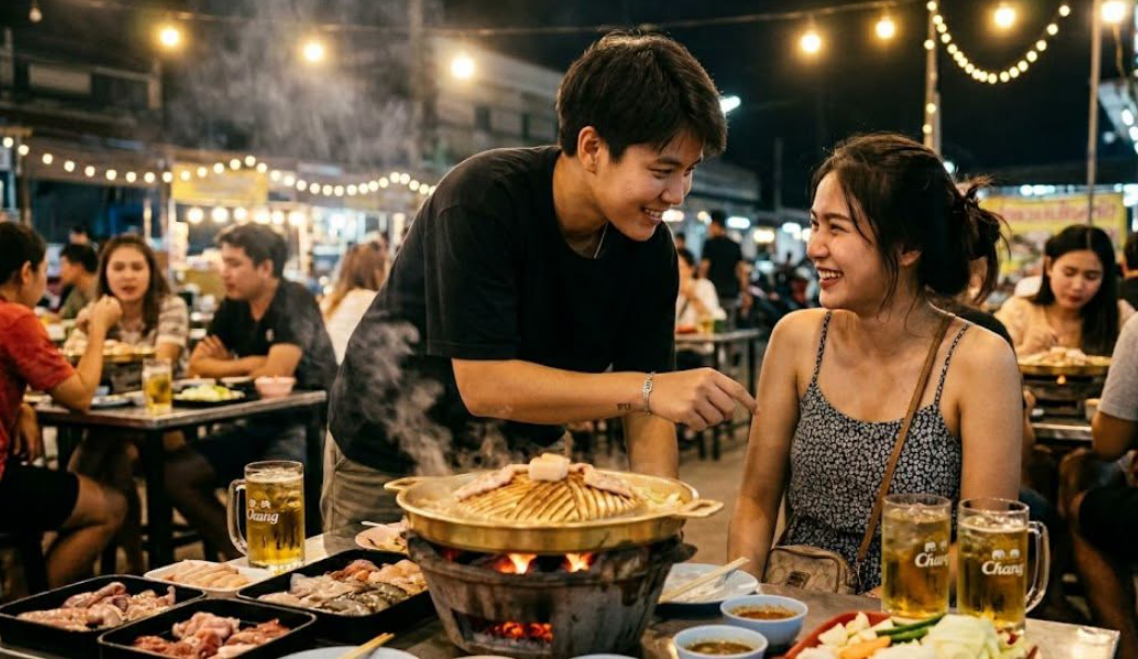
“Baby, Daddy got us some money tonight. Let’s go get Mookata.”
They head out to a local, smoky Thai BBQ joint. The Tom confidently pays the 500 Baht bill and slides an extra 1,000 or 2,000 Baht into the girlfriend’s purse, purely to prove a point: I am the provider. I take care of my woman. To the Tom, that hard-earned cash from a Farang client is just fuel to keep his own domestic romance alive.
But the food chain doesn’t stop there. There is a third, silent tier to this ecosystem.
The ROV Shadow Economy
While the Tom boy is commanding the stage under a wig, and while the girlfriend is waiting at home looking pretty, there is often another player in the background.
In a nearby, budget Pattaya apartment, a young Thai guy with a thin mustache is sitting on a mattress in his underwear. The room is dark, lit only by the screen of his smartphone. He’s been playing ROV with his boys for seven hours straight. He doesn’t have a job, and he isn’t looking for one.
He is waiting.
He is waiting for the Tom boy to leave for the night shift. The exact moment the Tom heads out to put on that wig, this young man moves in. The girlfriend—the very same one who just got treated to Mookata and given “pocket money” by her hardworking Tom boyfriend—welcomes him with a smile.
She strokes his hair and says:
“Baby, Mommy has something for you tonight.”
She hands him a slice of that exact same Farang cash that trickled down through the Tom boy. And just like that, the ROV boy’s evening is set. He meets up with his friends at a local roadside spot, orders a bottle of Blend 285 whiskey or a bucket of ice-cold Chang beer, and talks about his gaming stats—entirely funded by a system he doesn’t even have to participate in.
The Ultimate Cash Flow
When you hand over your Baht to a beautiful girl in a bar, you aren’t just paying for a drink or a smile. You are funding a complex, beautiful, and hilarious socio-economic wheel.
- The Foreigner funds the Tomboy.
- The Tomboy funds the Girlfriend (to feel like “Daddy”).
- The Girlfriend funds the ROV Boy (to feel like “Mommy”).
The ROV Boy funds the local Whiskey Economy.
Next time you see a girl on stage staring blankly into the crowd, she isn’t thinking about you. She’s probably checking the time, wondering if the Mookata place is still open, and making sure her girl isn’t spending too much of “Daddy’s money” on someone else’s beer.
Leave a Reply