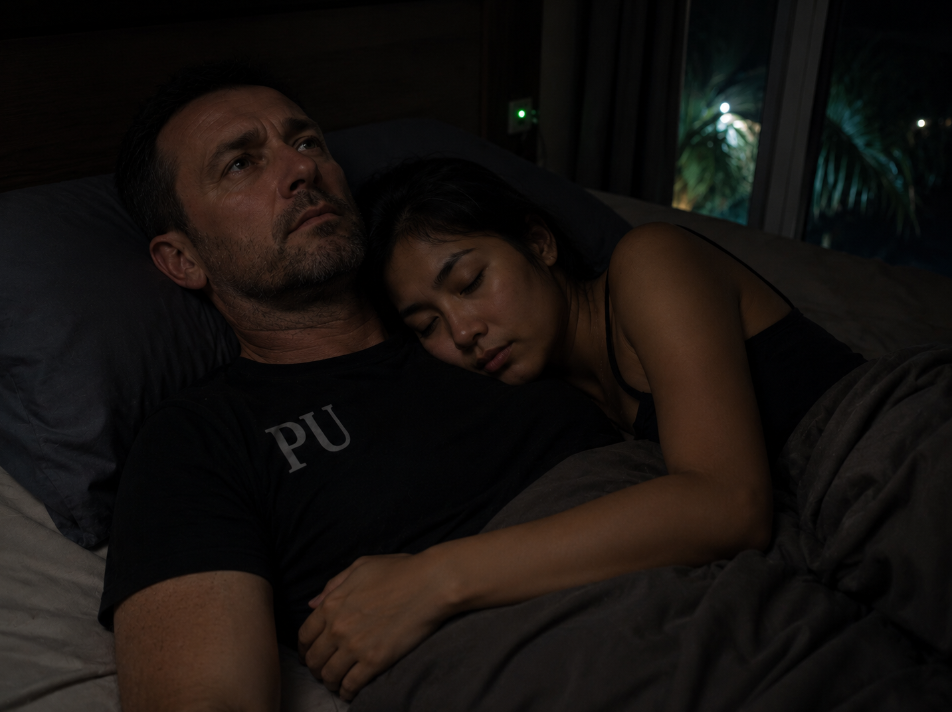
It is 3:14 AM. In the pitch-black room, the only light is the faint green LED of the air conditioner, and the only mechanical sound is its low, rhythmic drone. Outside the thin glass window, the tropical night is loud. There is the rustle of heavy palm leaves, the distant, chaotic barking of a soi dog pack, and the sharp, almost mechanical clicking of a giant Tokay gecko on the roof. The sounds are alien, slightly menacing, yet somehow, profoundly soothing.
He lies flat on his back, staring at the invisible ceiling. He is 43 years old, and his right arm is completely dead.
The blood flow was cut off an hour ago. The familiar pins and needles have faded into a heavy, cold numbness. But he doesn’t move. He barely even breathes deeply. He refuses to shift his weight because Kanya is sleeping soundly, her head resting heavily on his bicep, her slender arm thrown tightly across his chest as if anchoring him to the bed.
He turns his head just a fraction of an inch and buries his nose in her dark hair. He inhales.
It smells like cheap jasmine shampoo, sea salt, and baby powder. Instantly, the scent pulls his mind out of the dark room and throws it back to the beach this morning. He remembers watching her walk out of the ocean, the water dripping from her shoulders. She had dropped a piece of watermelon in the sand, looked at it, looked at him, and just burst into genuine, unfiltered laughter. There was no pretense. No hidden agenda. Just effortless, fluid joy.
He realizes, lying there in the dark, that for the first time in 43 years, the permanent, tight knot of anxiety in his stomach is completely gone. He is utterly, dangerously relaxed.
But then, the dead, cold weight of his right arm pulls him back across the world. It pulls him to Vienna.
The War Zone of Home
The epiphany doesn’t hit him like a lightning bolt. It creeps up on him like a rising tide: He doesn’t want to go home. And it is not because this place is a magical paradise. It is because home is a slaughterhouse.
In Vienna, there is a beautifully designed, minimalist apartment with expensive gray furniture. And in that apartment is Sabine.
They have been married for fourteen years, but the word “marriage” is a cruel joke. They are two inmates sharing a cell. The atmosphere in that gray apartment is so thick with toxic resentment that he can physically feel his chest tighten the moment he turns his key in the door. They cannot exist in the same airspace. It takes exactly five minutes for a conversation about the dishwasher to escalate into a venomous, screaming character assassination.
Over the years, Sabine has hardened. The softness of their youth has calcified into a rigid, almost masculine combativeness. Every interaction is a power struggle. Every word is a trap. She is fiercely independent, relentlessly critical, and constantly ready for war.
And caught in the crossfire of this emotional trench warfare is their 12-year-old son, Lukas. Lukas, who has learned to survive by simply putting on his noise-canceling headphones and staring blankly at his iPad while his parents tear each other to pieces in the kitchen.
The Difference Between “Better” and “Worse”
Foreigners often lie to themselves when they come to Thailand. They say they love the culture, the food, the sunshine, the freedom. But lying there at 3 AM, he admits the ugly, unvarnished truth to himself.
He is not staying for the beach. He is staying for the absence of war.
The contrast is staggering. Kanya doesn’t care about his political opinions. She doesn’t want to dissect his character flaws over a glass of overpriced wine. She just wants to eat spicy food, laugh at stupid jokes, and hold onto him in the dark. Beside her, he feels like a man again—not a failure, not an opponent, not a punching bag. Just a man.
He looks at his phone glowing softly on the nightstand. His return flight on Austrian Airlines departs in exactly four days.
He imagines the sharp European winter wind hitting his face outside the Vienna airport. He imagines the aggressive silence in the car ride home. He imagines Sabine’s tight, furious jawline, ready to initiate the first argument before he even unpacks his suitcase.
In the dark, Kanya shifts slightly in her sleep. She mumbles something in Thai, her breath warm against his neck, and tightens her grip on his chest.
His right arm is entirely numb now. It feels like it belongs to someone else. He slowly closes his eyes, deciding to let the arm die. Let it fall off. Let the life he built in Vienna burn to the ground. Let the lawyers take the gray apartment.
He is not getting on that plane.
Leave a Reply