He was a classic Pattaya cynic. The kind of guy who sat over a pint of beer in a Soi Buakhao bar, preaching the “3F rule,” laughing at the romantics who bought cars for Thai girls, and repeating the ultimate expat mantra: “You don’t buy here, you only rent.” He thought he saw right through the matrix.
But by his fourth year in the city, even the thickest-skinned veterans hit the wall of neon fatigue.
He was sick to his stomach of the bars. Sick of the high heels, the layers of foundation, the short skirts, and the identical mirror selfies from club bathrooms. He was tired of the copy-pasted “I miss you baby” texts and the forced sexy poses. Suddenly, he wanted something pure. He wanted to pierce through the glossy commercial shell and see the actual human.
He messaged a girl he had been seeing for the last couple of weeks:
“Send me a normal photo. Not sexy. Not from the bar. Just your real life.”
The Illusion of Authenticity
In his head, he had already painted the picture. He expected an indie-movie aesthetic: a cozy morning, her sitting by the window in an oversized t-shirt, no makeup, holding a cup of coffee. Maybe a cute cat in the background. Something “authentic” and touching, but still aesthetic, safe, and romantic. He wanted to see a girl who could be saved.
Five minutes later, his phone buzzed. A series of photos came through.
He opened them—and a cold sweat broke out on his neck. It didn’t look like a romantic morning. It looked like a chronicle of a social disaster.
The Anatomy of Reality
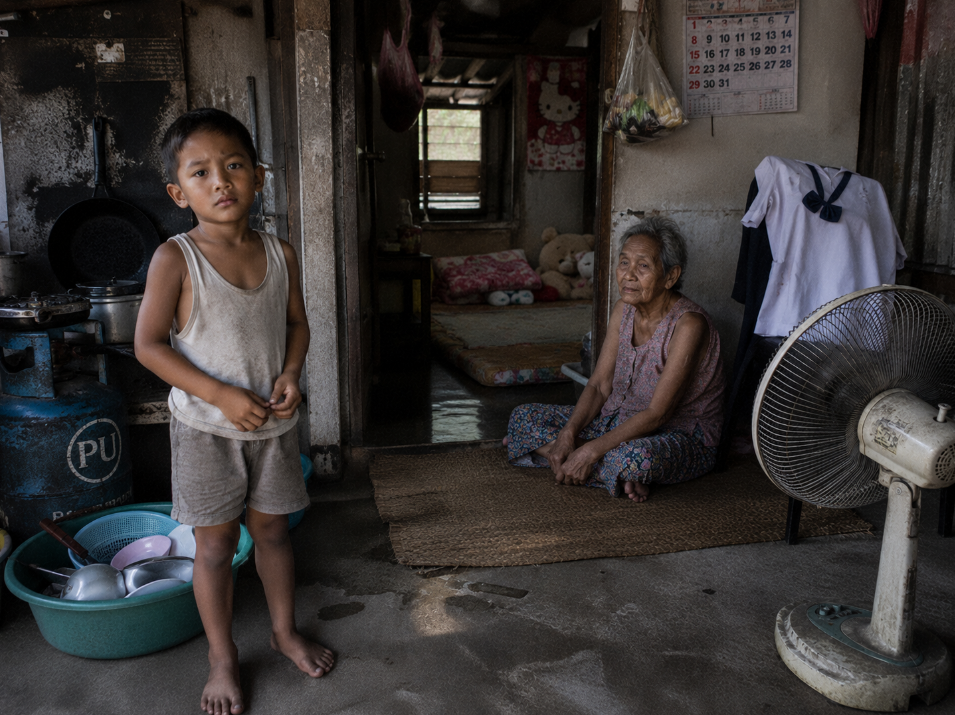
The first photo showed a little boy. Barefoot, in a dirty tank top, standing on a raw concrete floor. In the corner was the “kitchen”: a soot-blackened gas cylinder, a plastic basin floating with unwashed dishes, and a charred frying pan.
In the second photo, an old, withered woman—her mother—sat on a woven mat beneath a humming, heavily dust-coated fan. A faded, three-year-old calendar hung on the wall. Through the doorway, he could see a blindingly white, dusty dirt road. A heavily washed school uniform was casually tossed over a chair.
But the most brutal punch came with the third picture.
The caption read: “My room.“
If it weren’t for that caption, he would have assumed it was a shot of a makeshift landfill. There was no room. There were two walls, unevenly wrapped in construction plastic and scraps of plywood. Rags were piled on the floor to serve as a mattress. In the corner sat plush toys rotting from the humidity, sitting beneath a decaying, peeling Hello Kitty poster.
This was her normality.
The Weight of Real Life
He stared at the screen of his expensive smartphone, feeling his worldview collapse in on itself.
He had always thought the bar was the hardest, dirtiest, and darkest part of her life. He thought she was suffering in neon slavery.
It turned out the bar was the easiest, most understandable, and prettiest part of her existence. The bar was just packaging. It had bright lights, loud music, alcohol, youthful energy, and the illusion of endless choices. Yes, it was a cynical money-extraction machine. But to the expat, it was a familiar play with clear rules.
Her actual, “normal” life was a thousand times heavier and more terrifying than any fantasy.
In this reality, there was no room for sexuality. There was only poverty baked into the concrete. There was a child who called his grandmother “Mom” more often than his actual mother. There were debts, hospital bills, and an entire village that knew exactly how their daughter earned the money for her remittances in Pattaya.
In that moment, he realized the most important truth about himself. He only wanted “real life” until he saw how much it weighed.
He wanted to cherry-pick a comfortable version of the truth—a pretty face without makeup. But the real her came as a package deal with a plastic basin, a dusty fan, and a concrete floor. In the bar, buying a lady drink, he was in control. He was a VIP client. But looking at these photos, he suddenly realized: in her real life, he ceases to be a client. Here, he instantly transforms into a potential participant in the family economy. A walking wallet expected to save them from all of this.
He quietly locked his phone screen. Real life turned out to be far too expensive to look at.
Leave a Reply