The motorcycle taxi drivers at the corner of Soi Wat Boon all know Thomas. Most of them think the seventy-year-old expat is slowly losing his mind, though they respectfully keep that opinion to themselves.
Every single afternoon, right at the peak of the crushing tropical heat, Thomas leaves his condo. He doesn’t take a baht bus. He doesn’t ride a scooter. He walks. He walks exactly ten kilometers, tracing the exact same route down to the Jomtien Beach promenade and back, his pace mechanical and unwavering, his shirt soaked through with sweat.
When he reaches the final stretch of his daily march, he steps into the blast of air conditioning at the local 7-Eleven. He always buys two large iced coffees.
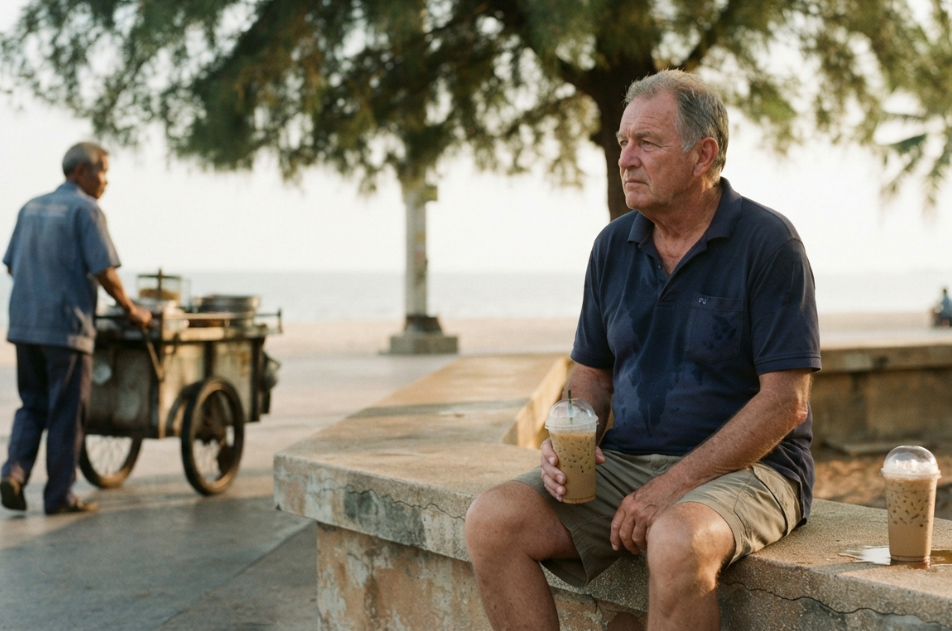
He doesn’t drink either of them yet. Holding one in each hand, feeling the cold condensation drip against his fingers, he walks another two hundred meters down the pavement until he reaches a specific spot on the low concrete seawall under the shade of a massive casuarina tree, facing the sea.
Thomas sits down on the ledge. He carefully places the second iced coffee on the warm concrete next to him, pops the plastic lid off his own, and stares out at the Gulf of Thailand.
The Rhythm of Two
He doesn’t walk ten kilometers because he is crazy. He walks because it is the only way to keep the ghost alive.
For twenty years, this was not a solo march. He used to walk this exact route with his Thai wife, Som. In the early years, she absolutely hated it. She would drag her feet, wipe the sweat from her brow with a tissue, and complain with theatrical exasperation.
“Farangs are crazy,” she would grumble, holding a parasol to block the sun. “Why do you love suffering in the heat? Thai people only walk if the motorcycle is broken. We have a car with air conditioning, Tom!”
But over the years, a quiet shift happened. Her complaints stopped. The ten kilometers became their shared ritual. It became the time when they didn’t look at their phones, didn’t talk about bills, and didn’t worry about the future. They just matched their breathing and their footsteps.
And at the end of the ten kilometers, they would sit on this exact spot on the concrete seawall. They would watch the sun turn the sky into bruised purple, sip their cold coffees, and dream about what they would do when they grew truly old together.
The Khanom Vendor
A squeaking wheel breaks Thomas’s thoughts.
An old Thai man in a faded blue shirt is slowly pushing a heavy wooden cart along the beach sidewalk. The sweet, rich smell of roasted coconut and pandan fills the air. It’s the khanom (traditional Thai snack) vendor.
A sharp, physical ache hits Thomas in the chest.
Som used to stop this exact vendor every single afternoon after their walk. She would buy sweet sticky rice wrapped in banana leaves, laughing with the old man, handing him a twenty-baht note.
Thomas watches the vendor wipe his wrinkled face with a small towel. The old man’s back is hunched. He is easily ten years older than Som was when the sudden illness took her away just three years ago.
Thomas stares at him, wrestling with the cruel mathematics of grief. How is it possible? he thinks. How is it fair that this fragile old man is still here, pushing the exact same cart over the exact same pavement, and she is gone?
He looks down at the second cup of iced coffee on the concrete ledge next to him. The ice is slowly melting inside the plastic.
Suddenly, a warm, familiar sea breeze sweeps off the water, rustling the thick leaves of the almond tree above him. It brushes against his shoulder, carrying the scent of salt and sweet coconut.
Thomas closes his eyes and takes a deep breath. He doesn’t care if the taxi drivers think he has lost his mind. He doesn’t care about the blistering heat. Tomorrow, he will wake up and walk the exact same ten kilometers. Because as long as his feet keep moving on their path, as long as the second coffee is waiting on the wall, she isn’t really dead. She is just walking quietly beside him.
Leave a Reply