(Author’s Note: A subscriber asked a brilliant follow-up question regarding our recent post about the financial expectations placed on Thai women. He asked: “Does this mean Thai families in Isan prefer girls to boys? Does having more daughters increase the chances of surviving poverty?”)
If you open TikTok or YouTube, you will see endless “gender reveal” videos from the West or China where fathers throw tantrums or walk away in disgust when they find out they are having a girl. In much of the world, patriarchy dictates that a son is a blessing to carry on the family name, and a daughter is a financial burden.
But in the working-class and rural villages of Isan—the very villages that supply the workforce for Pattaya’s neon ecosystem—the exact opposite is true.
If you strip away the romance and look at the raw sociology, a daughter is the ultimate investment. A son is a financial liability.
Here is the unfiltered math of the Thai village.
The Liability of a Son
If you have a son, he will eventually leave. He might ordain as a monk to make spiritual merit, or he will go into the army. When it is time for him to marry, local tradition demands that your family pays the Sin Sod (dowry) to the bride’s family. And in the traditional matrilocal society of Isan, the son then packs his bags and moves into his wife’s family home. You paid to raise him, you paid for his wedding, and then you lost his labor to another family.
The Daughter as a Pension Fund
But a daughter? A daughter is the economic engine of the bloodline.
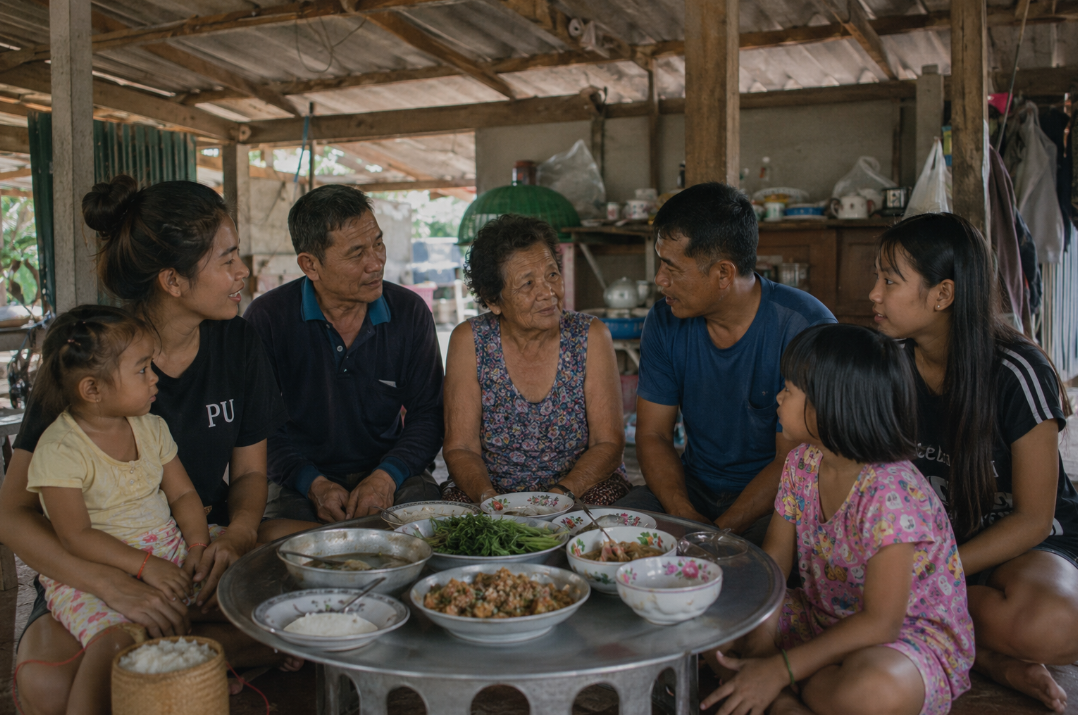
According to traditional Thai social structures (which are still taught in standard Thai school curriculums), daughters do not leave. The eldest daughter brings a husband into the parents’ house. They live there and take care of the elders until the next daughter marries. Eventually, the youngest daughter inherits the family home, taking on the absolute duty of caring for the parents until their last breath. Even if a daughter divorces, she simply returns to her parents’ house with her children and continues to care for the elders.
For a poor farming family barely making ends meet, multiple daughters mean multiple safety nets.
The “Mia Farang” Macroeconomics
This brings us to the “Mia Farang” (Foreigner’s Wife) phenomenon. The women you see working in the bars of Pattaya are not rebelling against their culture. They are executing its deepest mandate on a hyper-capitalist, global scale.
They are doing exactly what Isan daughters have done for centuries—providing for the elders—they are just using Western currency instead of rice harvests.
This isn’t a theory; it is a macroeconomic pillar. According to a landmark study by Khon Kaen University, foreign husbands and sponsors transfer approximately 8.67 billion baht annually directly into the Isan region. The National Economic and Social Development Council (NESDC) once estimated that remittances from Isan women involved with foreigners made up around 6% of the entire region’s GDP.
(Disclaimer: Wealthy, ethnic Chinese-Thai families in Bangkok, driven by Confucian traditions, still strongly prefer boys to carry on the family business. But they are not the ones staffing the bars and massage parlors of this city).
The Brutal Conclusion
So, to answer the subscriber’s question: Yes. In the brutal economics of the provinces, a family with three daughters has a financial rescue plan. A family with three sons just has a massive upcoming bill for three dowries.
When you see a girl in a Pattaya bar sending 50% of her earnings back to her village, you aren’t just looking at a transaction. You are looking at an ancient matriarchal survival system adapting to the modern world.
Leave a Reply