Songkran in Pattaya smells like warm talcum powder, wet asphalt, and stale beer. For a fifteen-year-old boy dragged up from the quiet back-roads of Isan by his family to visit his older sister, it wasn’t a holiday; it was an alien planet.
They had come down to the coast because the sister had left for the neon lights three years ago with a vague promise of working in a “hotel.”
That’s how he ended up standing in the lobby of a mid-tier Jomtien condominium, paralyzed by the sheer vertigo of it all. Back home in the village, the horizon was defined by flat rice paddies and the rusted frame of his uncle’s old tractor. Here, the horizon was a vertical wall of tinted glass, air-conditioning units dripping relentless condensation, and a rooftop swimming pool that mirrored the blinding neon sky.
For a kid whose primary life ambition was finally assembling the Lego technic set his sister had mailed him for his birthday four months ago—a box still sitting half-opened and gathering dust on a wooden shelf back home—the city felt loud, rich, and dangerously fast.
The shock deepened upstairs in the condo. His sister’s “fiancé” was a sunburned European man in his late fifties, wandering around the apartment completely shirtless, his belly soft like dough, holding a lukewarm can of Chang. While the adults shouted pleasantries over the roar of the hallway traffic, the foreigner noticed the boy staring blankly at a flat-screen television. With a grunt, he tossed a PlayStation controller across the sofa.
The boy pressed a button. The graphics exploded into life. It was a world of high-definition destruction and speed he had only ever seen on cracked mobile phone screens in the village. He sat there, frozen in total, spellbound awe, while a grown man from halfway across the world casually funded the electricity bill that kept the console running.
Later that afternoon, reality hit the pavement.
The family was walking near the Jomtien beachfront, dodging water-guns and ice-water buckets, when a brand-new pastel-green Vespa scooter cut aggressively through the Songkran traffic. On the front seat, steering with effortless, cynical familiarity, was Mint—the nineteen-year-old girl from his village back home, four years older than him, whom he had hopelessly, silently worshipped all through school. Clinging tightly to her waist was a scrawny, middle-aged foreigner, his scalp peeling from the sun. She didn’t look back, didn’t wave, and didn’t belong to the village anymore. She was a ghost in a tourist town, moving at a speed his family’s rusted pickup truck could never touch.
The trip ended, the water dried up, and they returned north. But the village looked different now.
Two days after getting back, the quiet of the school holidays hung heavy over the province. The afternoon heat was thick, still, and suffocating.
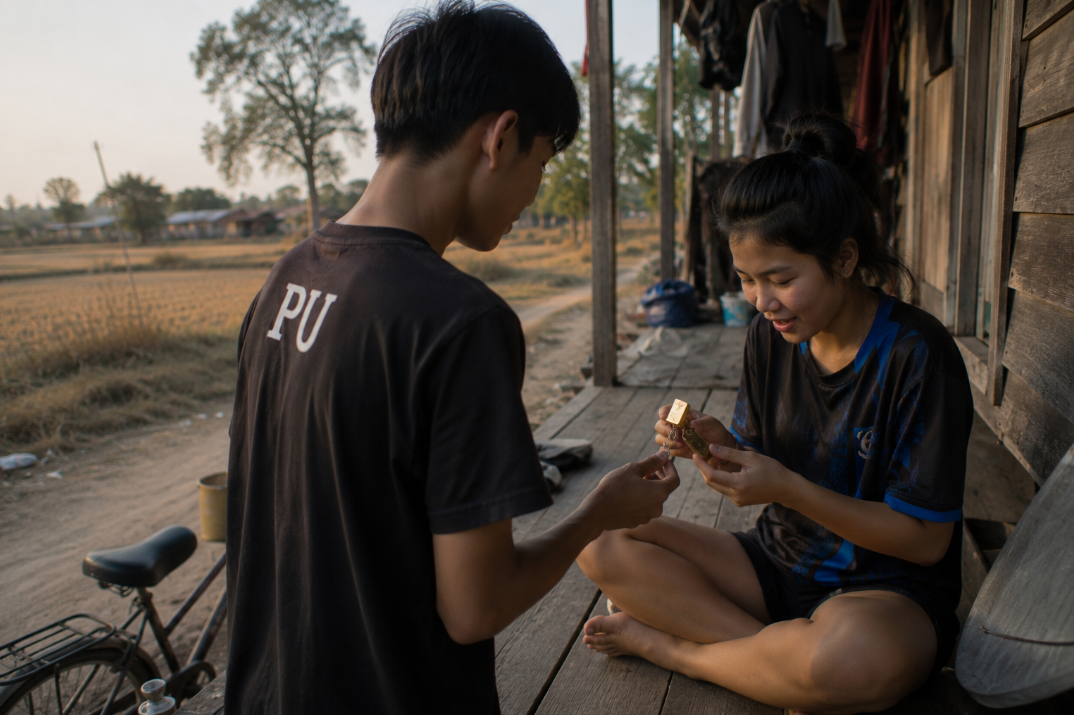
He kicked the stand up on his rusted bicycle and pedaled down the dusty dirt track toward the edge of the village to visit Baifern, his fourteen-year-old school girlfriend. He found her sitting on the shaded wooden porch of her house, staring down at a cracked, ancient smartphone with a shattered screen, its display flickering with faded colors.
He leaned his bike against the fence, stepped up the stairs, his heart hammering against his ribs, carrying a small, neat plastic pouch. Inside was a sleek, imported silver lighter and a heavy, gold-plated keychain—items the shirtless European in the Jomtien condo had absentmindedly tossed into a drawer and told him to “take, whatever, kid.”
He handed it to her, adjusting the collar of his shirt with feigned nonchalance.
“What is this?” Baifern’s eyes widened, her fingers tracing the foreign brand printed on the plastic wrapping. “Where did you even get this?”
The boy looked out over the dry, sun-bleached rice fields, swallowed hard, and let the machinery of the ecosystem take over his voice.
“From the city,” he said, staring right into her eyes with the practiced, effortless confidence of a man who owned a condominium and a Vespa. “You’re different from the others here. I’m going to take care of you. I’ll always spoil you like this.”
Baifern gasped, a sudden, bright smile breaking across her face as she clutched the foreign trinket to her chest.
In the neon jungle of the coast, it takes decades to learn how the machine works. But in the dust of an Isan village, it takes a fifteen-year-old boy about two seconds to realize that the script writes itself.
Leave a Reply