Nid, 48 — Düsseldorf, Germany
The heavy porcelain plate on the oak dining table holds a massive portion of Schweinebraten and potato dumplings, but Nid is barely looking at it. Her smartphone is propped against a salt shaker, displaying a pixelated video feed of a tin-roofed patio in Surin. Her niece has just given birth and is currently eating a fiercely red plate of Som Tum with raw fermented crab. Nid watches the screen, her mouth watering, and sighs in rapid Isan dialect. She would give absolutely anything for that crab right now, but her husband, Hans, refuses to let her fly to Thailand until the weather turns. She promises to come for Songkran, bringing the usual tribute: duty-free Chanel perfume and Swiss chocolate. The conversation shifts to the newborn. The father is a farang who has already stopped answering calls. Nid’s face hardens into a mask of pure, pragmatic survival. “Don’t worry,” she tells her niece. “The first one abandoned me too, but look at my house now. Demand the child support. Tell him you know where his embassy is and that you will make a scene he cannot afford. Squeeze him.”
Dao, 52 — Naklua, Pattaya
The doctor at Bangkok Hospital Pattaya was incredibly explicit about the varicose veins, strictly forbidding footwear over an inch high. Dao ignores the throbbing in her calves, shifts her weight in her four-inch stilettos, and adjusts the suffocating elastic corset digging violently into her ribs. She has just finished convincing a 38-year-old Russian tourist that she recently turned 42. It worked. He bought her three tequila shots in rapid succession. She can feel her heart hammering against the corset. She is supposed to be monitoring her hypertension, taking the little white pills every morning. But if her blood pressure spikes and she has to sit at home, she will miss the next tuition installment for her youngest son’s university in Bangkok. She pastes on a luminous smile, swallows the lime, and asks the Russian if he wants to play pool.
Mam, 42 — Soi Ko Phai, Pattaya
The heavy Ford Ranger aggressively mounts the curb outside a glowing Thai host club. Mam kills the engine, steps out, and effortlessly tosses the heavy fob to her security guard. “Grab the liquor boxes from the car,” she orders. “Yes, boss,” he barks, sprinting to the tailgate. Walking inside, she spots two farangs looking slightly lost at a front table—a rarity in a hardcore local pub. She approaches, offers a flawless, respectful wai, and thanks them for coming. Noticing their whiskey, she snaps her fingers at a waiter, ordering a beer tower to their table on the house. She retreats to a dark corner booth, pulling out invoices to calculate tomorrow’s ice and mixer deliveries. Her phone vibrates. It’s her primary sponsor in Chicago. She answers, instantly softening her voice into a higher, sweeter register. “So busy, tee-rak. In the club, many people.” Just then, one of the expats approaches her booth with a full glass of beer to thank her. Mam stares at him, says “I will call you right back” into the phone, seamlessly drops the helpless-girl persona, and raises her glass with the cold, confident smile of an apex predator.
Phon, 49 — Surin Province
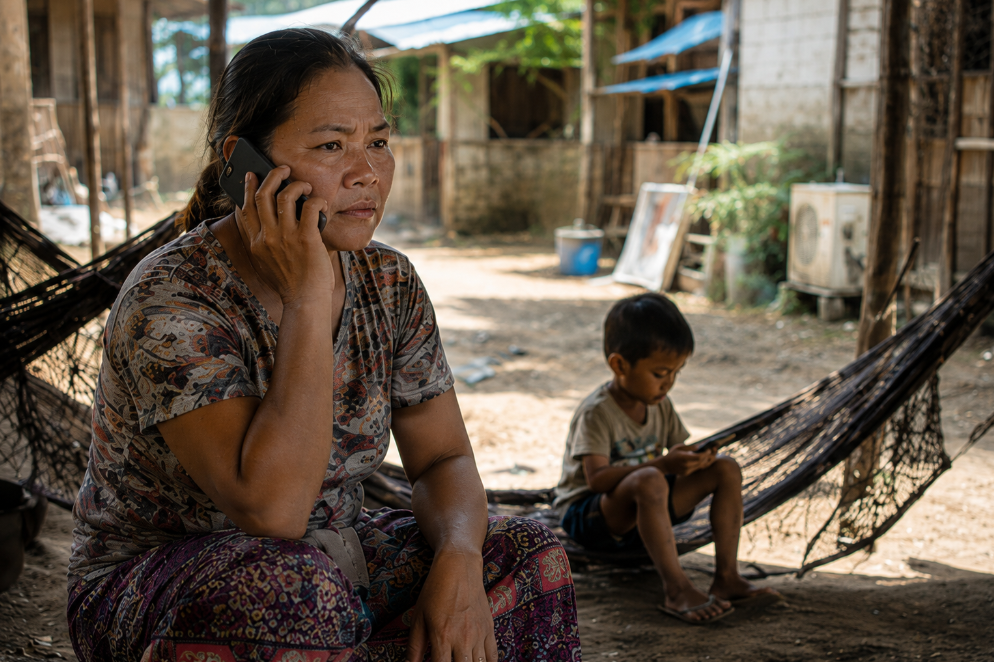
The air is thick with afternoon dust and the smell of burning sugar cane. Phon’s back aches as she finally manages to rock her daughter’s one-and-a-half-year-old baby to sleep in the hanging fabric hammock. Across the cracked concrete floor, her older grandson sits glassy-eyed, endlessly scrolling on a cracked smartphone. Phon wipes the sweat from her neck, picks up her own phone, and dials her daughter. “Where are you? At work?” she snaps. “Don’t forget to transfer the 3,000 baht today. The youngest is out of diapers and milk powder.” A pause. Her daughter is making excuses about a slow season. Phon’s voice turns into a whip. “What do you mean you don’t know? If you don’t know, then come back here and watch your own children, and I will pack my bags and go back to work in Pattaya. When I was working on the street, you never lacked for anything!” She hangs up, staring into the glaring Isan sun, trapped in the exact same cycle she spent twenty years trying to escape.
Joy, 55 — Pratumnak Hill, Pattaya
She sits on the balcony of a pristine 20th-floor condo, pouring a very expensive glass of Australian Shiraz. At her feet, a meticulously groomed Pomeranian chews on a designer squeaky toy. Joy did everything right. She didn’t gamble, she didn’t support a village of lazy brothers, and she didn’t fall in love. She bought two condos in Jomtien and one in Pratumnak, living quietly off the rental yields. Her bank accounts are full. Yet, as she looks out over the neon grid glowing below, the silence of her apartment is deafening. Her phone has not rung in four days. The only people who ever reach out to her are distant relatives asking for loans, or real estate agents trying to sell her a new off-plan development. She successfully bought her way out of the industry, only to realize she purchased a fortress with no doors.
The neon grid never actually lets anyone go; it simply changes the currency it demands. What unites these women is not their past, but the permanent, invisible scars left by the survival mechanics they were forced to master. Some escaped to Europe, some built businesses, some retreated to the village, and some are still agonizingly pacing the bar floor. But there is no universal, triumphant exit. They simply traded one set of profound compromises for another, forever carrying the ghost of the city in their blood pressure, their bank transfers, and the quiet, terrifying moments before they fall asleep.
Leave a Reply