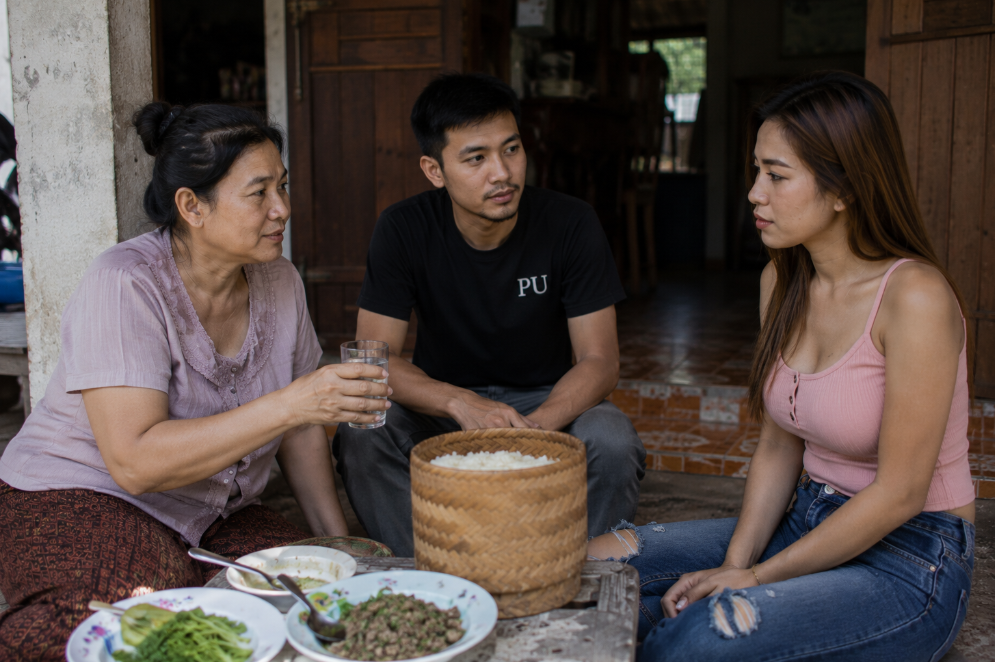
Wut held his breath as they stepped onto the tiled porch of his childhood home in Udon Thani. Standing next to him was Dao. Six years ago, she was the most beautiful girl in their high school, the one who gently rejected his awkward teenage advances before packing a cheap suitcase and disappearing into the neon machinery of Pattaya. His mother already knew everything. She didn’t need Wut to confess; the rural village gossip network operates with terrifying speed and precision. She knew exactly where Dao had been, and exactly how she had funded the new concrete wall around her parents’ house.
The heavy wooden door opened. His mother stepped out, her face completely unreadable. She looked at Dao. She looked at her son. Then, she walked over to the cooler, poured a glass of ice water, and handed it to the guest.
“Kin khao rue yang?” she asked. Have you eaten yet?
If this scene were written in a Western script, it would demand a dramatic, explosive confrontation. The Western narrative of the industry relies heavily on the concept of the permanent scarlet letter—inevitable rejection, an unbridgeable moral divide, and a permanently shattered family. But the reality on the ground often operates on a completely different frequency.
In the academic paper Thai bar girls and farang: A customized inter-cultural professional services market, researchers analyzed focus group data to understand how society views a sex worker’s ability to transition into marriage. Their tentative conclusion suggests a profound cultural divergence: Thai society generally believes that sex workers can, and do, get married, facilitated by a relative lack of severe or lasting social stigma. It is crucial to be honest with the data—this is a localized focus group study, not an absolute, nationwide statistical law. But it perfectly captures the quiet pragmatism of the Thai working class.
This acceptance is deeply rooted in local psychological architecture. It traces back to the concept of bunkhun—filial piety and profound gratitude. Dao didn’t go to Pattaya to abandon her family; she went into the trenches to save them. In the eyes of the village, her sacrifice was a brutal, grueling form of duty. Furthermore, Thai culture draws a distinct line between Na (social face) and Kyat (inner honor). Dao may have temporarily sacrificed her Na under the strobe lights of the city, but to those who truly understand the economic gravity of the province, her Kyat remains entirely intact because her motives were rooted in family survival.
Sitting at the kitchen table, Wut’s mother didn’t deliver a moral lecture. She didn’t demand a tearful confession about her years on the coast. Instead, she asked if Dao knew how to manage a household budget. She asked if she was ready to settle down and take care of her son. The past simply did not surface in the conversation—not because it was a suffocating, unspeakable taboo, but because it was entirely irrelevant to the immediate transaction of building a family’s future.
This is not to romanticize the situation or claim it is a universal guarantee. Walk three houses down the road, and you might find a mother who would scream, throw the glass of water, and burn the bridge forever, terrified of the neighborhood shame. The stigma absolutely exists, and the fear of losing face can still tear families apart.
But the Western narrative of eternal, inescapable ruin is not the only truth. Thai society is infinitely more complex than a rigid, black-and-white moral binary. Wut’s mother is neither a progressive hero nor naively blind. She is simply looking at her future daughter-in-law through a different coordinate system—a worldview where the question of “what did she do to survive yesterday” is far less important than “what kind of wife and mother will she be tomorrow.”
Leave a Reply