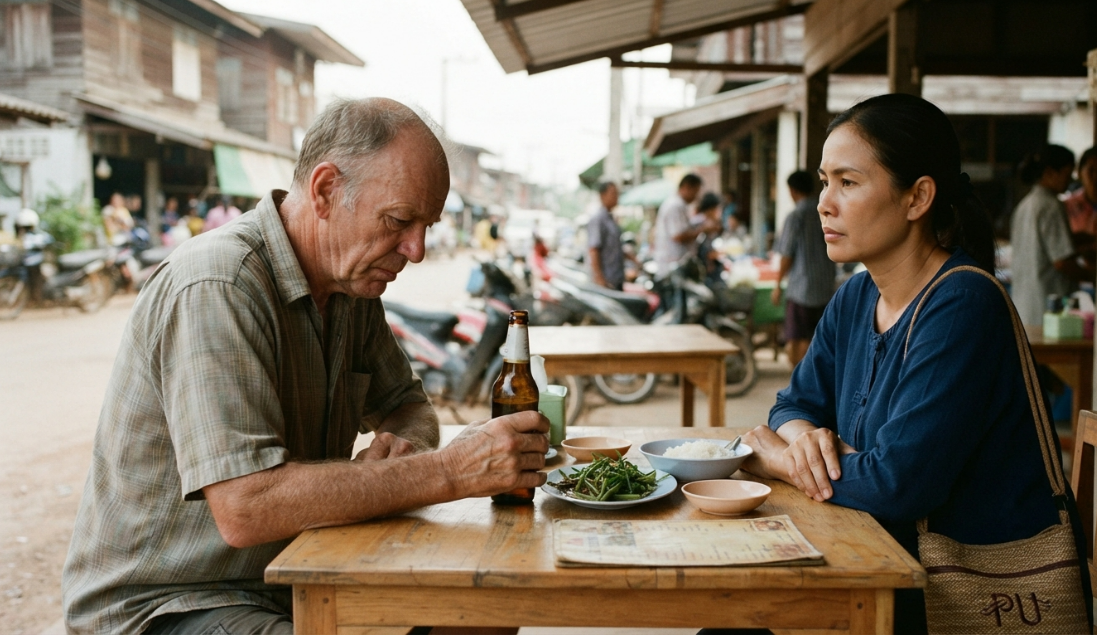
The most exhausted cliché on the neon grid is the tragic tale of the naive Western man systematically drained by a cunning Thai bar girl. It is a story repeated on every barstool from Walking Street to Jomtien. But what if the fundamental premise of this narrative is backwards? What if the root of the widespread disappointment isn’t the women who allegedly deceive, but the men who arrive with a deeply flawed psychological calculation from the very first day?
Look at the actual demographic reality, stripped of the victim complex. Field studies analyzing the health and sociology of Western husbands in Isan paint a very specific, data-backed portrait. These are largely men of retirement age, often carrying the heavy baggage of non-communicable diseases and, crucially, unresolved mental health struggles from back home. Many arrive bruised by brutal divorces, financial settlements, and a profound loss of agency in their previous lives.
The calculation they make upon landing is deeply human, if ultimately misguided. A pension that barely covers heating and rent in a dreary Western suburb suddenly translates into perceived absolute power in a developing economy. The unspoken equation seems simple: leverage a modest income to secure a compliant, submissive, perpetually grateful partner. They are not looking for an equal; they are looking to buy back the authority, peace, and ego they feel they were stripped of.
The grand irony of the city is their catastrophic misjudgment of the women they target. A traumatized expat walks into a bar looking for a docile, naive village girl to mold into a quiet caretaker. Instead, he sits down across from the spiritual descendant of Ya Mo—the legendary heroine of Korat who famously orchestrated the defeat of an invading army. The women of this region do not inherit a culture of learned helplessness; they inherit a brutal, generational grit built on surviving droughts, poverty, and systemic inequality.
The woman across the table is not a submissive blank slate. She is operating on a highly sophisticated strategy of hypergamy and bun khun—the absolute cultural obligation to financially sustain her family. While he thinks he is mesmerizing her, she is actively scanning him for red flags, cross-referencing his behavior in private social media groups designed to out abusive or broke expats. She is almost always more financially ruthless, socially hardened, and emotionally resilient than the man trying to “save” her.
This is exactly why the internet is choked with bitter, cautionary tales. It is not because “all Thai women are scammers.” It is because asymmetric expectations are destined to violently collapse. A man seeking an obedient emotional dependent will always feel betrayed when he realizes he has actually partnered with a pragmatic, hardened strategist operating her own unyielding agenda. The famous “Pattaya disappointment” is merely the sound of a fragile fantasy of control shattering against concrete reality.
There are, of course, thousands of foreigners who build deeply functional, mutually respectful partnerships here. This is one specific archetype, not a universal diagnosis. But it is an undeniably massive pillar of the local ecosystem.
Perhaps the endless debate over who is scamming whom in Pattaya is the wrong question entirely. The more accurate question is much colder: when these two worlds finally collide, which person actually sat down at the table with a realistic understanding of exactly who they were dealing with?
Leave a Reply