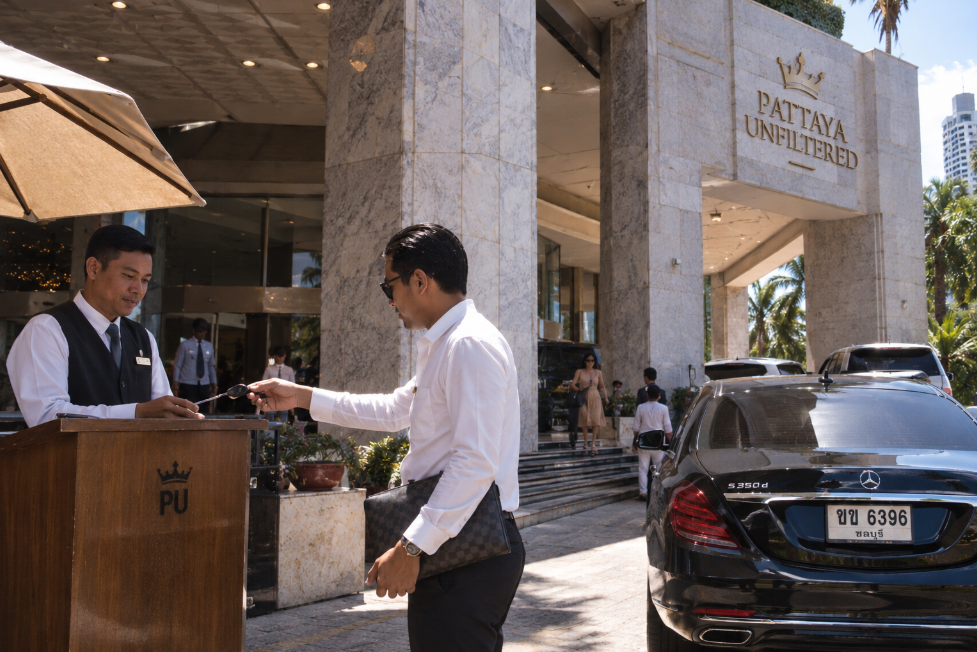
Spend a few years in Pattaya or Sukhumvit, and you start believing you understand the mechanics of Thai adult nightlife. You learn the geometry of the beer bar, the pulsing rhythm of the go-go, the transactional weight of a lady drink, and the exact economics of a bar fine. You learn to navigate the neon grid where women stand shoulder-to-shoulder on the pavement, competing for the attention of passing strangers.
You think you know how the machine works.
The strange, almost unsettling reality is that much of this sprawling, neon-soaked system wasn’t originally designed for Thai men at all. It was engineered specifically to meet the psychological and logistical expectations of Western tourists.
Running parallel to this highly visible, street-level ecosystem is an entirely different, traditionally Thai-oriented adult entertainment infrastructure. It is an industry built on different architecture, different billing systems, and entirely different concepts of status and privacy. It features massive concrete buildings, hushed lobbies, glass walls, private rooms, and hostesses whose time is measured by the hour, not the drink. In some of these venues, you might not see a single foreign customer all night.
Because while the farang system sells movement—bouncing from one open-air bar to another—the Thai system sells the room.
THE FISHBOWL (Aab Ob Nuat)
To understand the classic Thai model, you have to leave the chaotic pedestrian streets of Pattaya and look at the massive, fortress-like complexes that historically dominated Bangkok corridors like Ratchadaphisek, Rama 9, and New Phetchaburi.
You don’t casually stroll into an aab ob nuat (literally: bathe-bake-massage, or “soapy” massage). You arrive purposefully, handing your keys to a valet at a massive, multi-story building that looks more like a 1990s corporate hotel than a nightlife venue. Inside the air-conditioned lobby, there is no pounding street music or aggressive hawking. Instead, there is the tu pla—the “fishbowl.” Behind a massive pane of glass, dozens of young women sit on tiered seating, each wearing a numbered badge. The customer selects a number, and the transaction moves immediately behind closed doors into a private suite equipped with a large bathtub and a bed.
The mega-complexes of the golden era (like the now-closed Emmanuelle) were sprawling entertainment hubs featuring restaurants, massive VIP karaoke suites, and jacuzzis. While the industry has shrunk, massive venues like Colonze and Poseidon still operate today. Currently, the starting price for a standard room and service at these major Ratchada-area establishments typically ranges from 2,500 to 5,000+ baht, depending on the tier of the woman selected.
This model exists in Pattaya too, hidden in plain sight. Establishments operating on this classic “soapy” model (historically clustered around Soi Honey and a few larger complexes) currently range from 1,500 to 5,000 baht. But because they are housed inside large buildings rather than spilling out onto the street, the average foreign tourist barely registers their existence.
(A necessary legal distinction: Do not confuse an aab ob nuat with a legal brothel. Thailand has spent decades perfecting the art of making everyone understand exactly what kind of establishment they have entered without necessarily putting the same thing on the paperwork. Bath and massage venues operate under specific, regulated business licenses. Commercial prostitution remains formally illegal under the Prevention and Suppression of Prostitution Act of 1996. What a customer assumes happens behind a locked door, and what the venue legally sells, are two different things.)
THE PRIVATE KARAOKE ROOM
When a Western tourist hears “karaoke,” they picture a sticky dive bar, an open microphone, and a drunk friend murdering Hotel California in front of fifty strangers.
In Thai nightlife, the karaoke model is entirely different. It is built around a private room, a bottle of whiskey, mixers, food, and the dek nang drink—literally, “girls who sit and drink.” A group of Thai men will book a room, and hostesses will join them to pour drinks, sing, talk, and maintain the atmosphere. There is no public stage. Everything happens within the closed ecosystem of the private room.
The billing here is entirely different from the Pattaya lady-drink model. In these venues, customers usually pay for the hostesses’ time. Billing systems vary wildly across the country.
Crucially, the presence of a dek nang drink does not automatically equate to commercial sex. While some illegal operations are regularly raided for trafficking and prostitution, many karaoke lounges are exactly what they claim to be: private rooms where men pay for female company, conversation, and singing, and the transaction ends there.
THE PREMIUM G-CLUB
If you want to see the sharpest contrast to the Pattaya beer bar, look at the premium Thai Gentlemen’s Clubs (G-Clubs) in Bangkok.
The farang model is based on low friction: buy a cheap beer, buy a lady drink, see where the night goes. The G-Club model is built on high minimum spends and structured exclusivity. You arrive with friends, you book a table or a private party room, you open premium bottles, and you hire PR hostesses by the hour.
To understand the economics, look at the publicly listed 2026 prices for a massive, well-known G-Club in Bangkok:
Minimum spend at a standard table/bar: 3,000 baht per person.
Bottle service begins around 6,000 baht.
A standard PR hostess costs 2,000 baht for the first hour (and 1,000 baht for each subsequent hour).
Dancers/models cost 3,000 baht for the first hour.
Private VIP rooms range from 3,500 to 10,000 baht, often requiring a minimum number of hostesses to be booked.
(Note: These are current prices from one specific major club, not a national tariff. However, they perfectly illustrate the structural difference).
The club’s own official guide explicitly states that they do not use the lady-drink system. You are paying strictly for the woman’s time at your table. It is a model designed for local businessmen and elites to entertain clients and friends in a highly controlled, high-status environment.
THE LOCAL THAI GO-GO
Even when Thai men do frequent go-go bars, the atmosphere is often distinct from Walking Street. In Bangkok areas like Saphan Kwai, traditional Thai-oriented go-gos still exist. These venues are generally darker, older, and cater strictly to a local, working-class or middle-class male demographic. The music is heavily focused on Thai country (Luk Thung) or local pop-rock, the comedic interactions are entirely in Thai, and the foreign presence is negligible. The core mechanic of dancing and tipping remains, but the cultural frequency is entirely different from the hyper-commercialized, English-speaking tourist traps of lower Sukhumvit.
WHAT HAPPENS IF A FARANG WALKS IN?
So, what happens if a Westerner decides to bypass the tourist grid and walk into one of these Thai-centric venues?
In the large, established venues, nothing bad happens at all. Many of them actively welcome foreign money. One massive soapy complex explicitly notes “Foreigners Accepted” on its directories (though warning that English is limited), and another major venue runs a fully English website. Premium G-Clubs heavily market to affluent foreigners, with their own guides on how to request an English-speaking hostess. And no, there is no reliable, verifiable rule that a foreigner automatically pays a secret “farang price” at the door of major establishments.
But if a foreigner wanders into a small, deeply local provincial karaoke joint without understanding the rules, the friction begins.
There will likely be zero English spoken. The concept of buying a single beer and sitting at a bar might not exist. And, most dangerously, the foreigner may not understand the hourly billing system. In July 2026, two British tourists in Chiang Mai made headlines when they refused to pay a staggering 150,000-baht bill after a night in a local karaoke lounge. The venue explained the math: the tourists had ordered almost every hostess in the building, at 700 baht an hour, for five continuous hours. It wasn’t necessarily a scam; it was a catastrophic misunderstanding of a business model they didn’t know they were participating in.
A farang can live in Pattaya for ten years. He can know the exact price of a lady drink in fifty different bars. He can know exactly which go-go on Walking Street just changed management, which soi gets busy at 1 AM on a Friday, and exactly how much a bar fine costs before midnight.
And he can still know absolutely nothing about the adult nightlife built for Thai men.
Because what most foreigners confidently call “Thai nightlife” is often something else entirely. It is just the specific, narrow sliver of Thai nightlife that was built for them.
Leave a Reply