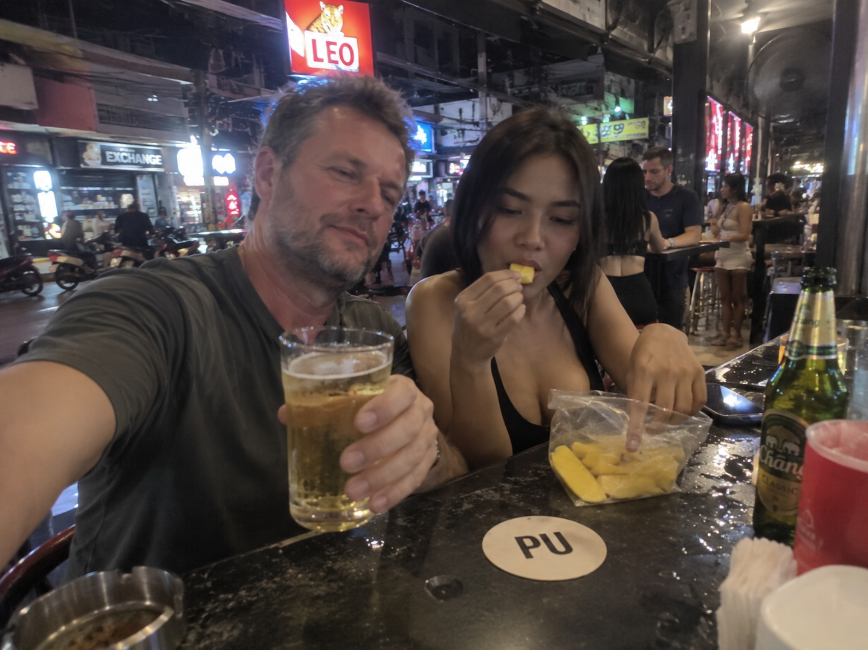
Eight o’clock in the evening. A bar on one of the most infamous Sois on earth. Two British guys, both pushing fifty, are sitting at the counter. One of them is with a girl who just brought him a fresh beer. As she sets it down, he hands her a small plastic bag—sliced mango he bought off a street cart on his way over. She smiles genuinely, says thank you, and wanders off to eat it.
The second guy stares at him. There is a heavy pause. Then, a caustic smirk spreads across his face.
“Are you serious, mate? You bought her a mango? What’s next, you gonna wash her knickers for her?”
The first guy shrugs. The cynic doubles down.
“Would you buy a chocolate bar for your plumber? You pay for her time. She does a job. Stop trying to turn a rental into a romance.”
The first guy doesn’t answer. He just stares at his beer, not wanting to argue. But something in his expression shifts.
The “plumber” argument is a Pattaya classic. But it’s not actually about plumbing, and it’s certainly not about economics. It is a psychological Kevlar vest. The man loudly deploying this logic is terrified of three specific things.
First: Being played. If the interaction is strictly a business contract, he cannot be scammed. Contracts do not have feelings, which means they do not carry the risk of emotional pain. Pain is exactly what he flew six thousand miles to escape.
Second: Looking weak. In the expat ecosystem, catching feelings for a bar worker is not a compliment. It is a terminal diagnosis. It is the ultimate loss of face among the barstool brotherhood, the kind of thing whispered behind your back when you go to the bathroom.
Third: Admitting he actually wants affection. Not just sex, and not just company. Care. He wants someone to ask if he has eaten today. He wants someone to smile at him not because the Mamasan is watching, but because they are actually glad to see him. But admitting that makes him vulnerable. So, he reduces a living, breathing human being to a household utility. You can’t be betrayed by a pipe. You just pay the invoice.
The problem with the plumber analogy is that it collapses under its own weight the second you actually look at it.
People who champion “real relationships” usually counter with, “She’s not a plumber, she’s a human with feelings!” That is true, but it’s a weak argument. Let’s assume the cynic is right. Let’s assume she is just doing her job.
First off, your plumber doesn’t hold your hand while you fall asleep. Your plumber doesn’t remember that you hate ice in your beer. Your plumber doesn’t laugh at your terrible jokes, and he certainly doesn’t look at you with that specific, quiet exhaustion that says, I wish I was somewhere else too. That is emotional labor. It requires human bandwidth. Even if it is entirely transactional, it leaves a mark on both people.
Secondly, a plumber fixes the sink and leaves. He doesn’t linger in your head. He doesn’t text you three days later to see if the faucet is dripping. He doesn’t remember what you told him about your estranged daughter. A bar girl stays. Maybe not physically, but she stays in your habits, in your phone, and in your head.
And lastly, no one in the history of humanity has ever sat at a bar in tears, staring at an empty stool, mourning the departure of the bloke who unclogged their U-bend. Nobody keeps a plumber’s number saved in their phone for a year knowing they will never call it. But they do it for bar girls every single day.
Transactional logic—”I pay, I receive”—works flawlessly in a supermarket or a garage. It fails spectacularly in human interactions because humans are not inventory.
If it’s truly just a mechanical exchange of cash for services, why do you go back to the exact same girl? Why not the girl next to her? Why not a different bar entirely? Why do you remember her name, and why does she remember yours?
If it is just business, why do you feel a hollow drop in your stomach when she walks away to entertain a new customer? You got exactly what you paid for. You knew the terms and conditions. So why the sudden emptiness?
Because you didn’t buy a service. You bought a connection. A connection might start with a price tag, but it cannot be contained by one. When you try to force a human bond into the rigid box of a plumbing invoice, you aren’t outsmarting the system. You are only fooling yourself.
The guy spouting the “plumber” theory isn’t protecting his wallet. He is desperately protecting his fragile ego. If it’s just a transaction, he is invincible. He can walk away anytime. He is “free.” But he doesn’t feel free. He feels completely isolated, and he resents the women in the bars for constantly reminding him of it.
The guy who bought the mango isn’t a naive idiot. He just isn’t ruled by fear. He understands that a transaction and genuine warmth are not mutually exclusive. He knows you can pay for someone’s time and still enjoy their smile. He knows the brutal rules of the game and chooses to play it with a shred of humanity anyway. He isn’t a victim. He just figured out how to exist in this city without turning into a robot.
An hour later, the cynic pays his tab, nods to the bartender, and walks out into the humid night. He strolls down Soi alone. He has a receipt in his pocket, but he doesn’t look at it.
The first guy is still sitting at the counter. The girl is sitting next to him, eating the mango out of the plastic bag. She offers him a piece. He takes it, and she smiles.
Outside, the cynic turns into a quiet alleyway. He stops, pulls out his smartphone, opens a dating app, and starts swiping.
Leave a Reply