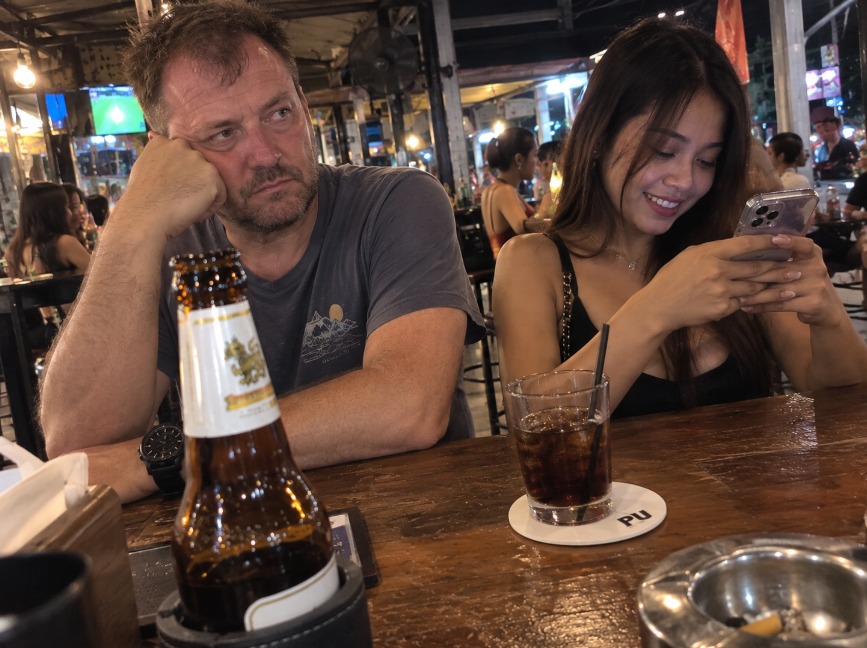
It is nine o’clock in the evening at an open-air bar on Soi 7, and a forty-five-year-old man is sitting on a stool trying to understand why his money has suddenly stopped working. He buys a lady drink for the Thai woman sitting next to him. She accepts it, takes a polite sip, and immediately goes back to scrolling on her smartphone. When he tries to strike up a conversation, she gives him a thin smile, murmurs a quick apology, and returns her attention to the screen.
Assuming the first drink wasn’t enough to secure her interest, he orders her a second. She accepts it again, resting her hand on the cold glass without taking a sip. A notification lights up her phone, and she smiles—a genuine, bright reaction meant for a man in an entirely different time zone, not the one sitting two feet away from her.
For decades, the transactional rules of Pattaya were incredibly simple and universally understood. You walked into a bar, picked a girl, and bought her a drink. In exchange, she sat next to you, laughed at your jokes, held your hand, and provided the illusion of desire. It was never about genuine romance; it was an unspoken commercial contract. The man paid for a specific role to be played, and the woman performed it. The ecosystem thrived on this exact exchange.
But that fundamental rule has been quietly rewritten, and the transition is leaving a lot of traditional farangs deeply frustrated.
Women in the nightlife industry simply don’t play the old game anymore, not because they have suddenly become cynical, but because they finally have leverage. Armed with smartphones and digital sponsors sending money, they are no longer entirely dependent on the immediate cash of the guy sitting right in front of them. You are no longer the only option in the room; you are just one of a dozen men in her LINE chat history. If she doesn’t find you interesting, she no longer feels obligated to fake it. She will take your drink, but she won’t deliver the girlfriend experience you assume you just purchased.
When observers look at this dynamic, they immediately want to assign blame. They want to call her a greedy scammer or label him an entitled creep. But the reality of the grid is much more nuanced, and neither of them is actually the villain.
The man at the bar isn’t at fault. He grew up in an era where the old operating system worked flawlessly. He didn’t study the shifting microeconomics of the city or read the latest expat forums. He just flew in, walked into a bar, and expected the transaction to function exactly as it did ten years ago. When she ignores him, he doesn’t think she is just disinterested; his transactional mind tells him he is being robbed. He genuinely believes that if you pay for a service and don’t receive it, you are being scammed. He doesn’t realize that her attention is no longer a guaranteed commodity.
From her perspective, the interaction is purely pragmatic. Faking enthusiasm for a stranger is exhausting emotional labor, and she simply doesn’t want to expend that energy tonight. The nature of her job has fundamentally shifted. Previously, the job was to aggressively entertain. Today, the job is often just to physically occupy the space—to sit at the counter and wait until the customer figures out the new rules or finally leaves. She isn’t trying to be rude or malicious. She is just physically present while her mind is thousands of miles away, focused on the digital sponsor who actually pays her rent.
Eventually, the man finishes the last warm sip of his beer. Defeated and confused, he leaves a crumpled banknote on the counter and stands up.
She doesn’t look up from her screen. She doesn’t ask him to come back tomorrow, and she doesn’t thank him for the drinks. He walks out onto the crowded street, having no idea that the city he remembers no longer exists.
Back inside, she casually picks up his empty glass and wipes down the sticky counter with a cloth. The next client walks in and takes a seat. She looks up, flashes a polite smile, and welcomes him to the bar, perfectly adapted to a new reality where a 150-baht drink doesn’t buy anything except the drink itself.

Leave a Reply