I. The Accidental Metamorphosis
If you sit long enough at a corner bar on Soi Buakhao and ask the veterans how they ended up living in Pattaya for two decades, you will never hear a story of a calculated, grand relocation. No one packs their bags in Manchester or Munich with a master plan to abandon their homeland forever.
It always starts with a thirty-day stamp. Then it becomes a three-month tourist visa. Then the winter back home looks a little too grey, a little too unforgiving, so they decide to skip the flight. Just this once.
The locals who work in the ecosystem—the bartenders, the motorcycle taxi drivers, the laundry women—watch this metamorphosis happen in real-time. They see the frantic, sunburned energy of a two-week tourist slowly dissolve into the slow, shuffling gait of a permanent resident. The wardrobe fades from bright vacation shirts to washed-out singlets. The Thai locals don’t act surprised. They have seen the gravity of this city pull thousands of men into its orbit. They just quietly observe the inertia taking hold.
II. The Lie of the Return Ticket
“I’m heading back after this season.” “Just one more year to figure things out.”
You hear these phrases constantly. The expat isn’t actively lying to his friends back home, and he isn’t lying to himself. He just possesses an absolute inability to visualize his return.
He imagines stepping off a plane into the freezing rain of a country that has entirely moved on without him. A country where everything is violently expensive, where the culture feels alien, and where no one is waiting for him. The thought induces a quiet, paralyzing panic. So, he delays. The Thai people around him hear the promises of departure. They know the script by heart. They never argue. They just nod politely and pour another drink, knowing perfectly well he will be sitting on the exact same stool next November.
III. The Currency of Visibility
To understand why they never leave, you have to understand the brutal mathematics of aging in the West.
Back in his home country, he is a retired mechanic or a divorced accountant. He is invisible. Society has designated him as irrelevant. He walks down the street and no one makes eye contact.
But here? On his specific corner of the grid, he is somebody. He is “Mr. John” or “Mr. Dave.” People greet him when he walks out of his condo. The waitresses know how he likes his coffee. The security guard salutes him.
Logically, he knows the dark secret behind this respect: it is largely transactional. It exists because he holds the money. But when a man is starving for human connection and relevance, he will gladly pay the market rate. A transactional smile in the warm Thai sun is infinitely better than slowly freezing to death as a ghost in your own country. The currency of visibility is the most addictive substance in Pattaya.
IV. The Glass Wall of Belonging
After ten or fifteen years, a dangerous psychological illusion sets in.
He speaks conversational Thai. He eats brutally spicy Isaan food with his hands. He is married to a local woman, pays for her nephew’s schooling, and helped build a concrete wall around her family’s house in the province. In his own mind, he has crossed the threshold. He believes he has assimilated. He thinks this is his home.
But in the complex, ancient architecture of Thai society, he is, and will always be, a farang.
This is not a malicious insult, nor is it conscious racism. It is simply the rigid structural reality of a culture built entirely on bloodlines, unspoken hierarchy, and generational networks of obligation. A foreigner cannot just insert himself into this web. He is a satellite orbiting the culture, not a part of its core.
The Thai locals understand this invisible wall perfectly. They also know that explaining it to him would break his heart and shatter the illusion he has paid so much to build. So, out of profound cultural politeness, they say nothing. And the expat, out of psychological necessity, chooses to believe the silence means acceptance.
V. The Final Rest
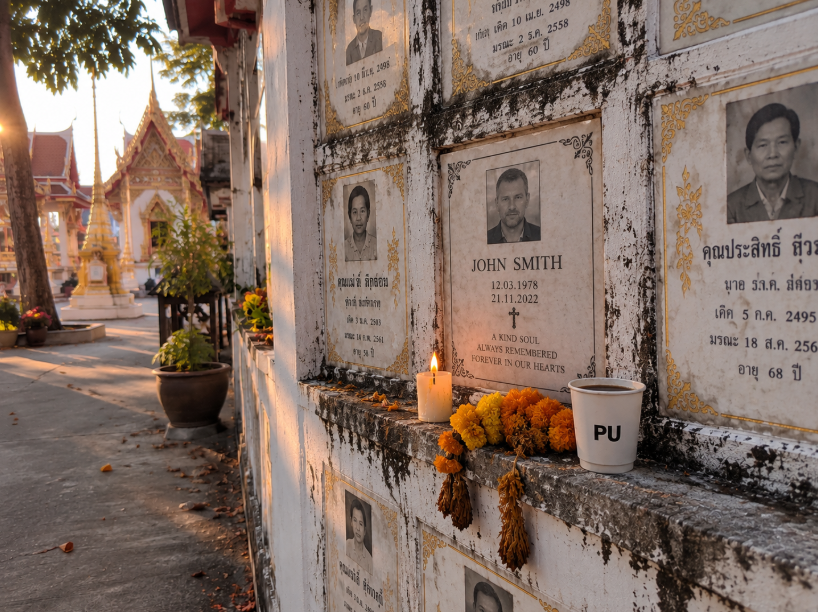
This silent agreement continues right up to the very end. The ultimate proof of the city’s gravitational pull isn’t found in the bars; it is found in the quiet, shaded courtyards of the local Buddhist temples.
Far away from the neon lights, set into the weathered concrete walls of the Wat, you will find small, square memorial plaques containing ashes. Among the Thai script, you will suddenly see them. Small golden squares etched with English letters.
Thomas from Berlin. Richard from London.
Men who chose not to return home, even in death. They preferred to have their names written in a language the local monks cannot read, resting in a soil that never truly claimed them as its own. It is the final, permanent realization of the expat bargain: you can stay here forever, but you will always be a guest.
Leave a Reply