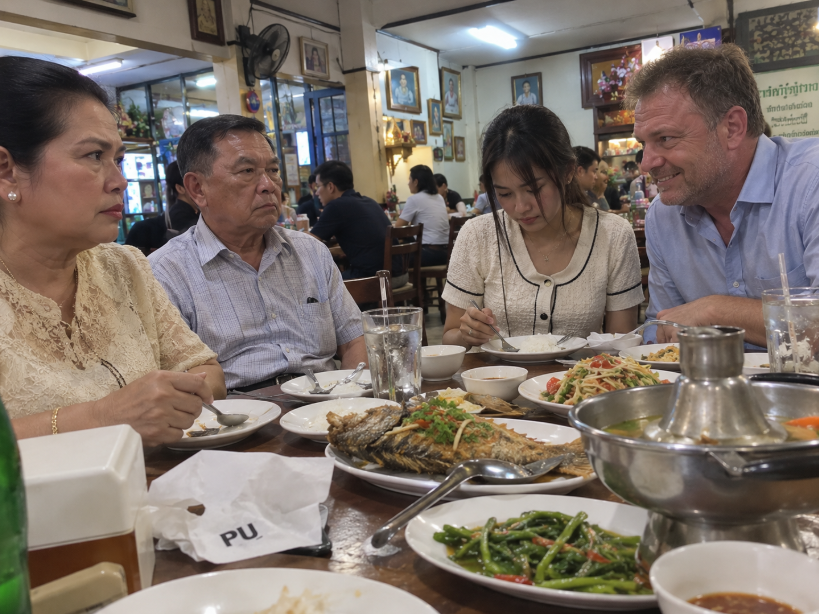
There is a deeply ingrained myth that floats around the expat bars, passed down from one generation of bar stools to the next: Every Thai woman secretly wants to marry a Westerner.
It is easy to believe this when your entire understanding of Thailand is confined to a three-kilometer radius of Walking Street. Inside the neon grid, where financial survival is the only metric that matters, a foreign passport and a pension represent ultimate stability.
But step outside that highly specific ecosystem. Walk into the world of the Thai middle class, the government workers, the university graduates, and the local business owners. Suddenly, the Western passport loses its magic. In fact, it often becomes a liability.
Many Western men experience a brutal reality check when they try to date outside the nightlife industry. They are shocked to discover that traditional Thai parents do not want their daughter marrying a farang. Even if he is wealthy. Even if he is kind, loyal, and treats her like a queen.
The Western man thinks his character and his bank account should be enough. But he fundamentally misunderstands the architecture of a traditional Thai marriage.
In the West, marriage is the romantic union of two individuals. In Thailand, marriage is a corporate merger between two families. It is an alliance designed to increase the social capital, stability, and Naa Taa (face) of both bloodlines.
A wealthy Westerner brings financial capital, but he brings absolutely zero social capital.
He operates entirely outside the Thai network. If the family business runs into a licensing issue, the farang son-in-law cannot call a cousin in the local police force to smooth it out. If a nephew needs a recommendation for a prestigious school, the farang cannot pull strings at the Ministry of Education. He doesn’t understand the intricate, unspoken rules of Thai hierarchy, patronage, and obligation.
To a traditional Thai family, a son-in-law who is a mid-level Thai police officer with a modest salary is infinitely more valuable than a retired European engineer with a million dollars in the bank. The police officer brings protection, status, and a web of useful connections. The farang just brings money. And in the complex ecosystem of Thai society, money without connections is fragile.
Furthermore, a farang disrupts the social harmony. At weddings, funerals, and merit-making ceremonies, he doesn’t know how to navigate the subtle dance of who to Wai first, how low to bow, or how to properly address the village elders. He is a permanent outsider, a well-meaning bull in a cultural china shop. For parents who value social standing among their peers above all else, having a son-in-law who cannot integrate is a constant, exhausting loss of face.
The realization is a bitter pill for many expats to swallow. They arrive expecting to be the ultimate prize, only to find out that in the real Thai economy of status and connections, they are completely unbankable.
Leave a Reply