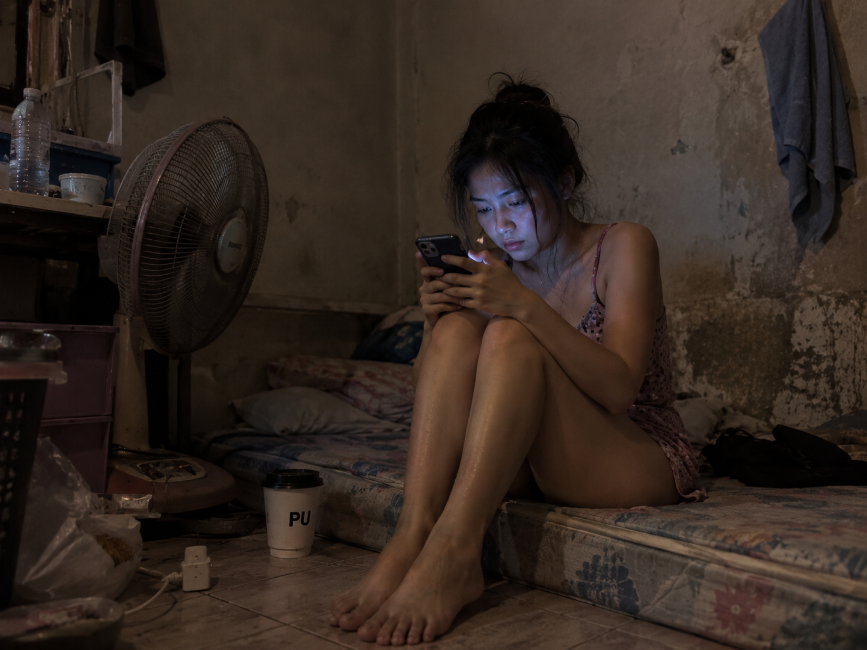
The reality of her life unfolds in a cramped, windowless room somewhere in the labyrinth of Pattaya, far removed from the pristine condos rented by the men she meets. There is only a spinning floor fan pushing warm air across a thin mattress on the floor, a damp towel hanging from a solitary nail, and a plastic water bottle sitting on a windowsill that faces a blank concrete wall. She sits with her knees pulled tightly to her chest, her face illuminated only by the glow of a cheap smartphone. On the screen, two little girls—no older than four and two—are laughing and waving at the camera. They have no idea where their mother is or what she actually does; they only know the comforting sound of her voice through the tinny speaker. She watches them without shedding a single tear and without cracking a smile. She simply watches, turns the screen off, sits in the heavy silence, and then turns it back on again.
This isn’t another tragic, romanticized tale of a naive village girl seduced by the bright lights of the big city. It is the cold, calculated reality of a twenty-two-year-old mother who was forced to make an agonizing choice because the only alternative was watching her children starve. She isn’t a passive victim of circumstance, but a pragmatist executing a necessary, brutal decision. Back in her village in Isaan, rice is treated as a currency and generational debt is the baseline condition of existence. She already tried the socially acceptable route, spending her days on a sweltering factory floor for twelve hours at a time, earning a meager three hundred baht a day. That kind of money doesn’t even cover baby formula, let alone secure a future. When someone finally told her that she could earn real money in Pattaya, they didn’t promise her it would be easy or glamorous. They just told her it was possible. So she packed her bags.
Her nightly routine on the neon grid is an exercise in profound emotional detachment. When she sits in the bar, flashing a practiced smile and asking tourists where they are from, she is simply running a script. She listens to stories she couldn’t care less about, laughs at punchlines she has heard a thousand times, and holds the hands of men she feels absolutely nothing for. She drinks the sugary lady drinks not out of thirst, but because every glass represents a commission, and every commission is another transfer sent back home. When she leaves with a client, she simply turns off the switch in her head, dissociates from the physical reality, and does exactly what is required. She doesn’t keep a tally of the men. She only counts the nights left in the month, calculating exactly how much she needs to hit her target so she can eventually escape back to her real life.
It is incredibly easy, and deeply insulting, for outsiders to pity her. She doesn’t need sympathy, and she certainly isn’t selling her soul. She is a mother doing whatever it takes to feed her daughters. She knows perfectly well how the expats judge her, what the neighbors in her village whisper behind her back, and how polite society views her profession. She knows all of it, yet she walks into that bar every single night because her pride is entirely secondary to her children’s survival. It isn’t some beautiful, poetic sacrifice; it is just grueling, relentless, humiliating work.
She refuses to cry herself to sleep because breaking down is a luxury she simply cannot afford. If she shatters, she can’t work, and if she doesn’t work, her family doesn’t eat. Instead, she actively erases the clients from her memory the second they leave the room. The only images she allows her mind to retain are the faces of her girls. She doesn’t hate herself, because self-hatred requires the kind of time and emotional energy she doesn’t possess. Her entire existence is narrowed down to a singular, desperate cycle: earn, transfer, return, and hug.
The hardest moment of her life wasn’t walking into a bar, but sitting on the night bus leaving her province. She remembers staring blankly out the window, refusing to look back at her daughters standing in the dirt. She knew that if she looked back, she would have stayed, and poverty would have slowly consumed them all. Her youngest daughter had held her hand right before she boarded, genuinely believing her mother was just going to a normal job. As the bus pulled away, she held her breath, knowing that if she let a single tear fall, she would demand the driver stop the bus, rendering the entire agonizing ordeal meaningless.
She doesn’t ask the world for understanding or forgiveness. She only ever offers one devastating explanation for her life: “I didn’t want to work like this. If I had a choice, who would want to be looked down upon?” It is a question that requires no answer, because the reality is that nobody wants this life, but someone had to step up and ensure those two little girls survived.
As morning breaks, she is back in her suffocating room. She watches the video of her daughters one last time before the screen goes dark. She takes a shower, lies down on the mattress, and closes her eyes. In just a few hours, the cycle will begin again. She will put on her makeup, step out into the neon glare, and smile as if she doesn’t have a care in the world.
Leave a Reply