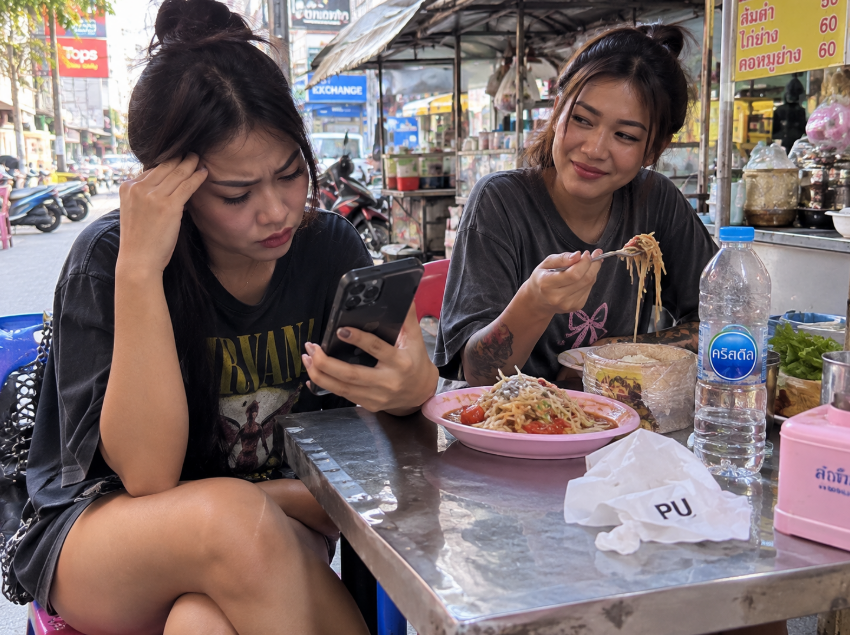
If you want to understand the actual mechanics of the grid, you have to stop listening to what the workers say while they are on the clock, and start listening to what they say to each other over a bowl of som tum at four in the morning.
If you sit quietly on the periphery of these late-night, off-duty conversations, you will repeatedly hear a very specific mantra.
“Mai yak mee faen. Puat hua.” (I don’t want a boyfriend. It’s a headache.)
“Mee faen, mee panha. Mai mee faen, mai mee panha.” (Have a boyfriend, have problems. No boyfriend, no problems.)
To the newly arrived Western tourist, this sounds completely counterintuitive. The prevailing myth on the streets is that every woman in the industry is desperately hunting for a wealthy foreign husband to rescue her. But the seasoned veterans of the ecosystem know the brutal truth: for a working girl, a relationship is rarely a fairy tale. It is a massive, exhausting, administrative nightmare.
The root of this puat hua (headache) is simple: the Western man is fundamentally incapable of separating her work from her personal life.
When a farang “claims” a girl in the industry, his ego immediately demands exclusivity in a completely non-exclusive economy. He expects her to behave like a traditional suburban girlfriend while she is standing in a place designed to extract money from men. He texts her incessantly during her shift. He demands video calls to prove she is alone in her room. He interrogates her about which customer bought her lady drinks and gets furiously jealous over men he will never even meet.
For the woman, this isn’t romance. It is unpaid emotional labor. Working in a bar is already grueling—smiling until your jaw aches, drinking on an empty stomach, and managing the unpredictable moods of strangers. Returning to her phone to manage the fragile ego and raging paranoia of a jealous Western boyfriend is a second full-time job. It is the ultimate puat hua. It is much easier, and far more profitable, to remain single, collect the bar fines, and sleep in total peace.
But there is always the exception.
There is always the farang who insists. The one who refuses to be just another customer. During his two-week vacation, he launches a relentless campaign to prove he is “not like the other guys.” He buys her out of the bar every night just so she doesn’t have to work. He pays her rent. He listens. He suppresses his jealousy and plays the role of the incredibly understanding, stable savior.
Eventually, worn down by his persistence and the promise of financial security, she yields. She agrees to be his faen (girlfriend).
The Western man celebrates. He thinks he has won the ultimate prize. He finally got exactly what he wanted. What he doesn’t realize yet is that he didn’t actually want this. He wanted the idea of her. He has no idea that he just inherited the village debts, the complex family politics of Isaan, and the heavy, suffocating weight of being her sole financial pillar.
And what about the girls who do actively seek out relationships? The ones who aggressively push for the “boyfriend” title from day one?
The locals read this dynamic flawlessly. When an industry worker is aggressively hunting for a relationship, she isn’t looking for love. She is looking for a retreat.
She is burned out. She is sick of the neon lights, sick of the tequila, and physically exhausted by the grind of the grid. She doesn’t want a soulmate; she needs a fully-funded sabbatical. The enthusiastic tourist who thinks he just found a fiercely loyal partner is actually just financing a six-month mental health break for a tired worker.
The ecosystem always balances itself. The tourist gets the immersive illusion of importance he flew across the world to find. And the girl? She either avoids the headache entirely, or she finds a guy willing to pay enough to make the headache worthwhile.
Leave a Reply