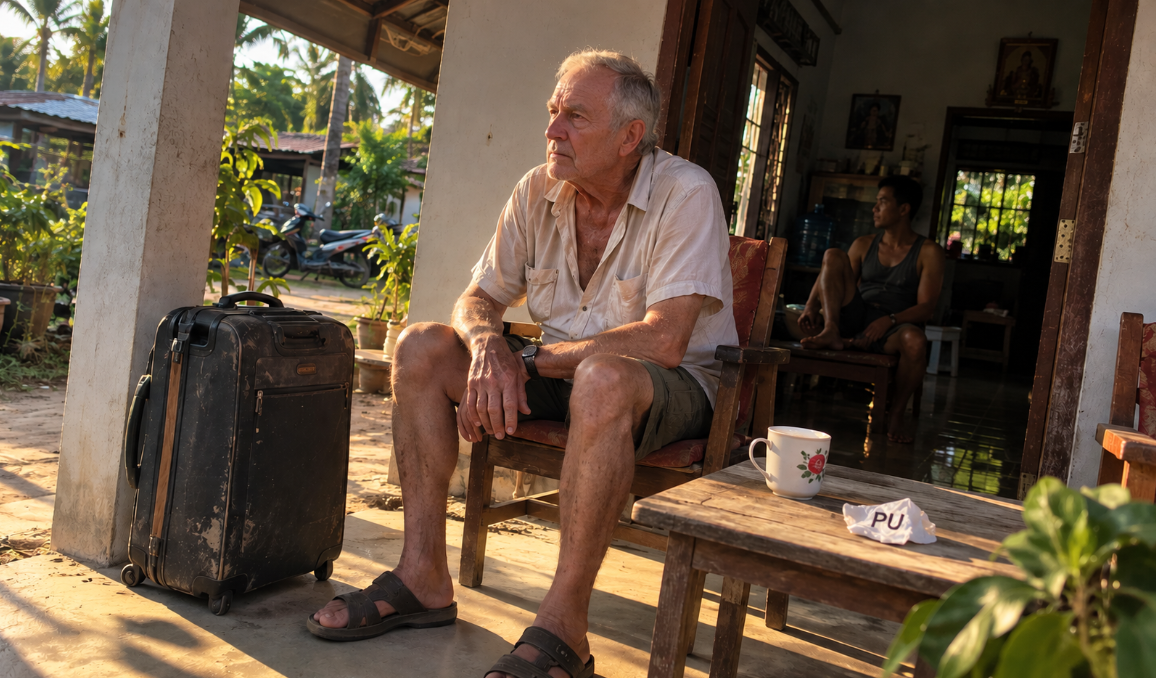
It has been three months since the funeral in Udon Thani. Werner sits on the veranda of a concrete house with a terracotta roof. He planted the garden himself. In front of him sits a cup of tea. The tea has gone cold.
In the yard stands his wife’s nephew. Werner remembers him as a child. The boy is a man now, and he has come to “help.” He doesn’t say anything directly. The Thai language is a masterclass in polite omission. He says, “Uncle, if you need help with the documents…” He says, “Auntie would want everything to be done legally.” He says, “We don’t want any problems.”
He doesn’t say, “It is time for you to leave.”
But the message is deafening in the pauses. It is in the way the nephew surveys the house. It is in the way the family already knows where the keys are kept and how the appliances work.
Werner looks at him. He understands. He always understood, deep down. He just hoped they wouldn’t touch him. He hoped he would die before she did. He hoped twenty years of marriage actually meant something on paper. He hoped she had left him something.
She didn’t. Or she did, but it wasn’t enough to stop the legal machinery.
Here is the brutal, emotionless fact that the expat forums try to ignore: a foreigner cannot own land in Thailand. This is not a strong suggestion; it is the law. Land can only be registered in the name of a Thai citizen.
When a Thai wife dies, the land becomes part of her estate. By law, her heirs are her family. A foreign husband is also an heir, but with a massive, fatal caveat: he cannot retain ownership of the land. He has up to one year to dispose of it, meaning the land eventually transitions to the Thai heirs or is sold.
In practice, the transition rarely involves lawyers showing up with eviction notices. Nobody tells you to get out. Instead, the relatives simply return. Politely. Gradually. First, they come “to visit.” Then they come “to help.” Then they “stay for a while.”
Before he realizes what has happened, the man who paid for every brick of the house is now just a guest. And nobody tells a guest when it is time to leave, because nobody knows exactly how to say it.
He was not expelled. He was simply rendered redundant. Slowly. Politely. Permanently.
This is not a tragic accident. It is a predictable pattern on the grid. Western men arrive in Thailand later in life. They have lived full lives in Australia or Europe. They are tired. They want peace. They find a woman, and they build a house—usually in her home province, far away from the neon lights of Pattaya. They believe it is their home because they wired the funds. They believe it is their home because she smiled and called it “our house.”
But legally, it is not. Legally, it is her land. Her inheritance. Her family’s asset.
These men don’t prepare for this. They don’t understand that a marriage certificate is not a shield against property laws. They think, “We are together, so everything is shared.” In Thailand, it is not shared. It is hers. And she is mortal.
The natural reaction of a reader is to hate the Thai family. It is a convenient narrative to call them greedy or heartless. It is also fundamentally untrue.
The relatives are not evil. They respect him. They remember that he helped build the house. They don’t want to violently throw him onto the street. They simply want what belongs to them by law, by tradition, and by right.
They don’t order him to leave. They wait. They wait with terrifying, polite patience. They arrive. They occupy the space. They orchestrate the environment so that he eventually comes to the realization himself. No screaming. No conflict. Total preservation of face for everyone involved.
This is not cruelty. It is the system functioning exactly as designed. And in this system, there is no place for him. Not because they don’t love him, but because he is a foreigner. And foreigners do not have a right to the land, even if they built the house, even if they buried their wife in the soil, even if they have nowhere else to go.
Returning “home” is an illusion. Werner thinks of Germany sometimes, usually in the middle of the night. He imagines the airport, the taxi, an apartment. But what apartment? He sold his flat decades ago. His brother is dead. His sister is in a nursing home. His old friends are busy with their grandchildren and their pensions. Life continued without him. He fell out of the orbit.
Germany is no longer home; it is just a place where people speak a familiar language. A home requires people who are waiting for you. Nobody is waiting for him. Not here. Not there.
He didn’t burn his bridges. He just let them slowly rot while he was busy loving a woman and building a house in Udon Thani.
It is evening now. Werner stands on the veranda of a house that is no longer his. Inside, his wife’s nephew and the nephew’s wife are eating dinner. They politely invited him to join. He told them he wasn’t hungry.
He looks at the garden, at the trees he planted twenty years ago. They have grown tall. They will remain here. He will leave.
He takes his phone out of his pocket and opens a photo of his wife. She is smiling. He looks at her face and thinks, “Did you know?” He will never know the answer.
He puts the phone away and walks into the bedroom he still instinctively calls his own. He begins to pack. He doesn’t have many possessions. He arrived in Thailand with a single suitcase. He will leave with a single suitcase. Two decades of a life, compressed into 20 kilos of luggage.
On the table, next to the cold tea, is a small cardboard coaster with a dark “PU” logo. It is from a bar in Pattaya where they met twenty years ago. He doesn’t throw it away. He places it in his suitcase. He is going back to where it all started, to try and begin again.
Leave a Reply