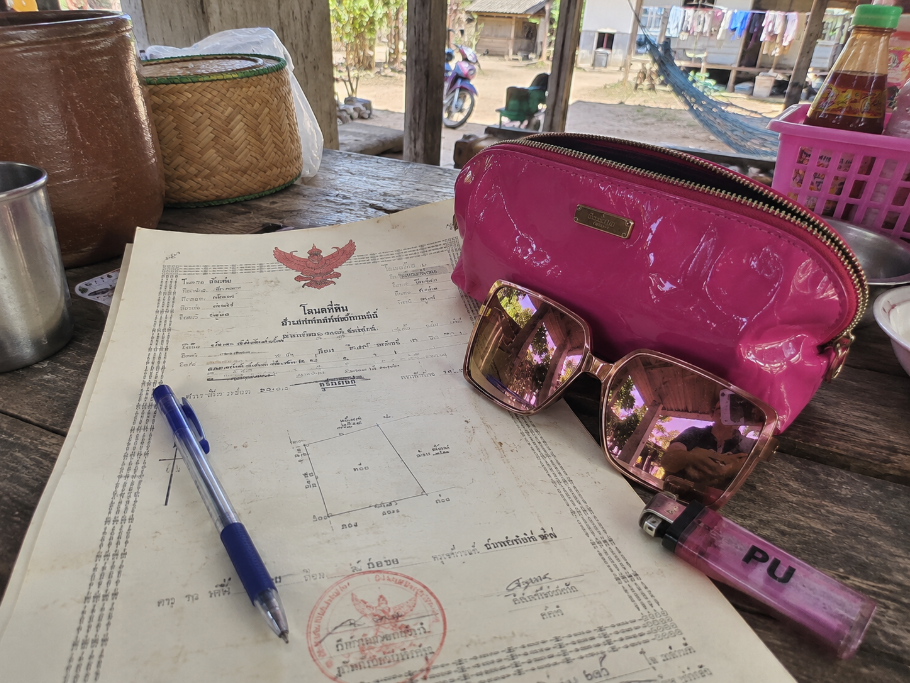
It is midday in a dusty village outside Mukdahan. A woman in her late forties sits on a shaded wooden veranda, ignoring the heavy heat. On the table next to her sits a smartphone displaying a photo of her daughter smiling in Pattaya, framed by blurred neon lights, a table full of beer bottles, and a foreign man in a short-sleeved button-down shirt. The mother doesn’t stare at the photo for long; her eyes are fixed on the paperwork in front of her. It’s a bank contract. The plot of land that belonged to her family for forty years is being leveraged to the absolute limit. She signs the paper, not because she wants to, but because she knows the daughter working in that neon-lit “hotel” will wire the money to cover the interest. She puts the pen down, looks out at the dry rice fields that can no longer feed them, and texts her daughter: Thank you. We will manage. She doesn’t cry. She is just used to the math.
The entire migration pipeline from the quiet roads of Mukdahan to the bar stools of Pattaya—and occasionally, onward to the freezing suburbs of Europe—is not driven by simple poverty. It is driven by a highly structured, multi-generational financial chokehold. It starts with the family debt, usually a loan taken against the only asset they own: the land. When the rice fails for the third year in a row, the bank comes to collect, and the family faces total ruin. Then comes the second layer: the cultural debt, known as bunkhun. In Thai culture, gratitude to your parents is not a warm metaphor; it is a strict, inescapable financial obligation. The traditional rural gender role dictates that the daughter is the ultimate breadwinner, meaning she doesn’t send money home because she is feeling generous—she sends it because she is morally indentured. And she isn’t just funding survival. She is funding the family’s “face.” The money pays for the grandmother’s medicine, but it also pays for the new air conditioner and the flat-screen TV, because looking poor in the village is social death.
When the land can no longer produce a crop, the daughter simply replaces the asset. Women from Isaan use their bodies following the exact same economic logic their grandmothers used to farm the soil. The land was an asset to be leased, worked, and harvested for cash. When you have no land, no formal education, and no safety net, your body becomes the only viable real estate you can leverage. This isn’t tragedy; it is brutal, rational economics. The wage gap dictates the terms of reality: a woman in Mukdahan might make 330 baht for a grueling day of physical labor, whereas a sex worker on the grid in Pattaya can easily pull in 50,000 baht a month. She isn’t a “fallen woman” making extra pocket money for herself; she is the localized social security system for an entire extended family that the state has completely abandoned.
Sociologists studying this specific demographic have a term for it that completely shifts the narrative away from Western morality: indentured sex-work migration. It breaks the tired binary of the woman being either a helpless trafficking victim or an empowered feminist making a free choice. The reality is a third option. She knows exactly where she is going. She knows exactly what the job entails. She calculates the risk, understands the price, and signs the invisible contract because she simply has no other alternative. The family invests the daughter, and the daughter returns the capital. It is a family business plan that is incredibly cruel, yet flawlessly effective.
Even when the business plan succeeds—when the debt is paid, the concrete house is built, the land is bought back, and maybe she even secures a foreign sponsor who takes her overseas to continue the cycle in euros—the transaction is never truly free. She eventually comes home, but the cost of the payout is permanent. She has seen things she cannot unsee, done things she cannot forget, and endured a psychological grind that permanently alters her baseline of reality. She bought the family’s land back, but she had to sell herself to do it.
Evening falls over the village. The daughter is back for a two-week visit, sitting on the veranda, smiling as she talks about her “hotel job” in Pattaya and the nice foreign man who treats her so well. The mother just listens, nodding and smiling, actively choosing never to ask a single clarifying question. On the table inside, the documents prove the land is secure. The new air conditioner is humming loudly on the wall. The neighbors are suitably envious. Everything is perfectly fine.
The mother looks at her daughter and sees herself twenty years ago. She wants to say something, but saying it out loud would require acknowledging the truth, and acknowledging the truth would shatter the fragile illusion they have both sacrificed everything to build. Instead, she just picks up her phone and takes a photo of her daughter smiling. She puts the phone down and looks out at the green rice fields. The land has returned. The daughter has returned. But they both know that something else was left behind in Pattaya, and it is never coming back.
Leave a Reply