For two years, Thomas fought a war he was statistically guaranteed to lose.
His opponent was not a person. It was the collective financial black hole of a village in Sisaket. He was fighting the classic Isan windmill: the brother’s gambling debts, the mother’s mysterious medical bills, the roof that seemingly collapsed every rainy season, and the uncle’s broken tractor.
Thomas, a stubborn man from a culture that believes every problem has a solution, threw money at the windmill. He drained his savings, downgraded his condo, and stopped drinking imported beer. He did it all because he believed in the Western Hollywood transaction: if you sacrifice everything for a woman, eventually, she will break down, look deeply into your eyes, and confess her undying love.
But the woman he was fighting for, a twenty-six-year-old named Nam, refused to play the Hollywood script.
Whenever Thomas tried to talk about their feelings, looking for that verbal validation, Nam would just look at him with flat, exhausted eyes.
“Love is nothing, Thomas,” she told him once, counting out the cash he had just handed her for her mother’s electricity bill. “Love doesn’t buy rice. Love doesn’t fix the roof. Farang talk about love too much.”
This drove him insane. He was bleeding himself dry for her, and she wouldn’t even give him the basic courtesy of a romantic lie. He wanted the grand declaration. He wanted the validation that he wasn’t just another ATM, that his sacrifice actually meant something to her.
Then came a Tuesday in October.
Thomas was officially broke. The windmill had won. They were sitting on the balcony of his cheap apartment. He had just told her that the money was gone. There would be no more transfers to Sisaket. He couldn’t play the savior anymore. He waited for her to pack her bags. He waited for the cold Pattaya logic to kick in, where the money stops and the girl vanishes.
She didn’t pack her bags. She just sat there in the dark, looking at this stubborn, depleted foreigner who had fought her family’s greed until he had nothing left.
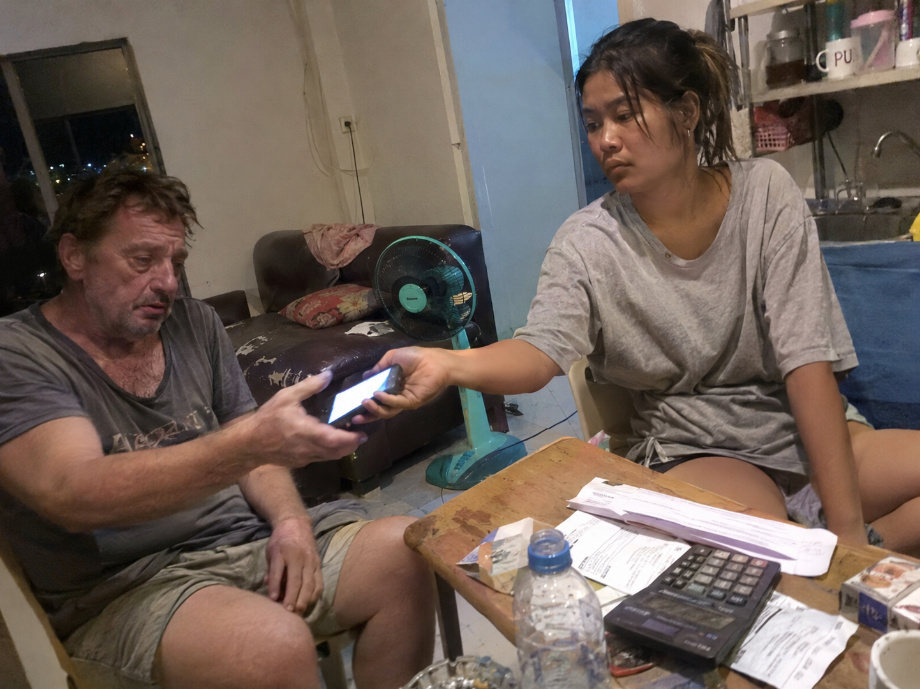
She leaned in, gently pulled his phone from his hand, and opened his Google Translate app. With slow, deliberate movements, she typed a short phrase in the curved, ancient script of her language:
คุณคือเนื้อคู่ของฉัน
She handed the phone back to him. Thomas looked down at the glowing screen. The app had roughly translated the Thai into English: Soulmate / Destined Partner.
Thomas sighed, putting the phone face down. He felt a wave of disappointment. To his Western mind, it sounded like cheap astrology. A horoscope word. It sounded passive. It wasn’t the passionate “I love you” he had spent two years and forty thousand dollars trying to buy. It felt like a consolation prize.
But Thomas didn’t understand the language of the city he lived in.
If you ask any working girl in Pattaya to say “I love you,” she won’t even blink. The English word “love,” and even the Thai word “rak”, are completely worthless currencies in this town. They are transactional barcodes. You scan them to get a free drink, to secure a monthly allowance, or to keep a sponsor happy.
Since she arrived in Pattaya at nineteen, Nam had said “I love you” to British retirees, Korean tourists, and German engineers. If you checked the chat logs on her phone, she had probably typed or said “I love you” exactly 1,481 times in her life. It was a reflex. It meant absolutely nothing.
But Neua Khoo (เนื้อคู่) is not a word you use in a bar.
It is an ancient, heavy, fatalistic concept rooted deeply in Thai Buddhism and animism. It doesn’t mean butterflies in your stomach. It means karma. It means that out of millions of souls, you and this person are bound together across past and future lives by an inescapable, invisible thread. It means you are tied to each other, for better or for worse, through poverty, suffering, and time.
Thomas sat in the dark, feeling unloved and defeated, completely unaware of the magnitude of what had just happened.
He didn’t get the Hollywood ending. But he got something much rarer. Nam had sold “I love you” 1,481 times to men who could afford it.
But she had only said Neua Khoo once in her entire life. And she gave it to a man who had absolutely nothing left to pay for it.
Leave a Reply