It is three in the morning inside a sterile short-time hotel room. The air conditioner is rattling faintly in the background. A sixty-year-old man is lying flat on his back, staring at the ceiling. Next to him is a thirty-year-old woman. They aren’t sleeping, and they aren’t touching.
He is talking. He’s talking about his estranged daughter, his brutal divorce, and how terrified he was to fly to Thailand because he thought the entire experience would make him feel dirty. She is just listening. She isn’t scrolling through her phone. She is looking directly at him.
The bar fine was already settled. The short-time rate is sitting securely in her purse. The transaction technically ended twenty minutes ago, and she has absolutely no financial obligation to stay awake for this. But she is listening anyway. She is exhausted, her feet hurt from the heels, but she listens because he is talking about the terrifying prospect of dying alone—something that quietly echoes in her own head. She doesn’t offer empty platitudes or fake a giggly smile. She simply rests her hand heavily on his shoulder. The room goes quiet. A minute later, his breathing slows, and he falls asleep. She lies there, staring at the same ceiling, not thinking about the money she just made. She is thinking about her own father, whom she hasn’t seen in five years.
There is a strange, quiet phenomenon on the neon grid that completely shatters the cynical logic of the veteran expat: genuine emotional intimacy often takes root directly inside relationships that were exclusively designed to be financial transactions. It isn’t a rare exception. It is a recurring pattern.
The money doesn’t magically disappear, but it fades into the background, making room for a connection that cannot be reduced to just sex or cash. This happens through three very specific mechanics. The first is time. A standard transaction is an hour. But when a customer returns three, four, five times, that hour stretches. He talks. She listens. It stops being a service and becomes a bridge. The second is vulnerability. The man is shielded by the fact that he is paying. He can confess his deepest fears, his shame, the things he could never tell his ex-wife, precisely because he knows this woman on the payroll won’t judge him. He opens up, and in return, she stops seeing a walking ATM and starts seeing a human being. The third is recognition. She remembers how he holds his glass, what he refuses to talk about, and the fact that he was actually kind to her when he didn’t have to be.
Western observers usually want to force this dynamic into two comfortable boxes: either he is a naive idiot buying fake love, or she is a ruthless predator faking a smile. Both versions are incredibly lazy.
He isn’t stupid. He knows exactly how the grid works, and he knows she is on the clock. But he feels something anyway, not because he is being scammed, but because he is profoundly lonely. Intimacy isn’t a commodity you can purchase, but it also isn’t a commodity that money prevents from forming. And she isn’t a predator. She is simply a woman doing a job, and doing a job doesn’t magically erase your humanity. She gets tired, she feels pity, and sometimes, despite all her rigid defenses, she actually gets attached. The paradox is that the transaction doesn’t prevent the intimacy; it frames it. The money creates a safe boundary, and inside that boundary, something real occasionally breathes.
But this grey zone is incredibly dangerous for both of them.
For her, catching feelings makes an already brutal job almost impossible to survive. If she actually cares, she can’t just switch her emotions off when the next customer buys her a drink. She knows that if she reveals her true attachment, he might use it against her, or worse, pack his bags and leave her completely broken. So she stays silent. She smiles, she goes to work, and she buries whatever real emotion she felt.
For him, the danger is believing that the frame has vanished entirely. The connection feels so intensely real that leaving the country becomes a psychological agony. He flies home to an empty house, constantly texting her, clinging to the memory of someone actually listening to him. He thinks it is true love. She won’t correct him. The feeling is real enough for him to survive another year in his cold reality.
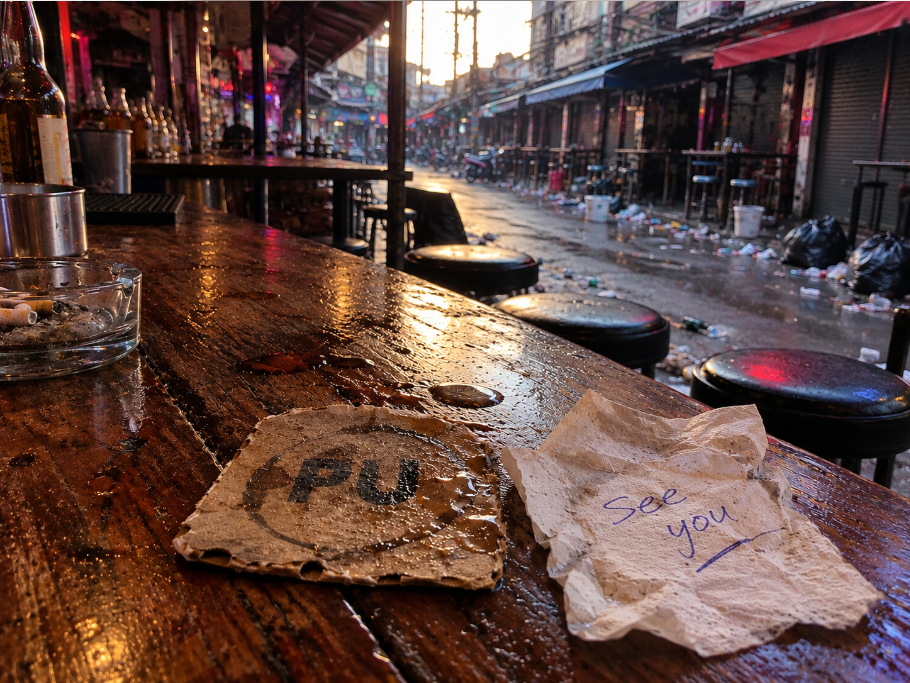
Morning breaks over Pattaya. He is still sleeping heavily. She quietly gathers her things, being careful not to wake him. She grabs a hotel pen and writes a quick note on a napkin. Not “thank you.” Not “goodbye.” Just See you.
She steps out onto Soi Buakhao. The street is dead, littered with empty bottles and exhausted motorcycle taxi drivers waiting by the curb. She climbs onto a bike, heading back to her cramped room, her mind already shifting back to the relentless rhythm of survival—she needs to sleep, she needs to eat, she needs to buy rice.
Back at the bar where she works, a cardboard coaster with a faded “PU” logo sits wet with condensation from the night before. No one has wiped the table yet. It will sit there until evening, and then it will be thrown away. Just like everything else on the grid.
But the man sleeping in the hotel won’t forget. He won’t necessarily remember her exact name or the shape of her face in a few years, but he will remember the profound, anchoring sensation that for one unpaid hour in the middle of the night, someone actually sat beside him and listened. It wasn’t a fairy tale romance. It was human proximity. It happened, it ended, and for a while, it was enough.
Leave a Reply