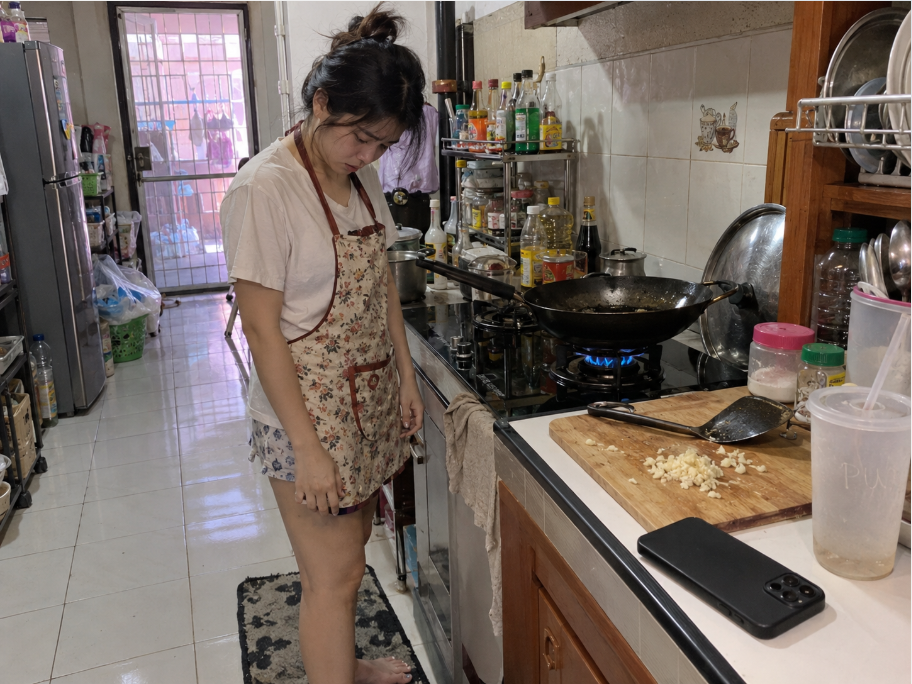
The townhouse smells like hot oil, holy basil, and garlic. There is a Honda City parked in the driveway, a five-year-old child sitting at a desk at a local school, and a mortgage that gets paid on the first of every month. It has been six full years since Nan walked out of a neon-lit go-go bar for the last time. She works a normal administrative job now, making 15,000 baht a month, and she quietly wires 10,000 of it straight back to her village in Isaan to fulfill her duty as a daughter. She insists on working because she knows Soren hates the endless financial demands of her family, and paying the village tax from her own meager salary is her way of shielding him.
They have built a completely normal, middle-class life. But you can leave Isaan, and yet Isaan never really leaves you.
Soren walks into the kitchen to grab a bottle of water and hears the sharp, stressed cadence of the northeastern dialect. Nan is on the phone with her mother, stirring a wok with one hand while holding the phone with the other.
“But I don’t get paid until the end of the month,” she says, her voice tight with frustration. “My salary is only fifteen thousand. Why doesn’t he ask his friends? He has no kids. He lives alone. He makes good money. How does he have money to travel, but no money for this?”
Nan notices Soren standing in the doorway. The phone call instantly ends. She puts the device face down on the counter and stares at the floor tiles.
Three years ago, this exact scenario would have triggered a massive, exhausting argument. Soren would have exploded, yelled about boundaries, and lectured her about being treated like an ATM. Today, he just leans against the refrigerator.
“How much this time?” he asks quietly.
“Fifteen thousand,” she says, not looking up from the floor. “For my brother.”
Soren knows the brother well enough to know this isn’t a scam. The brother makes 30,000 baht a month working a steady job. He is single, has zero responsibilities, and frequently posts Facebook photos of himself vacationing in Chiang Mai. The situation is painfully simple: the brother blew his entire paycheck partying on his last trip, realized he couldn’t survive until payday, and called his mother for a loan. And the mother, operating on pure, ingrained cultural muscle memory, immediately bypassed the son and called the daughter. It didn’t matter to the mother that the son made twice as much money. In the rigid financial architecture of the village, the daughter is the eternal safety net.
Soren looks at his wife. She is absolutely drowning in shame. She has spent six years building a respectable life, completely severing herself from the transactional mentality of the grid, yet she is still tethered to a system she cannot control. He opens his mouth to explain, once again, the fundamental absurdity of a woman earning 15k subsidizing a man earning 30k. But he stops. It’s useless. He isn’t fighting her; he is fighting the absolute, crushing gravity of bunkhun.
He knows exactly how this plays out if he tries to prove a point and says no. She won’t argue with him. She will simply nod, wait for him to leave the room, and quietly call a local loan shark to borrow the cash at twenty percent monthly interest, just so she doesn’t lose face by failing her family. It is a trap she cannot escape.
He sighs, rubbing his temples.
“Give me his account number,” Soren says.
Nan finally looks up, her eyes shining with an uncomfortable mix of relief and intense embarrassment. She dictates the numbers. Soren opens his banking app, taps the screen a few times, and transfers the 15,000 baht.
“If he doesn’t pay this back on payday,” Soren says, his voice flat and devoid of anger, “you are never helping them again.”
She nods quickly. Soren turns around and walks back to his laptop in the living room. Nan turns back to the stove, dropping chili peppers into the hot wok. The quiet, invisible tax of their life has been paid, and the evening simply goes on.
Leave a Reply