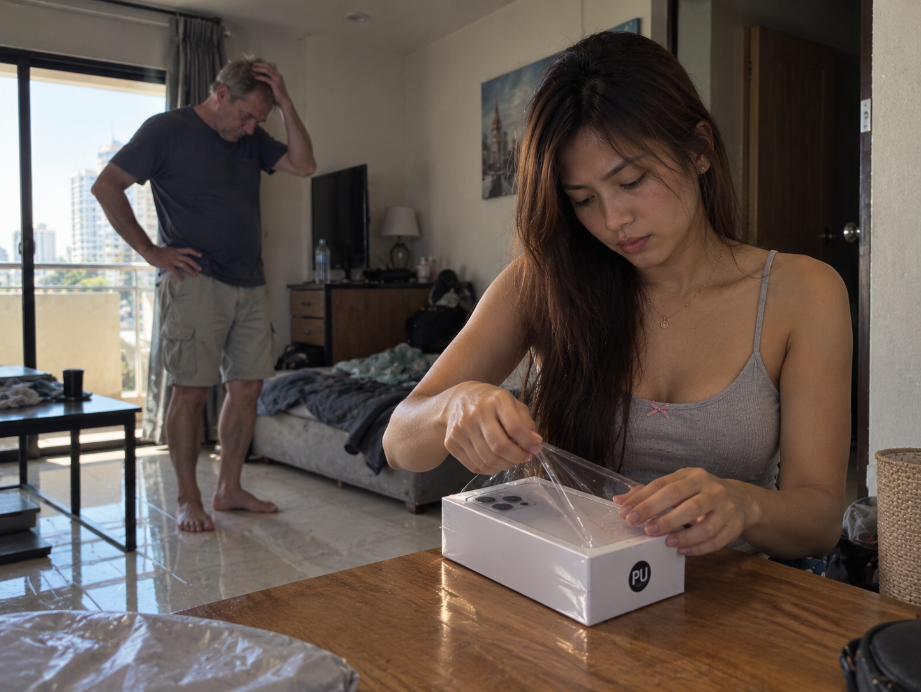
In any open market, the fastest way to drive up the price of an asset is to create artificial scarcity. The women working in the Pattaya ecosystem understand this economic principle better than most Wall Street brokers.
Mark, a 48-year-old expat, thought he had the industry figured out. He had been seeing the same woman from a bar on Soi 6 for three months. He was comfortable. He paid her a modest monthly allowance, took her to nice dinners, and enjoyed the illusion of a steady, exclusive relationship. He felt secure because he operated under the classic Western assumption: he had the capital, and therefore, he had a monopoly.
Then, the Phantom appeared.
It started with a subtle shift in her behavior. One evening, she arrived at his apartment and casually sat on the sofa, peeling the plastic wrap off a brand-new, sealed iPhone Pro Max box. Mark froze. He hadn’t bought it for her. When he asked about it, she brushed it off with a heavy sigh. “Just a customer. A Thai man. He owns a construction business in Chonburi. He keeps bothering me.”
Over the next two weeks, the Phantom became a recurring character in her narrative. He was always described as wealthy, persistent, and entirely serious. She would casually mention that the Thai businessman had offered to buy her a Honda City, or that he wanted to pay off her family’s farm debt so she could finally quit the bar.
She always delivered this information with a masterful layer of emotional manipulation. “He has a lot of money, but he is too old,” she would tell Mark, resting her head on his shoulder. “I told him I don’t want his car because I want to be with you. But my mother is still calling me about the debt…”
Why does this specific tactic work so flawlessly? Because it targets the Western expat’s most vulnerable asset: his ego.
If she created a fictional American or European rival, Mark would just see her as another bar worker juggling sponsors. But a wealthy local rival changes the psychology completely. It shatters the expat’s “Savior Complex.” It implies that she doesn’t actually need the Westerner to survive. It threatens him with a cultural defeat—the idea that she might choose her own people, leaving him utterly replaceable.
Mark’s financial logic evaporated. He was no longer just paying an allowance; he was entering a bidding war. His competitive instinct took over. He couldn’t let a local businessman out-provide him. Within days, Mark transferred the funds to cover the farm debt. He increased her allowance. He needed to prove he was the apex provider in her life. He thought he had won.
The reality? There was no construction boss from Chonburi. She bought that iPhone herself on a 10-month installment plan using an AEON financing card at Tukcom IT mall. The entire narrative was a flawlessly executed corporate pressure tactic.
When direct negotiation fails, you don’t ask for a raise. You simply let management know you have a better offer from a competitor, and you watch them outbid a ghost.
Leave a Reply