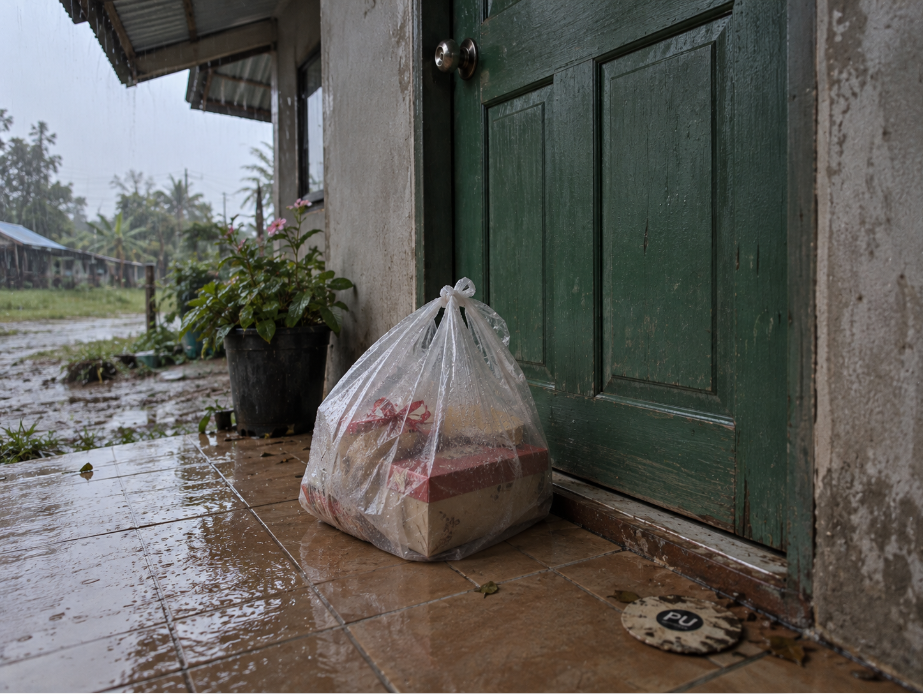
The door was painted that specific, cheap shade of green found exclusively in provincial Isan. The walls were fresh concrete. The floor was pristine tile. Norbert had paid for the roof in steady, monthly international transfers.
He knocked. Once. Twice. Three times.
Behind the door, there was only silence. Then, the faint sound of footsteps. The man looking silently through the peephole was the “brother.” The exact same brother Norbert had drank Leo beer with last year. The brother whose new motorcycle Norbert had financed. The man who had smiled, raised his glass, and said, “My sister is lucky to have you.”
The door did not open. The man did not say a word. He just stood there.
Norbert stood outside. In his hand was a plastic bag. Inside was a gift from Austria. Something she had specifically asked for. He didn’t remember exactly what it was anymore. He didn’t remember how much time had passed. He only knew she wasn’t coming out.
In the bars of Pattaya, Nit was never the loudest or the most beautiful. She was the one who remembered names. The one who asked about flight connections. The one who delivered the “I miss you” texts with lethal, calculated timing.
She was from Isan. She had a family. She had a husband. She had a child. She had a plan.
The man standing quietly on the other side of the green door was not her ex. He was her active, legal husband. He lived in the same house. He played the role of the brother not because he was forced to, but because it was an incredibly profitable position. As long as Norbert sent the money, the house had electricity, the family ate, the motorcycle ran, and they had a future.
This wasn’t a criminal conspiracy. It was an infrastructure. The mother knew. The sister knew. The neighbors completely understood. Everyone stayed silent because the money was real, and the morality of a foreign sponsor was an abstraction. Abstractions do not feed a village.
The system operated in flawless phases. It started in the bar, where Nit never asked for cash. She only talked about her mother and the village, creating a world that desperately needed a provider. Then came the validation. The “brother” was introduced. He didn’t ask for money either. He was respectful and funny. He drank beer with Norbert. He validated the expat’s ego, making Norbert feel like a respected part of a Thai family.
Then came the capital injection. She wanted a house. Not for herself, but for her aging mother. For the child. Norbert sent the money, month by month, directly to her account. He never checked the land title. He just believed.
Then came the return. He arrived unannounced. The house was finished, but the door was locked. A message arrived on his phone: “I am not feeling well. Maybe tomorrow.” Tomorrow never came. He asked the neighbors; they looked away. He asked the brother in the yard; the brother just shrugged and said, “She not here.”
Western readers look at stories like Norbert’s and ask the arrogant, obvious questions: How was he so blind? Why didn’t he check?
That is a comfortable view, but it misses the psychology completely. Norbert wasn’t simply scammed; he was a willing participant in his own illusion. He had known the “brother” lived in the house. He had paid for his food. He had actively chosen never to ask why the brother and sister slept in the same bedroom when he wasn’t around.
If Norbert had asked questions, he would have had to admit the brutal truth: he wasn’t finding love. He was purchasing a family. And a transaction was not what he had flown eight thousand kilometers to find. He came seeking the warmth of being necessary. Nit provided that warmth flawlessly. It was her job. The feeling he got was entirely real. Only the foundation was a lie.
Norbert stood at the door. One minute passed. Five. Ten.
He didn’t bang his fists against the green wood. He didn’t scream. He didn’t demand his money back. He just stood there.
Then he turned around. He walked to his rental car and got in. He looked in the rearview mirror. The house grew smaller, then disappeared. He drove toward the airport. He never looked back.
Left on the wet porch, the plastic bag with the gift from Austria sat in the rain. Nobody opened the door to take it.
Leave a Reply