In the classic Westerns, the moral architecture is comfortably simple. You look at the screen and you instantly know who is the savior, who is the villain, and who is just a ruthless opportunist. But on the grid in Pattaya, those three titles do not belong to static characters. They are just hats that people pass around, constantly swapping them depending on who is currently holding the money and who is telling the lie.
She lives in a cramped, six-thousand-baht apartment on the dark side of Sukhumvit. Her life is perfectly balanced on a terrifying, three-legged stool of deception.
There is the Farang. His name is Stephen. He lives six thousand miles away in a freezing, wet European suburb. He sends fifteen thousand baht on the first of every month. He believes he is her exclusive boyfriend, he believes she is sitting in her room studying English, and he believes he is a good man saving her from the bars.
There is the Thai Boyfriend. He lives in the six-thousand-baht apartment with her. He is twenty-four, wakes up at two in the afternoon, and spends five hours a day playing ROV on his phone. He knows everything about Stephen. He isn’t jealous; he views the foreigner strictly as a household utility, like the water pump or the Wi-Fi router.
And then, there is the Businessman.
The Thai Boyfriend knows about the Farang, but absolutely nobody knows about the Businessman. He drives down from Bangkok every other weekend. He wears a Rolex Daytona, smells like Tom Ford, and takes her to premium, air-conditioned seafood restaurants in Na Jomtien. He is the actual exit strategy. He is her genuine hope. He is married, of course, but he swears the divorce papers are being drawn up and his wife is moving out next month.
Last Tuesday, the illusion buckled.
The air in the apartment is suffocating. The cheap Hatari floor fan is rattling on maximum speed, just pushing hot air in a circle. The Thai Boyfriend is pacing at the foot of the mattress, agitated.
“Call Stephen,” he snaps, pointing at her phone. “Tell him your mother is in the hospital again. We have zero cash. I need to put gas in the PCX, and I have my friend’s birthday party tonight at the club. Tell him it’s an emergency.”
He doesn’t ask. He demands. He expects her to operate the ATM.
She picks up the phone. But she doesn’t open WhatsApp to text the European number. Stephen tapped out last week after paying for a fictional broken refrigerator. Instead, she opens Line. She messages the Businessman in Bangkok. I’m in trouble. Need money for rent.
Three minutes later, the Kasikorn app chimes.
The Boyfriend looks over her shoulder at the glowing screen. Five thousand baht. He smiles, entirely satisfied with himself. She immediately taps her screen again, transferring two thousand baht straight to his account. He kisses her on the forehead and walks out the door to go drink Hong Thong with his friends, completely convinced that he just successfully milked the clueless Farang.
He didn’t.
But what the Businessman didn’t tell her is that he didn’t use a ghost account to send the money. He used his primary company account. And in the digital age, a bank slip is an absolute, undeniable footprint. It took the Businessman’s wife exactly three minutes to look at the transfer history, copy the legal name attached to the recipient’s Kasikorn account, and paste it into the Facebook search bar.
Three days later. The late afternoon heat is finally breaking.
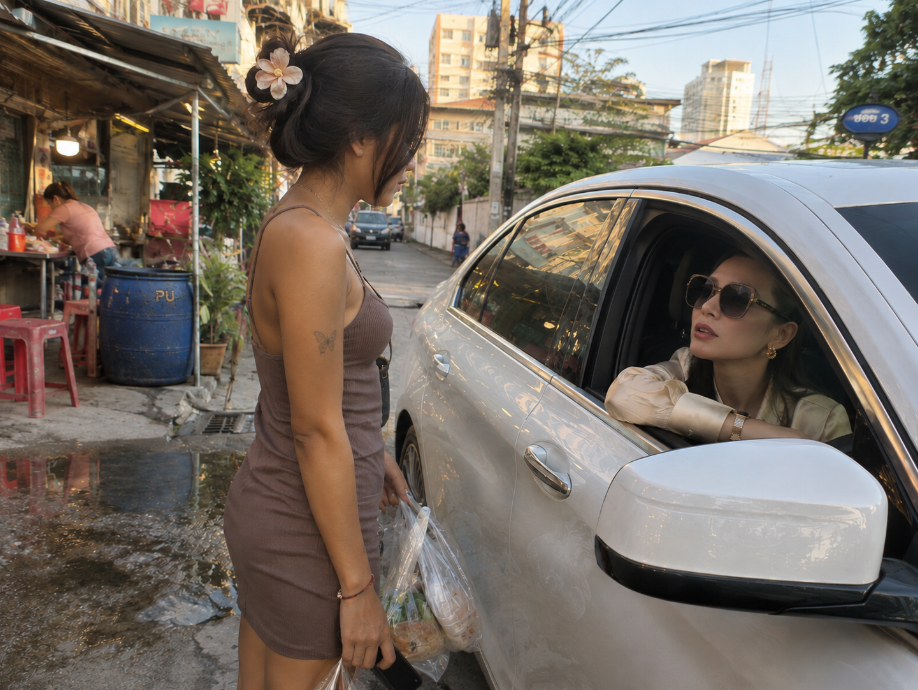
She is walking down a narrow, potholed soi near Third Road, stepping around stray dogs and puddles of gray water. She is wearing flip-flops and carrying a clear plastic bag heavy with som tum, grilled chicken, and a sweaty packet of sticky rice. She is just a girl walking home to a cheap apartment, thinking about her three men, wondering who is actually going to save her.
A pristine white BMW 5-Series glides to a stop directly beside her. It looks like a spaceship that just crash-landed in the slums.
The tinted passenger window slides down silently. The blast of freezing, premium air conditioning hits her bare legs. The woman sitting behind the steering wheel has flawless porcelain skin, a perfectly tailored silk blouse, oversized Celine sunglasses, and the unmistakable, terrifying aura of Bangkok high society. She looks at the plastic bag of street food, and then she looks directly into the girl’s eyes.
“Nong, nong,” the woman says smoothly, her voice completely devoid of anger, which makes it infinitely more dangerous. “Get in. We need to talk.”
Who is the Good, who is the Bad, and who is the Ugly?
Is the Farang the good guy for paying, or the ugly one for his delusion? Is the Boyfriend the villain for pimping out his own girlfriend, or is he her only true home? Is the Businessman the savior, or the ultimate predator? And what about her?
She stands on the dusty street, staring into the leather interior of the BMW, realizing she has absolutely no idea who the villain in her own story actually is.
Leave a Reply