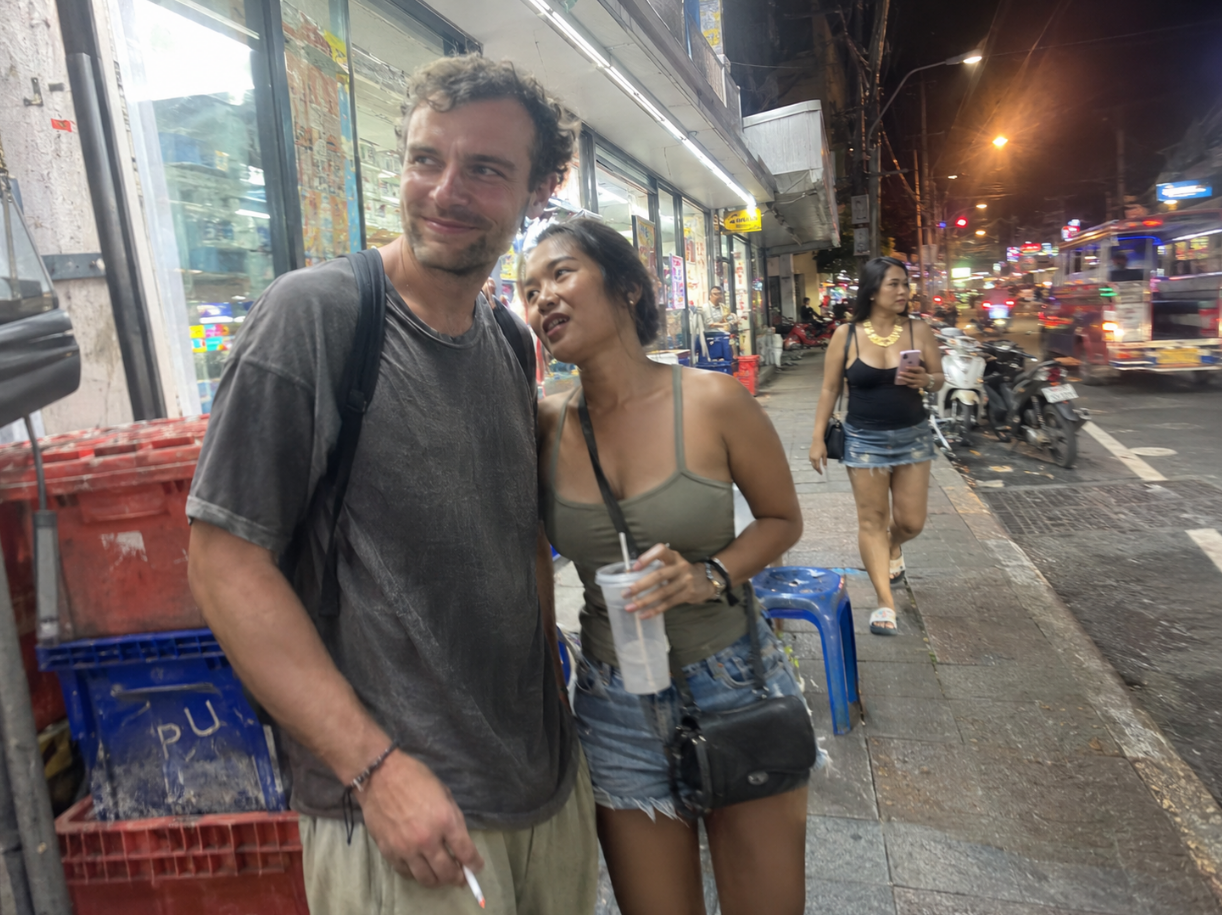
He is twenty-eight. He has been dating her for four months.
He has just checked his banking app, and the brutal reality of the grid has finally caught up with him. He is running out of money. To maintain this Schrödinger’s relationship—where she might actually love him, or she might just love his wallet, and as long as he keeps paying, he never has to open the box to find out—he needs serious cash flow. He needs a business.
Like every expat before him, he goes through the mandatory stages of delusion.
First, the imported dream: a Krakow sausage shop or a Hungarian goulash restaurant, which he quickly realizes nobody within a thousand-mile radius actually wants. Then, the classic trap: a coffee shop or a beer bar. She used to work in one, so she knows exactly how to run it, right?
But then, he starts looking closer. He starts noticing the invisible Thai infrastructure.
One afternoon, a pipe bursts in his condo. He watches his girlfriend take a photo of the leak, post it in a local Thai Facebook group, and receive six competitive bids from freelance plumbers in exactly four minutes. To him, it feels like discovering the dark web. He spends three days aggressively drafting a business plan for an “Uber for Plumbers” targeting foreign expats, planning to take a 20% cut.
He abandons the idea only when he realizes the fatal flaw in his business model: every expat in Pattaya already has a Thai girlfriend who does this for free.
He pivots to physical goods. At a local market, she complains that limes have gone up to twenty baht a kilo. The next weekend, they are walking through a local evening market in Rayong, and he sees limes for three baht a kilo. His brain instantly lights up. A six-hundred-percent margin. Arbitrage.
He spends an entire week building spreadsheets, trying to figure out logistics, but the expat-run delivery services eat all his profit. He gives up. The very next day, his girlfriend casually posts in a Thai ride-share group: “Anyone driving from Rayong to Pattaya tonight? Grab two sacks of limes, I’ll give you a hundred baht for gas.”
The limes arrive three hours later. The math suddenly works perfectly. He abandons the lime idea entirely and decides he needs to start a logistics company. But then he stumbles into a closed LINE group selling smuggled duty-free cosmetics, and spends the next three weeks obsessively mapping out a grey-market import empire.
He is spinning in circles, trying to monetize a system he doesn’t actually understand, constantly outsmarted by girls who navigate it effortlessly.
Then, the true epiphany hits.
They are standing outside a 7-Eleven. Her friend walks out. The friend is wearing a heavy, two-baht gold chain and tapping on a brand new iPhone. They exchange a quick, polite greeting. As the friend walks away to flag down a baht bus, his girlfriend leans in and whispers the gossip.
“She found a sugar daddy in Dubai,” she says, her voice full of envy. “She used a new VIP matchmaking agency in Bangkok. She had to pay the agency thirty thousand baht upfront, but they found her a rich sponsor.”
He stops dead in his tracks. The half-lit cigarette in his hand burns down a millimeter. The gears in his head violently shift.
He turns to look at her. “Wait,” he says. “She paid the agency?”
“Yes. Thirty thousand baht. To get in the VIP catalog.”
He looks down the street at the endless stream of girls walking the pavement. He looks at the bars, the massage shops, the coffee stands, all filled with tens of thousands of women desperately looking for an exit strategy.
He doesn’t want to sell Hungarian goulash. He doesn’t want to dispatch plumbers. He doesn’t want to transport limes.
He looks at his girlfriend. He smiles.
“I think I have a business plan,” he says.
Leave a Reply