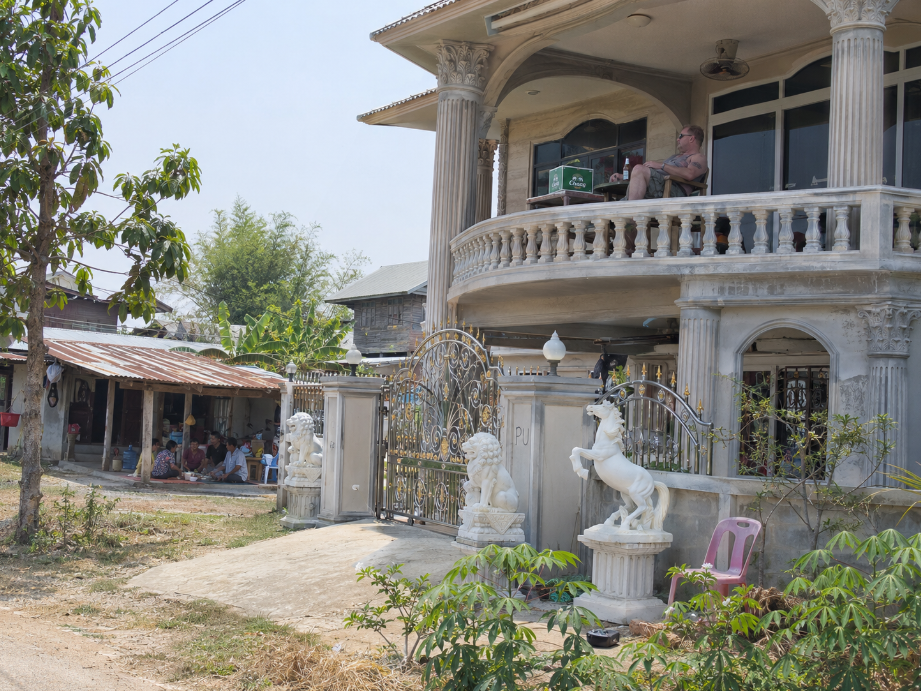
Anyone who has ever driven through rural Eastern Europe and seen the sprawling, gilded mansions of local barons knows the exact aesthetic: aggressive, unapologetic luxury dropped straight into the middle of red dust and weeds.
Drive deep enough into Isan, past the wooden stilt houses and corrugated tin roofs, and you will see the exact same architectural phenomenon rising out of the rice paddies.
Suddenly, behind a towering wrought-iron gate, stands a monument of pure concrete ambition—complete with thick Roman Empire columns and life-sized statues of rearing white horses, built in a subdistrict where nobody has ever seen a live horse in their lives, let alone a neoclassical sculpture. To the surrounding village, it is a massive upgrade, though not as a residence. It becomes the hottest local landmark for selfies and Facebook check-ins. Teenagers pose by the driveway lions and tag their location: Checked in at Ploy’s House.
Every single one of these houses comes with one non-negotiable feature: a massive second-floor balcony.
Nobody in the family ever steps foot on that balcony—except for three days a year, when Jack flies in from Europe. For seventy-two hours, Jack sits out there shirtless in his cargo shorts with a shrink-wrapped case of Leo beer at his feet, gazing out over the dirt roads and water buffaloes like a prison warden surveying the yard, or the newly elected mayor of the province, swelling with quiet pride.
Downstairs in the living room, Jack sinks into an oversized, stiff leather sofa and frowns at the massive flatscreen TV, confused as to why the power cord is dangling unplugged behind the cabinet. He has no idea that the plug hasn’t touched the wall socket since his last flight out twelve months ago. For the architects of these monuments, it always comes as a shock to learn that nobody even goes inside the house until the architect and his wife arrive from Pattaya. The family simply doesn’t know how to live inside a Western-style mausoleum. While Jack sits upstairs on his leather throne, his in-laws are out back under a low zinc awning, sitting cross-legged on a woven reed mat on the concrete floor, eating sticky rice and papaya salad together.
Yet the biggest shock for the men who build these palaces comes a year or two later—when the family quietly asks to build another house. A normal one.
A woman I know in Korat has one of those masterpieces standing on her family’s land. Her foreign partner poured a fortune into a cavernous two-story mansion—complete with the mandatory second-floor balcony and even a circular driveway with a tiered fountain in the middle, like a miniature French château parked next to a cassava field.
Not long after the construction crews left, her elderly parents pulled her aside and begged her to build them a normal house. They couldn’t live inside that echoing concrete monster. They couldn’t afford the electricity bill to cool twelve-foot ceilings, the tiled floors felt cold and sterile, and the whole place felt more like a provincial government office than a home.
She couldn’t bring herself to tell him. In his head, that circular fountain was proof that he had rescued them, elevated their lives, and fulfilled his grand duty as a man. Breaking that illusion would have crushed him.
So right now, quietly out of her own pocket money, she is paying local builders to put up a second house behind the palace: a simple, single-story place with low ceilings, where her parents can sit on the floor, eat dinner together, and turn on a regular electric fan in peace.
Leave a Reply