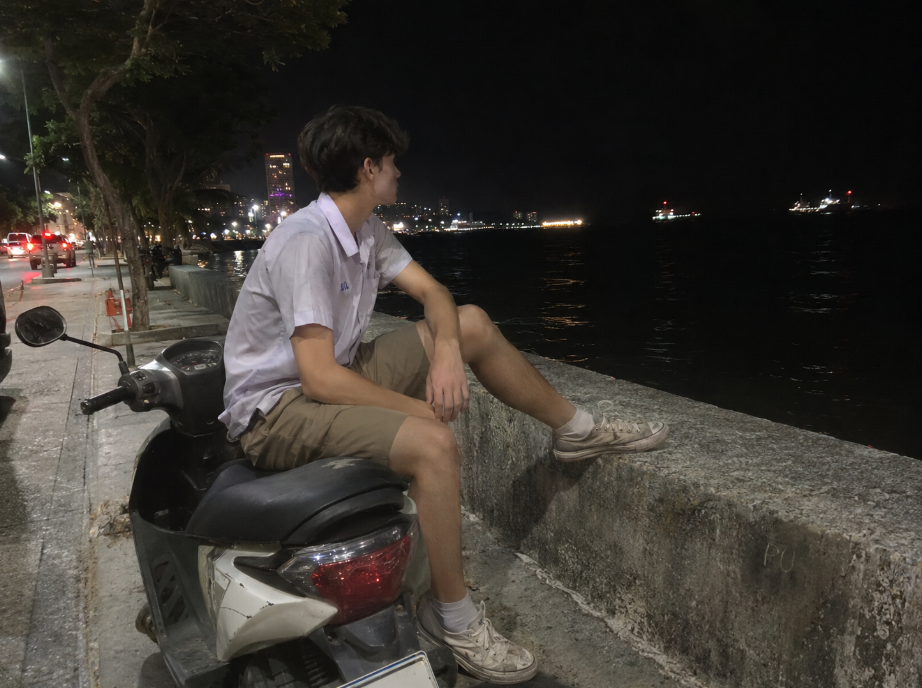
At four o’clock in the afternoon, when the bell rings at the public high school off Sukhumvit Road, he steps out into the blinding heat looking like a glitch in the crowd.
He wears the exact same uniform as every other seventeen-year-old boy pouring through the iron gates—a crisp white short-sleeved shirt with blue numbers stitched over the breast pocket, khaki shorts, and scuffed canvas sneakers. Yet he stands half a head taller than everyone around him. His nose is too sharp, his jawline too angular, and his hair catches a faint, dusty shade of brown in the afternoon sun.
He is luk khrueng—half-blood. In a city built entirely on temporary transactions, he is the permanent receipt nobody planned to keep.
His father is nothing more than a European surname printed on a Thai birth certificate and a faded photograph tucked inside a biscuit tin—a man who lingered in Pattaya for a few loud, hazy seasons, drank his savings away, and vanished back into the fog of the Northern Hemisphere before the boy was old enough to form a sentence. No child support, no second passport, no safety net waiting in Europe.
His mother works twelve-hour shifts in a dimly lit massage parlor down a narrow soi off Second Road. Every night at midnight, she comes home smelling of Tiger Balm, cheap jasmine oil, and bone-deep exhaustion, her thumbs swollen from kneading the sunburned shoulders of men who pass through town for ten days at a time.
Growing up in Pattaya with a split face means belonging to neither side of the street.
To his Thai classmates, he will always be Ai Farang. It doesn’t matter that he was born in Banglamung Hospital, speaks rapid-fire street Thai laced with his mother’s Isaan slang, eats papaya salad spicy enough to strip varnish, and weaves a beat-up Honda Wave through gridlocked traffic with the same reckless grace as any local kid. There is an invisible glass wall between them. When a fight breaks out behind the school or money goes missing from a backpack, eyes still flick toward his foreign face first.
To the tourists and expats, he is equally alien. When he waits on his scooter outside his mother’s shop, foreign men walk right past him without seeing him—or worse, bark slow, loud English at him, assuming he is a tourist’s kid. The cruelest irony is that he barely speaks English at all, just broken bar-level phrases and the slang he picks up from online video games. To the men sitting on the barstools, he is an uncomfortable mirror: living proof of what happens when the holiday doesn’t end at the departure gate.
Yet inside the school walls, his foreign features are pure currency. Thai television and pop culture worship mixed blood, and at seventeen, he cannot walk down a corridor without catching stares. Female classmates constantly slide into his LINE messages, slip folded notes into his desk, and invent excuses to ask for rides on the back of his scooter after class.
His mother misses none of it. She has spent twenty years watching teenage girls in this city wreck their lives before they even turn eighteen, repeating the exact cycle she has broken her back trying to pull him out of.
One night over a quiet dinner of fried mackerel and sticky rice, she set her spoon down, looked him dead in the eye without a trace of humor, and laid down the law. If he ever gets a single one of those schoolgirls pregnant, she told him, there will be no family meeting, no dowry negotiations, and no baby crying in their cramped room. She will march him straight down to Bali Hai Pier, pay a fisherman to take them out past Koh Larn, and throw him overboard into the open sea with her own hands.
He knew she meant every word.
Later that evening, after dropping her off for her night shift, he rides his scooter down toward the water near Pratamnak Hill and kills the engine. He sits on the warm vinyl seat, staring out across the black expanse of the Gulf where the red and green lights of anchored cargo ships blink slowly in the humid dark.
Behind him, the city hums its usual nightly rhythm—the distant thump of bass from Walking Street, the hiss of street woks, the roar of taxis hauling fresh arrivals down from Bangkok. Everyone in Pattaya is just passing through on a two-week stamp, a six-month visa, or a seasonal contract.
He lights a cheap cigarette, watches the smoke dissolve into the heavy salt air, and listens to the dark water slapping against the concrete seawall—the only place on earth he knows, and the one place that still hasn’t decided if he belongs.
Leave a Reply