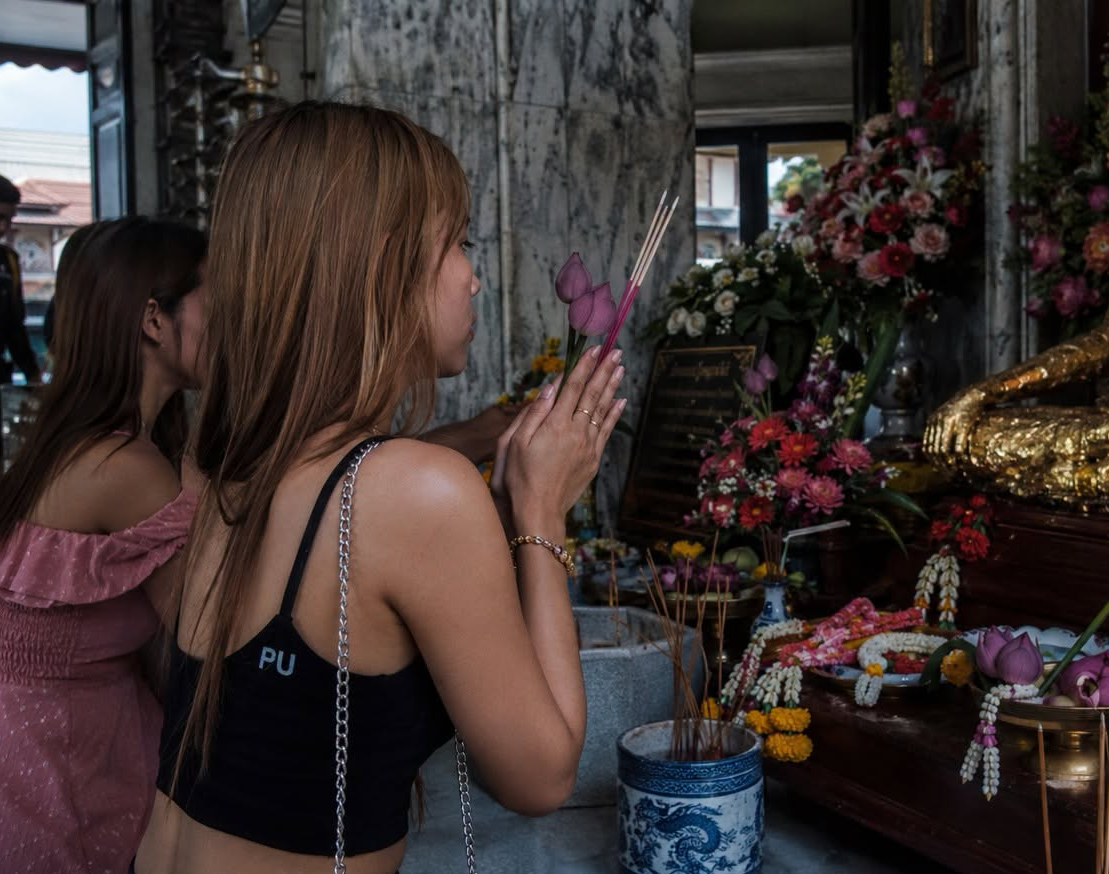
If you spend enough time observing the reality of Thailand’s nightlife, you quickly realize that the women working in the industry don’t just vanish when the neon signs turn off at 4:00 AM. They carry a deep, complex spiritual life that runs parallel to their chaotic jobs. And there is one specific place in Bangkok where almost every girl from the industry has gone, or will eventually go, to seek solace: Wat Khanikaphon (วัดคณิกาผล).
This isn’t just a picturesque temple for tourists. It is perhaps the greatest physical monument to Thailand’s incredibly pragmatic, nuanced relationship with morality, sin, and redemption. There is a lot to unpack here, because the history of this place breaks every Western stereotype about Thai culture.
The Madame Who Tried to Buy Heaven
In the 19th century, during the reign of King Rama III, Grandma Faeng (Yai Faeng) was an absolute titan of Bangkok’s underworld. She didn’t trade in silk or spices; she was the wealthiest and most powerful brothel madame in the capital’s red-light district.
Having amassed a massive fortune, Yai Faeng faced an existential crisis common in Thai culture: wealth in this life means nothing if your karma sets you up for suffering in the next. To secure her spiritual future, she poured an astronomical amount of money into building an entire Buddhist temple. She wanted the ultimate Tam Boon (merit-making). Later, King Rama IV officially gave the grounds a brutally honest name: Wat Khanikaphon, which literally translates to “The Temple of the Fruits of Prostitution.”
The Ultimate Reality Check
The climax of this story involves Somdet To, the most revered and spiritually advanced monk of the era. When the temple was completed, Yai Faeng proudly invited him to preach at the grand dedication ceremony. She sat in the front row, fully expecting to be praised in front of the city as a great patron of Buddhism.
Instead, Somdet To delivered a legendary, unfiltered reality check. He looked at the Madame and declared that if the spiritual merit of building a temple equals one Baht, her personal share was only one Salung (a quarter).
Why? Because the origin of the money matters. He explained that the bricks, the gold leaf, and the statues were all paid for by the tears, sweat, and exploitation of other women.
The Illusion of Laundering Karma
This is where Western observers often misunderstand Thai spirituality. The existence of this temple doesn’t mean Buddhism “approves” of the sex trade. In fact, Somdet To’s sermon was a harsh lesson against the concept of ทำบุญล้างบาป (Tham bun lang bap — an idiom meaning “to make merit to wash away sins”).
He proved that karma is not a bank transaction. You cannot spiritually launder dirty money by writing a massive check to a temple. In the Thai Buddhist worldview, good deeds and bad deeds exist on parallel tracks; one does not simply cancel out the other. The source of your wealth carries its own inescapable moral weight.
A Sanctuary for the Judged
Yet, the true beauty of Thai society lies in its lack of absolute ostracization. Yai Faeng wasn’t banished or burned at the stake. She was allowed to build something of public value, even if her merit was heavily taxed by karma.
Today, tucked inside the temple grounds, there is a small shrine dedicated to Yai Faeng. Women from the bars of Pattaya and Bangkok travel there constantly to light incense and leave offerings. They don’t go there asking for society’s approval. They go because the Madame from the 19th century understands their exact struggle, their moral compromises, and their desperate desire to build a better future for their families better than anyone else in history.
It is a perfect reflection of Thailand itself: a place where the sacred and the profane have always stood side by side, sharing the same complicated street.
Leave a Reply