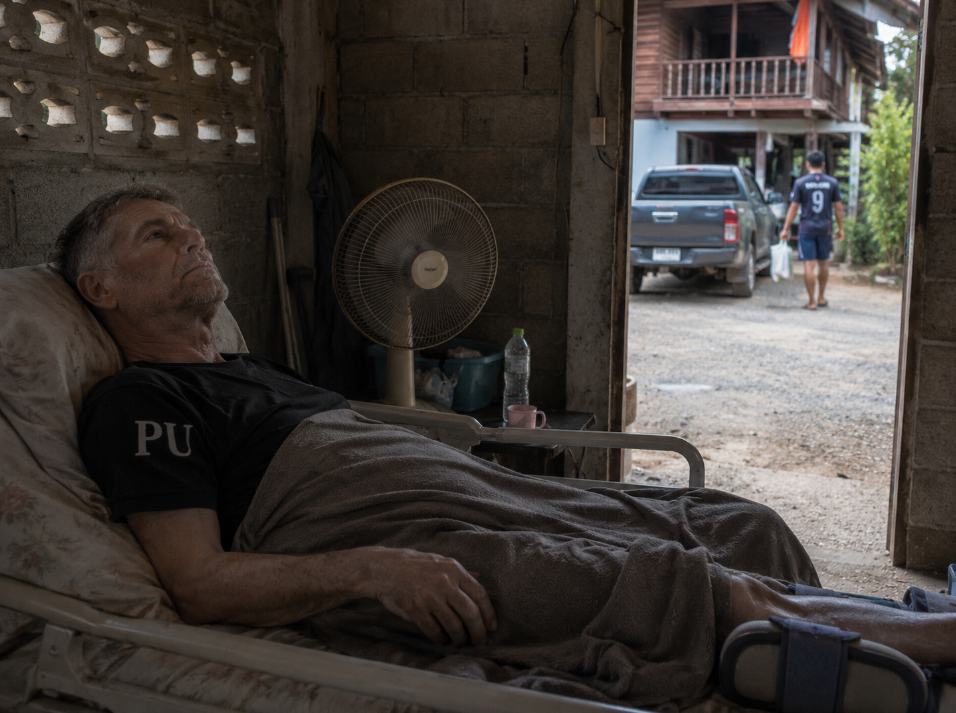
It is 3:00 PM in a dusty village somewhere in Buriram province. The afternoon heat is thick and suffocating, broken only by the rhythmic crowing of a rooster and the heavy bass of Isan country music playing from a neighbor’s house.
In a small, un-air-conditioned cinderblock annex attached to a large, beautiful two-story home, Richard is staring at the ceiling.
A rusty standing fan oscillates back and forth, blowing warm air over his thin, motionless legs. Two years ago, Richard suffered a severe stroke. Today, the right side of his body is completely paralyzed. He cannot walk. He cannot speak clearly. And he cannot leave.
Through the open window of his annex, Richard can hear the crunch of gravel. A shiny, late-model pickup truck pulls into the driveway of the big house. A young Thai man in a local football jersey steps out, carrying groceries. He walks into the main house, laughing, and Richard hears the familiar voice of his wife, Noi, greeting him happily.
Richard bought that truck. Richard paid for that house. But Richard’s name is on absolutely nothing.
The Illusion of Ownership
The tragedy of the abandoned farang is the darkest, most closely guarded secret of the expat ecosystem. It is the story nobody tells over beers in Pattaya, because it is the ultimate nightmare.
Five years ago, Richard was the king of his world. He had a solid pension, a healthy bank account, and a Thai girlfriend who made him feel young, respected, and loved. Tired of the noisy bars on Soi Buakhao, he made the classic expat move: he decided to “retire in the real Thailand.”
He sold his assets back home. He transferred the money. Because foreigners cannot own land in Thailand, he put the deed to the land in Noi’s name. He built a 3-million-baht house. He bought the truck in her name. He paid off her family’s debts.
He thought he was buying a permanent sanctuary. He didn’t realize he was just funding his own trap.
The Medical Breaking Point
In the Thai village ecosystem, a foreign husband is viewed through a lens of strict, unspoken pragmatism. He is an economic engine. As long as the engine runs, he is respected. He sits at the head of the table during family barbecues, the local villagers pour his whiskey, and he is treated like the village Poo Yai (Big Man).
But then, the stroke happened.
Western insurance often has limits, or it lapses. The hospital bills quickly drained Richard’s remaining cash reserves. When he was finally discharged, he was no longer an economic engine. He was a financial and physical burden.
The transition wasn’t violent. It was terrifyingly quiet.
Once the money stopped, the respect evaporated overnight. Richard was quietly moved out of the master bedroom—the room he had designed—and relocated to the ground-floor storage room, or the “annex,” so he wouldn’t soil the nice floors.
The New Village Dynamic
Noi didn’t kick him out onto the street. She don’t literally throw a crippled man into a ditch. She keep him alive. But she strip him of all dignity.
Noi brings him a bowl of rice, some boiled vegetables, and a bottle of water twice a day. Sometimes, her teenage niece comes in to hastily wipe him down with a wet sponge. But the romance, the care, and the partnership are dead.
Noi has a new life now. The young Thai man parking the truck is her new husband. He sleeps in Richard’s bed. He drives Richard’s car. He watches Richard’s television. The entire village knows this arrangement, and nobody says a word. Why would they? The farang’s money has successfully been absorbed into the local economy. The transaction is complete.
Richard lies in the heat, watching a gecko crawl across the cinderblock wall. He has no money to buy a plane ticket home. He has no assets in his home country to return to. His embassy will not act as a nursing home.
He is a ghost, trapped in a house he paid for, waiting for the mercy of a family that has already forgotten he is alive.
Leave a Reply