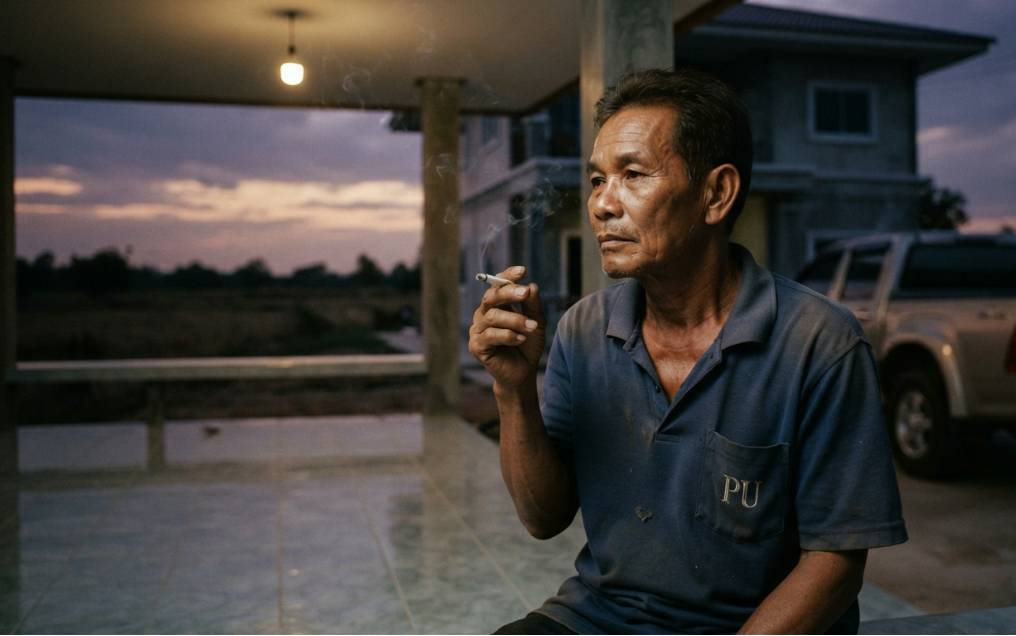
The sun was setting over the dry rice fields of Udon Thani, painting the sky in deep shades of bruised purple. Somchai, sixty-two years old, sat on the cool, polished tiles of his front porch. Behind him stood a newly built, two-story concrete house. In the driveway sat a gleaming, late-model Isuzu D-Max.
In this village, Somchai is a respected man.
He has a son who works on a construction site in Bangkok. Two years ago, the son fulfilled his ultimate duty to his parents: he shaved his head, put on the saffron robes, and ordained as a Buddhist monk for three months. In Thai culture, a son pays off his Bunkhun (the immense karmic debt of gratitude owed to his parents) by transferring this spiritual merit to his mother and father. Once the robes came off, the son was spiritually clear. He now has a wife and a baby, and he rarely sends money home. The village accepts this. His duty is done.
But Somchai also has a daughter. Her name is Fon.
Because women cannot be ordained as monks, the cultural mechanics of their Bunkhun are entirely different. A daughter cannot pay her debt in karma. She must pay it in cash. She must become the physical and financial caretaker of her parents’ old age.
And so, three years ago, Fon packed a single bag and took a VIP bus to Pattaya.
The Unspoken Contract
Every month, on the 5th, Somchai’s phone chimes with an SMS from Kasikorn Bank. A transfer of 25,000 baht.
Western expats sitting in the bars of Soi 6 love to debate the morality of the Thai family. They slam their Leo beers on the table and ask with furious indignation: “What kind of father sends his daughter to work in a place like this? How can he just take the money?” They imagine a cruel, calculating patriarch treating his daughter like a commodity.
But the reality of the village is infinitely more complex, and it operates on a powerful sociological mechanism known as Strategic Ignorance.
Somchai did not send his daughter to the bars. When she left, she told him she got a job selling clothes in a mall. Now, when they speak on the phone, the conversation follows a rigid, deeply rehearsed script.
“How is work, luk?” Somchai asks.
“It is tiring. The restaurant is very busy. The Farangs tip well,” she replies.
Somchai has lived a long time. He knows that no waitress in a normal restaurant makes 25,000 baht a month. He knows why her LINE profile picture shows her in a bikini on a yacht. He knows. The mother knows. The aunts know.
But no one will ever, ever say it out loud.
To speak the truth would be to destroy the family’s Face (Nâa). So, the entire family aggressively protects the fiction. They build an impenetrable fortress of silence around the origin of the money. She pretends she is a waitress, and they pretend to believe her.
The Merit Laundering
On Sunday morning, Somchai drives the new Isuzu to the village temple. He hands the head monk an envelope containing 5,000 baht from Fon’s transfer to help repair the temple roof.
The monk chants a blessing. The neighbors nod in deep respect. Somchai pours holy water onto the earth, transferring merit.
Anthropologists call this “merit laundering.” The money was earned in the dark, humid, morally gray ecosystem of Pattaya. But the moment it is donated to the temple, it is socially and spiritually cleansed. It becomes pure. Fon has fulfilled her duty as a good daughter, Somchai has elevated the family’s status in the village, and the source of the wealth ceases to matter.
In the brutal reality of rural Isan, poverty is the ultimate sin. Being landless, having a leaking roof, or being unable to donate to the temple brings a crushing, daily shame. The stigma of poverty is infinitely heavier than the distant, abstract stigma of what a daughter might be doing in a city 600 kilometers away.
The Burden of the Void
The Western man judges the Thai father because Western culture demands absolute, literal truth. But in Thailand, harmony and the preservation of dignity are far more important than the ugly facts.
Somchai sits on his porch in the twilight, smoking a rolled cigarette. He looks at his beautiful concrete house. He loves his daughter deeply. He worries about her. But he is trapped in a multi-generational cycle of poverty and cultural obligation that was written centuries before he was born.
He doesn’t ask questions, because he knows he cannot bear the answers.
So, he chooses the silence. He chooses the fiction of the busy restaurant. He stares out at the dark rice fields, carrying the heavy, unspoken burden of a father who traded the truth for his family’s survival, and hoping that whatever his daughter is doing in the neon lights of the South, she is at least staying safe.
Leave a Reply