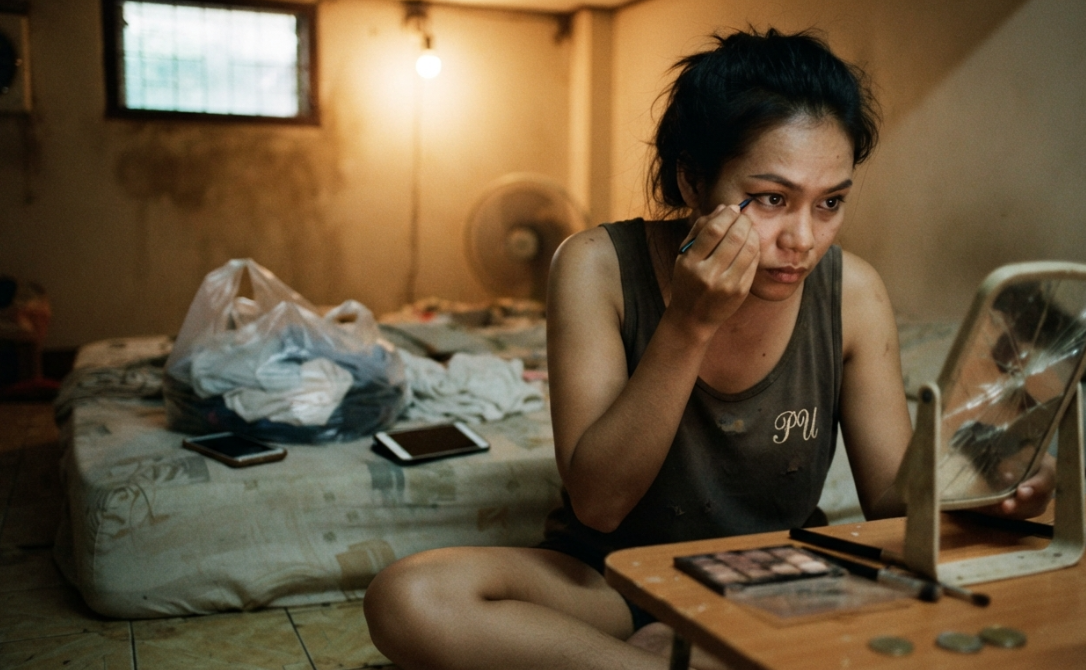
In a cramped, humid room behind Soi Buakhao, a cheap wall fan is pushing warm air around in a slow, tired circle. May is sitting cross-legged on the linoleum floor in front of a cracked mirror, carefully applying her eyeliner.
On the bed next to her lies a plastic bag of unfolded laundry. Her phone screen lights up constantly: a LINE message from a customer she doesn’t want to see, and a missed call from her mother in the province.
Somewhere in the world, on the Western internet, people are fiercely debating women exactly like her.
They write long, academic essays and argue in comment sections. Is sex work empowering? Is she a victim of the patriarchy? Is she an independent, liberated woman? Is she exploiting naive men, or is she being exploited by the system?
But as May blends her eyeshadow, she isn’t thinking about liberation theory. She is looking at her phone and doing a brutal, hyper-focused form of survival mathematics.
The rent is due in three days. Her son needs a new school uniform. Her mother needs money for blood pressure medication. She has to pay back the 2,000 baht she borrowed from her friend. Her motorbike needs a new tire. It is low season. The bars are empty.
She needs to somehow make money tonight.
The Labels vs. The Reality
To the Western observer, May is always a symbol, depending entirely on who is looking at her.
To the conservative, she made bad moral choices. To the feminist, she is a victim of a male-dominated world. To the angry expat, she is a ruthless, money-hungry predator. To the naive tourist, she is a poor, helpless girl who needs to be saved.
But to herself? She is just a human being carrying an entire family on her back.
May doesn’t wake up in the morning thinking: “Today, I am going to smash the patriarchy.” She wakes up thinking: “Where am I going to find 4,000 baht before Friday?”
She doesn’t use the slogan: “My body, my choice.” She simply looks at her phone, sighs, and says: “This customer is disgusting and annoying, but his money will pay the school fee.”
She isn’t building a career strategy based on modern empowerment. She is simply choosing between a bad shift, a bad client, a bad boyfriend, and a bad debt.
The Dirty Reality of Empowerment
Pattaya is a city where beautiful ideologies quickly lose to the electric bill.
May’s version of “empowerment” isn’t pretty. It isn’t a TED Talk. It isn’t an inspirational quote for an Instagram aesthetic. Her empowerment is dirty, exhausted, and ruthlessly practical. She does exactly what works, because she doesn’t have the luxury of time to live inside ideological categories.
There is a harsh, biting irony in this dynamic. Western men and women sit in comfortable, air-conditioned rooms, aggressively debating her life as an abstract concept. Meanwhile, May is the one actually paying for someone’s food, someone’s education, someone’s hospital bed, and someone’s loan.
The Western world can point at her and say: “She is using her body!” or “She is being exploited!”
And May would simply look back and say:
“Yes. And?”
Because none of those theoretical explanations pay her rent.
She finishes her makeup, grabs her purse, and rushes out the door. She doesn’t have time to debate whether her life is a tragedy or a triumph. She just needs to catch a motorbike taxi to the bar, because if she is late for her shift, the Mamasan will fine her 500 baht.
Leave a Reply