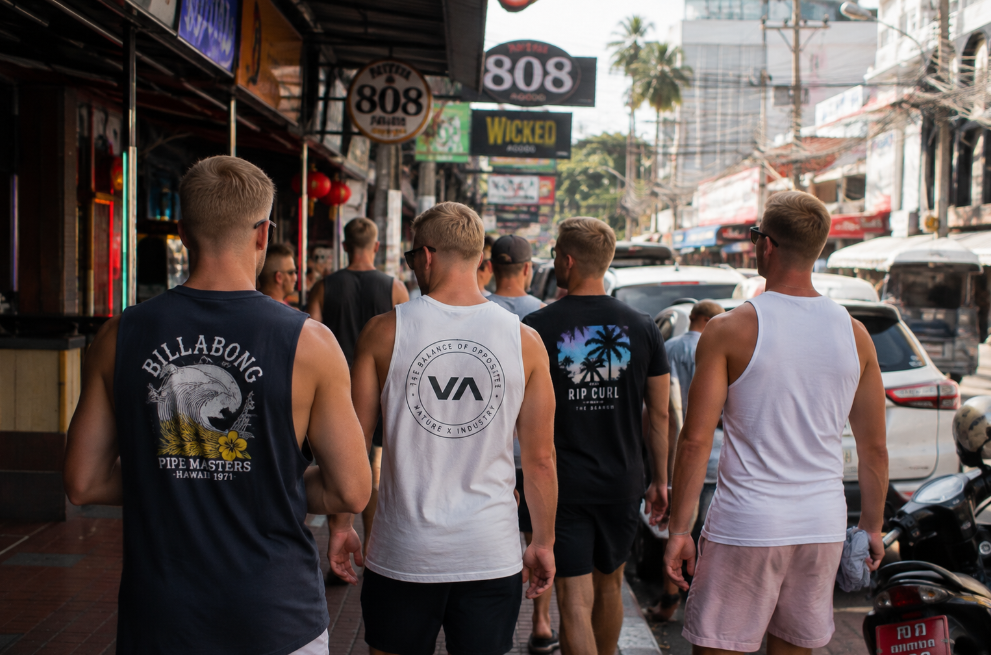
Right now, local Thai nightlife Facebook groups and freelancer LINE chats are buzzing with the same recycled anticipation. The USS Abraham Lincoln carrier strike group is docking at Laem Chabang. Five thousand sailors and Marines, fresh off more than 200 days at sea without a proper port call.
In the minds of bar owners and mama-sans, “5,000 sailors” sounds like a tsunami. It resurrects the old Vietnam-era mythology: an invading army of American uniforms, a rain of dollars, full bars, and a city temporarily saved by maritime testosterone.
But when you look at the actual statistics and the modern military funnel, the reality is almost comically small.
Let’s look at the math. Over a standard Thai long holiday weekend—like the ones in July—the Tourism Authority of Thailand (TAT) regularly tracks massive domestic movement. In July 2024, TAT officially reported – The Eastern region (Pattaya and Chonburi) alone generated over 4 billion baht in a single weekend, driven entirely by Bangkok weekenders and domestic tourists.
Local media optimistically estimates that if the sailors spend 1,000 to 3,000 baht each, it might generate 5 to 15 million baht for the city. For a neon metropolis that processes billions, 15 million baht over four days is not a structural earthquake. Statistically speaking, the arrival of a nuclear-powered aircraft carrier brings less economic impact than a cloudy Saturday morning during a Thai long weekend.
But the real illusion lies in the funnel of human behavior.
Five thousand sounds like an army, but the military doesn’t release 5,000 men into the bars at once. First, you subtract the personnel on duty and watch rotation. Then, you subtract those who take official MWR (Morale, Welfare, and Recreation) tours to temples or shopping malls. Then, you subtract those who go to Bangkok, or just stay around the port.
If you are brutally realistic: maybe 3,000 actually get shore leave over the entire period. Maybe half of them—1,500—end up in Pattaya’s nightlife zones. And of those, perhaps 25 to 30 percent actually want to participate in the transactional adult industry.
That leaves roughly 400 active nightlife customers.
When you smear 400 guys across Walking Street, Tree Town, Soi 6, LK Metro, Beach Road, and thousands of massage shops, it doesn’t look like an invasion. It looks like a few dense clusters of guys in matching haircuts.
The cinematic reality plays out in a Tree Town bar. The owner hypes up the girls in the afternoon: “Tonight, many Americans.” The girls do their nails, put on their best dresses, and wait. At 9 PM, a group of fifteen sailors finally walks in.
But they don’t tear the place apart. Two of them buy lady drinks. One guy is aggressively looking for a tattoo shop. Three are arguing about how to get to McDonald’s. One is sitting in the corner on FaceTime with his family. Another is staring blankly at his phone, explicitly stating he just wants a real bed and some sleep. Two hours later, they pay for their beers and leave. The bar is empty again.
By the time the fleet pulls out, the local Thai business communities and girls’ Facebook groups will be flooded with the exact same confused posts we see every single time a ship docks:
“So… did anyone actually see the sailors? Where were they?”
And just like always, the only proof of the “invasion” will be one viral TikTok of fifteen guys standing in a single bar.
Pattaya is a city built entirely on anticipating male desire, which is exactly why it constantly overestimates it. It forgets about rules, curfews, financial limits, and profound human exhaustion.
Sometimes, after 200 days in the middle of the ocean, a man doesn’t want to destroy the neon city. He just wants air conditioning, a clean mattress, fast Wi-Fi, a decent steak, and for absolutely nobody to ask him for anything.
Leave a Reply