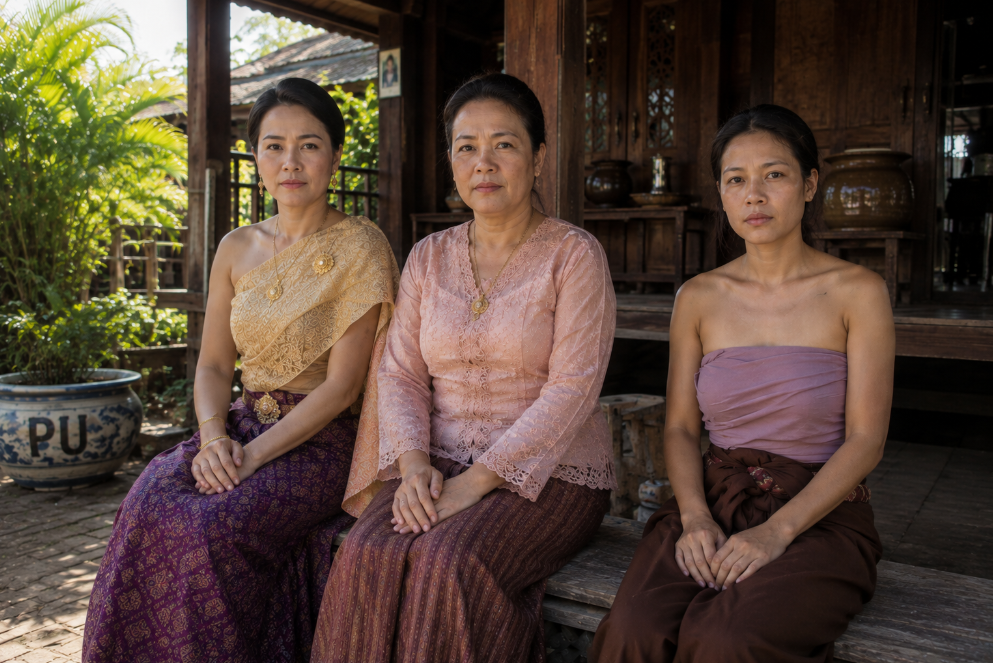
Before October 1, 1935, a Thai man having multiple wives was not a symptom of chaotic romance, secret infidelity, or moral failing. It was a highly structured, heavily bureaucratized legal framework. The law did not just vaguely tolerate polygamy; it strictly categorized it, assigning distinct legal weights, acquisition methods, and rights to three specific types of wives. It was an ecosystem of organized hierarchy.
Mia Klang Muang: The Strategic Alliance
The foundation of the household was the mia klang muang—the official, primary wife. Crucially, she was not chosen by the husband. This was a union engineered entirely by the parents, a classic arranged marriage complete with complex dowry negotiations and the merging of family assets. She held the absolute highest status, commanding the household and securing the primary legal rights over the family’s wealth.
Mia Klang Nok: The Personal Choice
In stark contrast stood the mia klang nok—the secondary wife. This was the woman the man chose for himself, acting purely on his own initiative and emotional preference after his primary marriage was established. This was not a hidden affair or a scandalous secret kept in a rented apartment across town. It was a legally recognized union. It was the officially sanctioned, legally binding predecessor to what modern society now quietly refers to as a mia noi or a gik.
Mia Klang Thasi: The Slave Wife
The third category requires looking at history without the softening, romanticized lens of period dramas. The mia klang thasi was the slave wife. These were women whose freedom had been explicitly purchased by the husband from their previous owners or impoverished parents. It is a harsh, unvarnished reminder of the deep social inequality embedded within the historical institution of marriage, where human transactions and matrimonial bonds were legally indistinguishable.
The Legitimacy of Blood
The most paradigm-shifting aspect of this ancient legal code was its approach to the descendants. Despite the massive social chasm between a high-born arranged bride and a purchased slave, the children from all three categories of wives were legally recognized. The system acknowledged a multiplicity of legitimate heirs, ensuring that the father’s bloodline superseded the social rank of the mother.
The 1935 Pivot
This entire legal architecture was dismantled in 1935 when the Civil and Commercial Code officially enforced strict monogamy. This was not a sudden, collective moral awakening. It was a calculated, pragmatic move in Thailand’s broader legal modernization. To secure international recognition, renegotiate unequal treaties, and align with Western legal systems, the nation had to restructure its family law to meet the standards of a rapidly globalizing world.
The Invisible Legacy
Yet, the stroke of a pen does not immediately erase centuries of cultural momentum. The institution of the secondary wife did not vanish in 1935; it simply lost its official legal status, transitioning from a rigid legal right to a complex social reality. A century ago, three women with vastly different origins could share the exact same legal title of “wife” under one roof. Today, the legal vocabulary has shrunk, replaced by a spectrum of informal titles—mia noi, gik, or simply “girlfriend.” The law disappeared. The underlying logic did not.
Leave a Reply