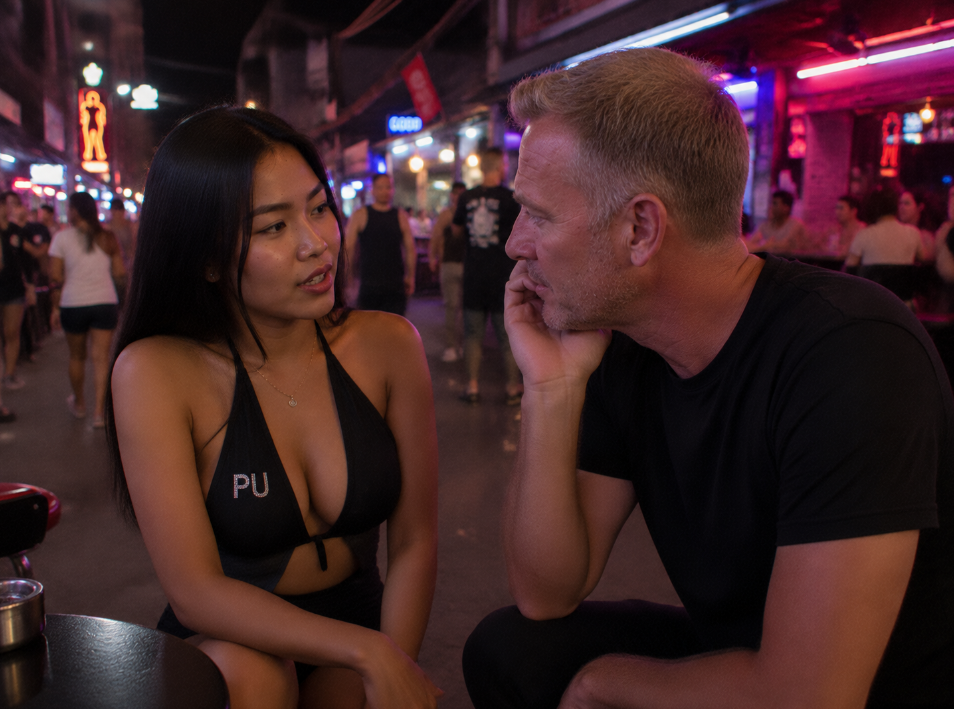
Foreigners arrive in Pattaya operating on a strict binary system. In their minds, a relationship with a woman falls into one of two categories: it is either true love (emotions, romance, free) or it is prostitution (a cold, calculated cash transaction).
But Thailand does not run on a Western operating system.
The fundamental misunderstanding that causes 90% of the heartbreak, anger, and drama in this city comes down to two untranslatable Thai concepts that Google Translate will never help you understand.
- เลี้ยงดู (Liang Du) — Love is a Verb, Not a Feeling
If you type Liang Du into a translator, it spits out “to support” or “to take care of.”
When a Western man reads “support,” he thinks of it as an optional, charitable act. Something you do if you are feeling generous, but not a requirement for love.
In the Thai cultural matrix, Liang Du literally means “to feed and care for.” It is not a romantic concept in the Western sense. It is the core duty of someone who claims to love you.
In the Thai understanding, love without Liang Du is not love. It is just empty noise. A father who Liang Du his children is a good father. A husband who Liang Du his wife is a good husband. A man who whispers “I love you” but does not Liang Du—who does not pay the rent, buy the food, or send the monthly transfer—is fundamentally useless.
In her coordinate system, love is measured in the consistency of your care. Money isn’t a replacement for love; it is the physical manifestation of it.
- ขายตัวไม่ได้ขายใจ (Khay Tua Mai Dai Khay Jai) — Selling the Body, Not the Heart
This is the psychological firewall that a girl in the industry builds inside her own mind. It translates to: “I sell my body, I do not sell my heart.”
Here is where the Western ego takes a massive hit. A farang pays the bar fine, hands over the cash, and genuinely believes he just bought intimacy—both physical and emotional. He thinks because he paid, she is temporarily “his.”
She takes the money and thinks one of two things:
If you are just a customer: Khay tua mai dai khay jai. The transaction is purely physical. The firewall holds. Her heart is entirely untouched and belongs to her family, her Thai boyfriend, or herself.
If she starts seeing you as a real partner: The dynamic flips completely. She is no longer “selling.” She is waiting for Liang Du.
The Ultimate Collision
This is the exact moment the Pattaya illusion shatters, and two people end up screaming at each other without ever talking about the same thing.
The farang pays the girl for a few days. He thinks: “This is a transaction. I paid, the tab is closed. See you next year.”
But the girl has decided she actually likes him. For her, accepting his money is no longer a transaction. It is the beginning of Liang Du. It is the start of a relationship. She is accepting his care.
Two people are participating in the exact same physical act, but experiencing entirely different realities.
He thinks: Paid and closed.
She thinks: He started to Liang Du me, which means we are together.
This is why she gets deeply hurt and offended when he simply packs his bags and disappears to the airport without a backward glance. And this is why he is utterly confused by her tears and angry Line messages. “Why is she mad? We had a deal, I paid her!”
Both of them are completely sincere. Both of them are absolutely right within their own cultural frameworks. And they never stood a chance of understanding each other.
The Expat Moral:
You can buy a woman’s time in Pattaya in three minutes. But you cannot buy her heart with a daily rate. If she is giving you her heart, she isn’t looking for a daily rate anymore—she is looking for Liang Du. If you don’t know the difference, you are playing a game where you don’t even know the rules.
Leave a Reply