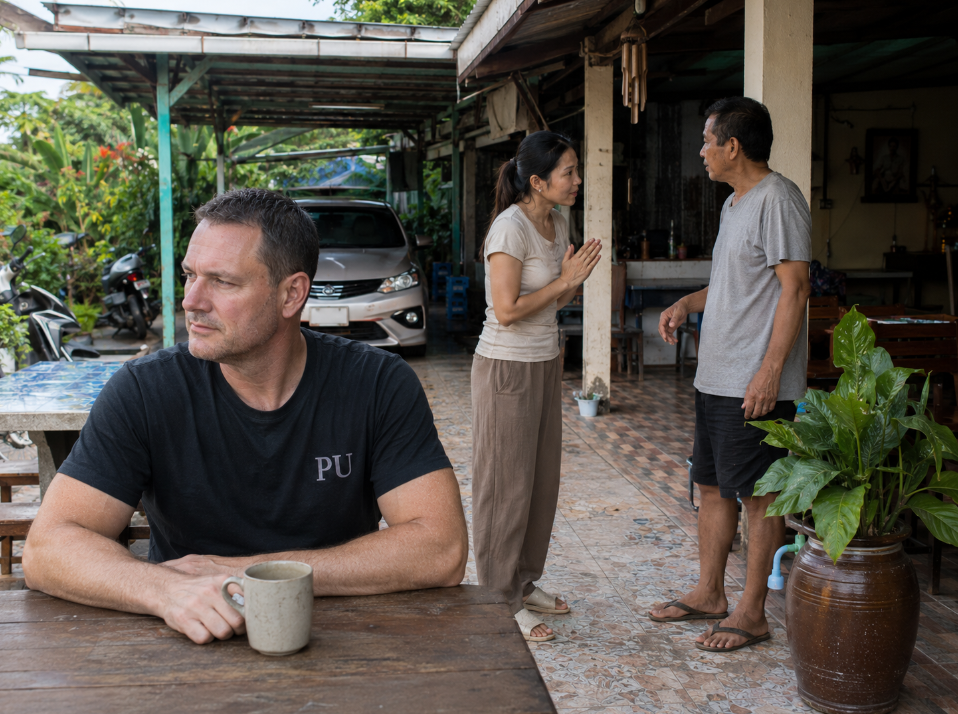
Every expat forums and barstool conversation eventually arrives at the same piece of advice: “If you want a peaceful life here, stay away from the bars. Find a ‘good’ Thai woman. Someone with a normal job, a conservative family, and traditional values.”
Many Western men follow this advice. They marry a school teacher, a clinic receptionist, or an office manager. They settle down in a quiet village outside the city, proud that they have avoided the neon drama. They believe they have found the ultimate, frictionless tropical dream.
What they don’t realize is that by marrying a “good” Thai woman, they didn’t just marry an individual. They married an entire, incredibly complex social matrix. And because the Western man is completely blind to this matrix, the Thai wife is forced to become his full-time cultural shock absorber.
The Illusion of the Nuclear Family
Take David and Nok. David is 60, a retired project manager from Leeds. He likes rules, logic, and boundaries. Nok is 35, works at a local bank, and comes from a respected family in a nearby province.
David thinks their life is simple. He thinks it’s just him, Nok, and their two dogs.
He doesn’t understand that in Thailand, a person is not an isolated island. Nok is a node in a vast web of social obligations, hierarchies, debts of gratitude (Bunkhun), and the constant, high-stakes currency of Face (reputation).
Because David doesn’t see the web, he constantly tears right through it. And Nok spends her entire life quietly walking behind him, tying the broken threads back together so their world doesn’t collapse.
The Diplomat in the Shadows
The burden usually starts with the small things.
Last month, David got furious because a neighbor’s contractor parked a cement truck blocking their driveway. David, applying Western logic, marched over and loudly confronted the neighbor, pointing at the property line and quoting the law. He demanded the truck be moved immediately. He felt strong, assertive, and entirely in the right.
He had no idea that the neighbor was the brother-in-law of the district chief. He had no idea that by raising his voice in public, he had caused a catastrophic loss of Face for the neighbor.
Nok watched from the porch, her stomach turning into a tight knot. She knew that in Thailand, being “legally right” means absolutely nothing if you make the wrong person look foolish. That is how dogs get poisoned. That is how property lines suddenly get “reassessed.”
So, what did the “good wife” do?
While David was inside drinking a beer, proud of his victory, Nok quietly walked over to the neighbor’s house with a basket of expensive fruit. She performed a deep, respectful wai. She smiled apologetically and lied, saying her husband was stressed about his health and didn’t mean to be aggressive. she smoothed over the bruised egos and restored the harmony of the street.
David still thinks he won the argument by being a tough guy. He has no idea that his wife is the only reason they can still sleep peacefully at night.
The Financial Firewall
Then comes the issue of family obligations.
In Western culture, your money is yours. In traditional Thai culture, a daughter’s success is deeply intertwined with her duty to elevate her parents. When a distant uncle dies, or a cousin gets ordained as a monk, the family is expected to contribute.
When Nok tries to explain this, David gets frustrated. “Why are we giving 3,000 baht to a cousin you haven’t seen in two years? We have our own bills!”
He sees it as a scam. He thinks her family is using him as an ATM.
He doesn’t understand that if Nok arrives at the village empty-handed, she is not just being frugal—she is bringing immense, crushing shame upon her parents in front of the entire community. It signals that her husband is either broke, stingy, or doesn’t respect her family.
So, Nok stops asking him. Instead, she carries a secret burden. She starts saving 500 baht a week from her own small salary, hiding it in a separate account. When the next wedding or funeral happens, she slips the envelope to her mother privately, saying it is from David. She protects David’s money, but she also buys his reputation in the village with her own secret sweat.
The Loneliness of the Bridge
This is the quiet cross the “good” Thai wife bears.
She lives in a state of constant, exhausting hyper-vigilance. She has to manage her husband’s Western bluntness, translating his ignorance into acceptable Thai politeness. She has to manage her family’s traditional expectations, translating their communal demands into a language her individualistic husband won’t find offensive.
She is a bridge stretched over a massive cultural canyon, with heavy traffic driving over her from both sides, all day, every day.
Western men love to boast about how relaxed and “sabai-sabai” their life in Thailand is with their wonderful wives. They don’t realize that the only reason their life feels so frictionless is because their wife is working overtime, absorbing all the friction for them.
Leave a Reply