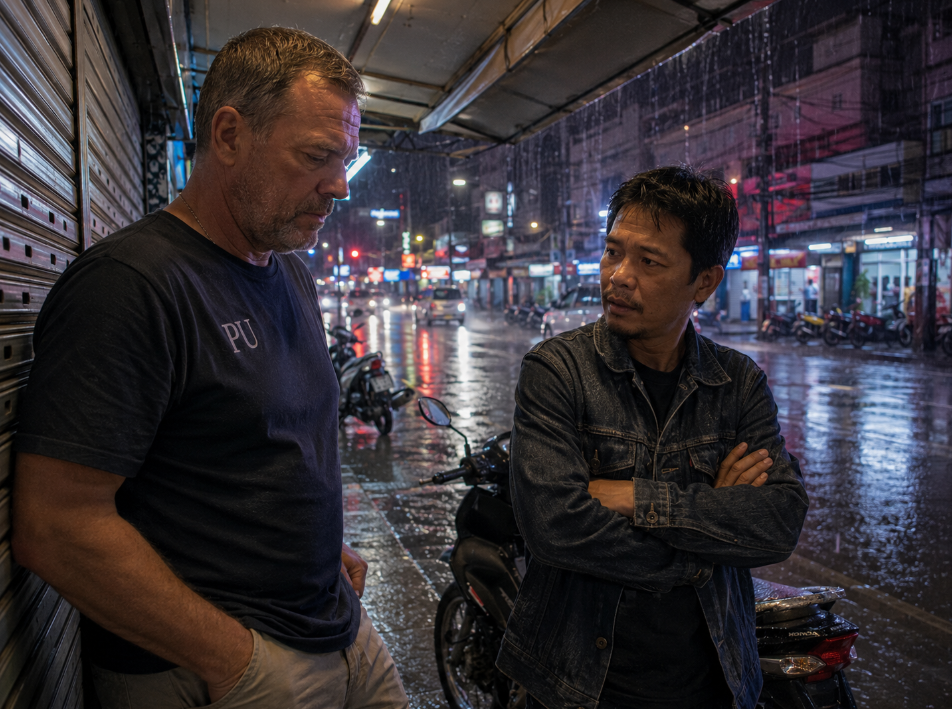
The narrative of Pattaya is almost always written in the language of division. It is a city built on the friction between opposites: East and West, rich and poor, the tourist and the local. We are conditioned to believe that a man who grew up in the suburbs of Sydney and a man born in the rice fields of Isan are entirely alien species, separated by a cultural chasm so wide it can never be crossed.
But sometimes, usually when the neon signs are turned off and the city is stripped down to its bare bones, the division simply evaporates.
THE CANVAS AWNING AT 3 AM
It happened on a Tuesday in September, during one of those sudden, violent tropical downpours that turn the streets of Soi Buakhao into fast-moving rivers.
Gary, a 54-year-old former contractor from Perth, darted under the canvas awning of a closed pharmacy to escape the rain. He was carrying the heavy, invisible weight of a man who had moved across the world to build a new life, only to realize the script had gone entirely wrong.
A moment later, a Thai man parked his motorbike on the sidewalk and ducked under the same awning. His name was Nueng. He was 42, wore a faded denim jacket, and had the deep, weathered tan of a man who spent his life navigating traffic.
They were not friends. They were just two strangers seeking shelter, standing two meters apart, watching the rain hammer against the asphalt. The silence between them was thick with the awkwardness of two worlds that rarely intersect outside of a transaction.
The Buzz of the Screen
Then, Gary’s phone vibrated in his pocket. He pulled it out, looked at the LINE message, and his shoulders instantly slumped. He didn’t type a reply. He just let out a long, slow exhale, pinched the bridge of his nose, and locked the screen. It was the universal gesture of a man who is profoundly, fundamentally exhausted by his own life.
Five seconds later, Nueng’s phone lit up. Nueng pulled it from his jacket, stared at the screen, and closed his eyes. He let out the exact same exhale. He slowly rubbed the back of his neck, his jaw tight.
Gary looked over. He pointed his chin at Nueng’s phone.
“Problem?” Gary asked, his thick Australian accent cutting through the sound of the rain.
Nueng looked up, slightly surprised the Farang had spoken to him. He offered a tight, cynical smile.
“Wife,” Nueng said in heavily accented, broken English. “Need money. Always… need money.”
Gary let out a dry, humorless laugh. He tapped his own phone against his palm. “Yeah, mate. Me too. New roof for the village. School fees. Car payments.”
The Invisible Bridge
Nueng didn’t understand all the English words, but he understood the tone. It wasn’t the complaint of a stingy man. It was the quiet despair of a man who realizes he is no longer seen as a human being, but merely as an engine.
Gary leaned against the closed metal shutter of the pharmacy. He looked out at the dark, flooded street.
“I give everything,” Gary said quietly, speaking more to the rain than to Nueng. “I built the house. I pay for the family. But… nobody ever asks how I am. Nobody asks if I’m tired. I’m just… the bank. If the bank stops paying, the bank is empty. Useless.”
Nueng stood perfectly still. He didn’t know the exact English translation for the complex psychological pain Gary was describing. But he knew the feeling intimately. It was the exact same feeling that kept Nueng awake at night in his tiny, 3,500-baht rented room, driving fourteen hours a day to send money to a family in Yasothon who only ever called on payday.
Nueng pointed to Gary’s chest. “You… ATM,” he said softly.
Gary looked at him and nodded slowly. “Yeah. ATM.”
Nueng tapped his own chest. “Me too. Drive all day. Send money. Mother happy. Wife happy. But inside…” Nueng paused, struggling to find the word. He made a hollow circle with his hands over his heart. “Inside… empty. Nobody care Nueng. Only care Nueng’s pocket.”
The Silent Recognition
There was no deep philosophical debate. The language barrier was too high for a detailed psychological analysis.
But as the rain continued to wash over the city, the two men stood in complete, shared understanding. In that brief moment, the cultural matrix of Pattaya vanished. There was no “wealthy Farang” and “poor Thai driver.” There were just two middle-aged men, standing in the dark, mourning the realization that the lives they had built required them to sacrifice their own humanity just to be useful to the people they loved.
They understood each other not through vocabulary, but through the cadence of their sighs, the heavy slump of their shoulders, and the shared, hollow look in their eyes. Sometimes, you can understand a man’s entire soul just by watching how he looks at his phone when the screen lights up.
A Resolution Without an Ending
Ten minutes later, the rain reduced to a light drizzle.
Nueng zipped up his jacket, walked over to his Honda Wave, and put on his helmet. He looked back at Gary, gave a brief, respectful nod, and drove away into the wet neon glow of the city. They didn’t exchange names. They would likely never speak to each other again.
But as Gary walked back to his empty condo, he felt something strange. He didn’t feel fixed. His problems were exactly the same. But for the first time in years, he didn’t feel entirely alone.
He had met a man from a completely different universe, and discovered that the world inside the man’s chest looked exactly like his own. And in a city built entirely on the illusion of difference, that is the rarest magic of all.
Leave a Reply