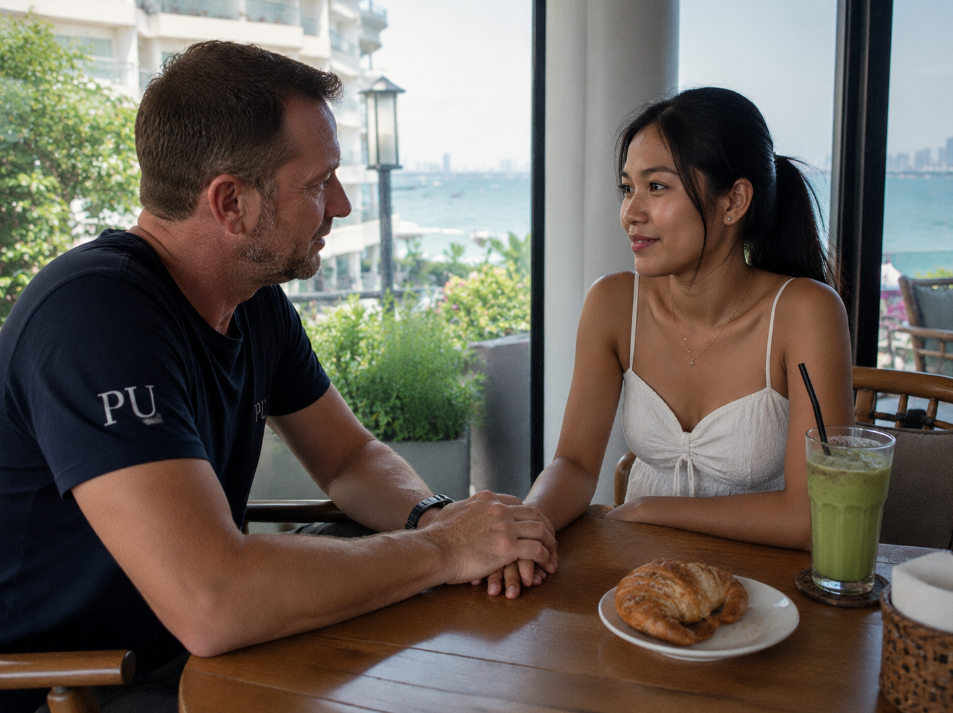
It was 2:00 PM on Pratamnak Hill. The sun was glaring off the ocean, and the air conditioning in the quiet cafe was humming softly. He sat across from her at a small wooden table, watching her stir her iced matcha.
In the daylight, she looked completely different. She was wearing a simple white sundress, her hair tied back, with almost no makeup. She didn’t look like a girl who had been downing tequila shots on Soi 6 twelve hours earlier. She looked like someone’s future wife. She looked like someone who needed to be saved.
He felt a sudden, intoxicating surge of protective nobility. He wanted to elevate himself above the thousands of other expats in the city. He didn’t want to be just another customer renting affection by the hour. He reached across the table, gently touched her hand, and delivered the line he had been practicing in his head all morning.
“I really care about you,” he said softly. “And I just don’t want to support the bar lifestyle anymore. You shouldn’t be in that place.”
In his mind, the scene was playing out like an indie movie. He was the principled hero offering her a way out of the neon darkness. He expected her to look at him with gratitude.
Instead, she didn’t even pull her hand away. She didn’t look offended, and she didn’t look grateful. She simply took a slow sip of her drink. The ice cubes clinked against the glass—the only sound in the cafe for a long, heavy moment.
Then she smiled. It wasn’t her flirtatious bar smile; it was a tired, incredibly practical smile.
“Okay, baby,” she said smoothly. “Then you help me not go to the bar.”
The romantic movie playing in his head violently skipped a frame. He blinked, instantly pulling his hand back just a fraction of an inch. “Well, I mean… not like that,” he stammered. “I mean you should find a normal job. Be independent. Take personal responsibility.”
She leaned forward, resting her elbows on the table. She didn’t raise her voice. She wasn’t angry. She simply began to unpack the architecture of her survival, laying it right in the middle of the table next to his half-eaten croissant.
She asked him, very politely, if a “normal” job at a 7-Eleven would cover the eight thousand baht rent for her room. She asked if personal responsibility would feed her four-year-old son, who lived with her mother in Roi Et, which cost another six thousand a month. She casually mentioned the loan on her Scoopy motorbike, the hospital bills for her uncle, and the debt she owed to a local gold shop.
She didn’t list these things to make him feel guilty. She listed them as unbendable facts of physics. For him, the “bar lifestyle” was a moral issue—a place of bad habits, loud music, and exploitation. For her, it was a payment infrastructure. It was the only math that kept five people from drowning.
“So,” she said softly, looking him dead in the eye. “If I stop… you pay for this?”
The silence that followed was the loudest sound in Pattaya.
It was the sound of Western morality violently colliding with Thai practicality. He wanted to be a savior, but he forgot to bring a budget. He wanted the absolute moral purity of taking a girl out of the industry, but he was terrified of becoming the financial safety net that replaced it. Condemning the system was free. Replacing it had a price tag.
He looked away, staring out the cafe window at the ocean, suddenly fascinated by a passing speedboat. He cleared his throat and muttered something about how they needed to “take things slowly.”
She just nodded, took another sip of her matcha, and checked the time on her phone. Her shift started at six.
Leave a Reply