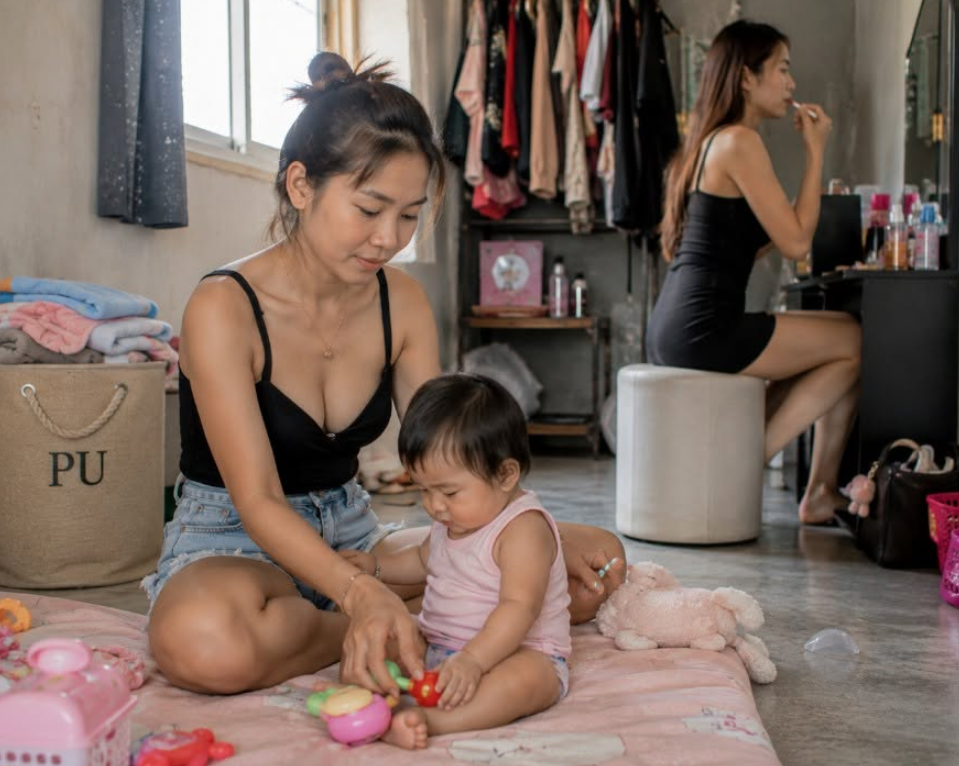
More than half of the nightlife workers in Pattaya are mothers. Some have two children, others are still young but already have four. It raises a heavy question that most tourists drinking at the bars never think about: When these women put on their makeup, dress up, and stand smiling under the neon lights, who is raising their children?
If the kids are in the provinces, the burden usually falls on grandparents. But what about the children born and raised right here in Pattaya?
The answer is a hidden, tight-knit daycare system within the community. They hire babysitters. And those sitters aren’t professional nannies—they are fellow nightlife workers from the exact same industry.
The 800-Baht Daycare Swap
Take the story of Fah (pseudonym), a 21-year-old girl who recently gave birth to her first child. Shortly after, she split from her boyfriend, becoming a single mother carrying the heavy, expensive cost of living in this city alone.
As soon as her post-C-section wounds began to heal, Fah had no time for extended maternity leave. She had to put on her lipstick and get back to the bar fronts to earn a living.
To solve the childcare crisis, Fah made a deal with a friend renting a room in the exact same building. She pays her friend 800 Baht a day to watch the baby. Her friend works as a freelance nightlife worker; on the days Fah hires her, she stays home to nurse the baby. On Fah’s days off, the friend dresses up and goes out to find clients. They swap roles in a endless cycle of survival.
The child grows up in a cramped, rented apartment complex where almost every tenant is a bar worker. The hallways smell of heavy perfumes, cigarette smoke, and late-night cooking. The child’s earliest memories are watching women put on high heels, count stacks of cash, and listening to endless hallway conversations revolving around customers, tips, and bar fines.
History Repeating Itself
But the most heartbreaking part of Fah’s story isn’t the environment her child is facing. It’s Fah’s own past.
Fah explained her childhood in a completely flat, normal tone, as if it was just how the world works:
Twenty years ago, Fah’s own biological mother was a single mother in Pattaya. She used to leave Fah in a cramped room with the neighboring bar ladies so she could put on heavy makeup and go work the Beach Road scene.
Fah looked back and said:
“I understand my mom perfectly. Back then, she probably had no choice, just like I have no choice right now.”
That single sentence exposes the cruel, cyclical nature of poverty hidden behind the neon glare. Poverty and environment have forced the destinies of two generations to overlap with cold-blooded precision.
The mother once stood on the streets, leaving her daughter for others to raise. Today, that daughter has grown up to step directly into her mother’s footprints—standing in front of a bar, leaving her own child with a co-worker, praying that the next generation can somehow break the chain.
Leave a Reply